
Table of Contents
You calculate a percentage by dividing the part by the whole, then multiplying by 100. That's it. The formula looks like this: (Part ÷ Whole) × 100 = Percentage.
If you just need an answer fast, here's a percentage calculator that does the work for you. But if you want to actually understand what's happening behind the numbers — and never get stuck on a percentage problem again — keep reading.
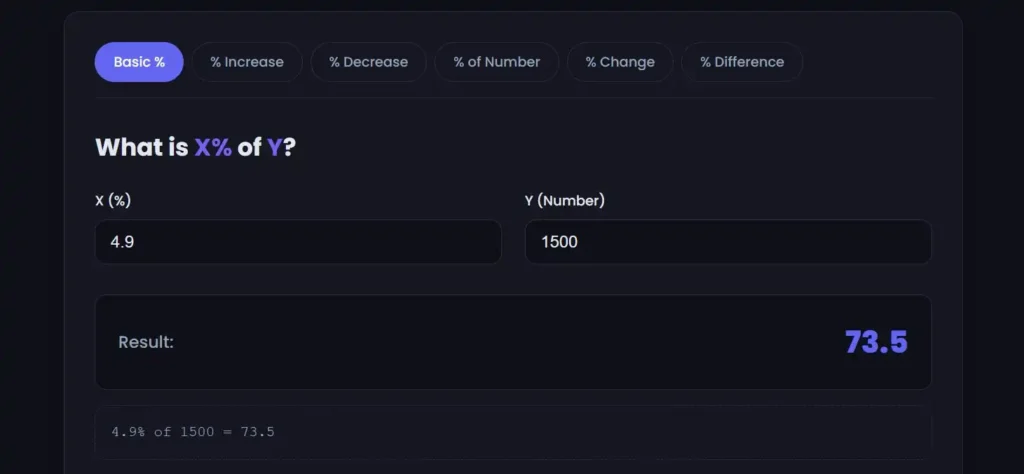
The Basic Percentage Formula
Percentages are just fractions with a denominator of 100. "Percent" literally means "per hundred." So when someone says 25%, they mean 25 out of every 100.
The formula:
Percentage = (Part ÷ Whole) × 100
Let's say you got 17 questions right on a 20-question quiz.
17 ÷ 20 = 0.85
0.85 × 100 = 85%
You scored 85%. That's the whole calculation.
Here's another: You have a $40 bill and want to leave a 15% tip.
$40 × 0.15 = $6
You'd leave $6. So your total becomes $46.
Many people freeze on tips because they try to do mental math under pressure. Just move the decimal point. 10% of $40 is $4. Half of that (5%) is $2. Add them together — 15% is $6. That's a trick worth remembering.
How to Calculate Percentage Change
Percentage change answers: "How much did this go up or down compared to where it started?"
Percentage Change = ((New Number − Old Number) ÷ Old Number) × 100
A common mistake: dividing by the new number instead of the old one. Always divide by the starting value.
Example: Your rent goes from $1,200 to $1,320.
1,320 − 1,200 = 120
120 ÷ 1,200 = 0.10
0.10 × 100 = 10%
Your rent increased 10%. That's an extra $120 a month, or $1,440 over the year. When you see it that way, a "small" 10% adds up fast.
If the number drops, the formula works the same — you'll just get a negative result. A $50 shirt marked down to $35:
35 − 50 = −15
−15 ÷ 50 = −0.30
−0.30 × 100 = −30%
That's a 30% decrease.
How to Find What Percentage One Number Is of Another
Sometimes you know both numbers but need the percentage between them. "What percent of 80 is 20?"
Use the same basic formula, but rearrange it:
Percentage = (Part ÷ Whole) × 100
20 ÷ 80 = 0.25
0.25 × 100 = 25%
So 20 is 25% of 80.
Real scenario: You budgeted $500 for groceries this month and spent $430. What percent of your budget did you use?
430 ÷ 500 = 0.86
0.86 × 100 = 86%
You used 86% of your grocery budget. You have 14% left. That's a useful number when you're halfway through the month and wondering if you can afford the good olive oil.
How to Calculate a Percentage of a Number (Reverse Percentage)
"What is 30% of 180?"
Convert the percentage to a decimal (divide by 100), then multiply.
30 ÷ 100 = 0.30
0.30 × 180 = 54
So 30% of 180 is 54.
Or say you want to take 20% off a $75 jacket.
$75 × 0.20 = $15
$75 − $15 = $60
You'd pay $60.
But here's a mistake people make: they see "20% off" and think they need to calculate 20%, then subtract it from some other number they already calculated. Just multiply the original price by 0.80 directly. $75 × 0.80 = $60. One step, done.
Percentage Difference vs. Percentage Change
These two get confused constantly. They measure different things.
Percentage change compares an old value to a new value — it's directional, has a start and end.
Percentage difference compares two numbers where neither is the "starting" point. The formula:
Percentage Difference = |Number A − Number B| ÷ ((A + B) ÷ 2) × 100
Example: You're comparing two phone plans. Plan A costs $45/month. Plan B costs $60/month.
Difference: |45 − 60| = 15
Average: (45 + 60) ÷ 2 = 52.5
15 ÷ 52.5 = 0.2857
× 100 = 28.57%
The two plans differ by about 28.6%. That's a useful comparison when neither plan is your "current" plan — you're just weighing options.
If you need more detail on how this differs from simple change, our article on how to calculate percentage change walks through real-world examples step by step.
Common Percentage Calculations People Actually Use
Tip Calculation
The standard tip in the US is 15% to 20% of the pre-tax bill. For a $58 meal with decent service:
20% = $58 × 0.20 = $11.60
Total: $69.60. Many people round up to make it simple — $12 tip on $58 works out to about 20.7%. Fine.
But calculate the tip on the pre-tax amount, not the after-tax total. In cities with 8-10% sales tax, tipping on the taxed total means you're tipping on the tax. It's a small difference, but it's the kind of thing that annoys servers and accountants equally.
Discount Shopping
"40% off" sounds great until you realize the store raised the original price by 15% the week before. That's why real shoppers calculate the final price, not the discount.
$90 shoes with 40% off: $90 × 0.60 = $54. Then add sales tax — say 7% — and you're at $54 × 1.07 = $57.78. Not $54.
Grade Calculation
If your final exam is worth 30% of your grade and you currently have a 78%, here's what you need to know: a 90% on the final only raises your overall grade to about 81.6%.
(78 × 0.70) + (90 × 0.30) = 54.6 + 27 = 81.6%
That surprises a lot of students. A 90 on the final doesn't "fix" a 78. This is also why you should use an average calculator when you're estimating semester outcomes — averages hide the weight issue.
Percentage Increase for Salary Negotiation
You're offered a 5% raise on a $52,000 salary. That's $2,600 more per year, or about $50 per week before taxes. Is that good?
Check the inflation rate. If inflation was 3.4%, your real raise is only 1.6%. That's a very different conversation with your boss. A percentage calculator helps you run these numbers in seconds while sitting in the meeting.
When You Should Just Use a Tool
Manual percentage math works fine for one-off calculations. But when you're comparing prices across three stores, recalculating a budget with six categories, or checking the percentage change across twelve months of data, doing it by hand gets tedious — and error-prone.
That's where our percentage calculator earns its keep. You type in two numbers, it gives you the percentage instantly. No mental math, no decimal point anxiety. If you're someone who calculates percentages more than twice a week — whether for work, shopping, or budgeting — bookmark it.
Frequently Asked Questions
How do you calculate a percentage of a number?
Multiply the number by the percentage as a decimal. For example, to find 25% of 80: 80 × 0.25 = 20. To convert a percentage to a decimal, divide by 100.
What is the percentage formula?
The formula is (Part ÷ Whole) × 100. Divide the portion you're interested in by the total amount, then multiply the result by 100.
How do I calculate percentage change?
Subtract the old value from the new value, divide by the old value, then multiply by 100. If the result is positive, it's an increase. If negative, it's a decrease.
How do you calculate a tip percentage?
Multiply the pre-tax bill amount by the tip percentage as a decimal. For a 20% tip on a $45 bill: $45 × 0.20 = $9. Then add the tip to the original bill.
What's the difference between percentage difference and percentage change?
Percentage change compares an old value to a new value and shows direction (up or down). Percentage difference compares two numbers where neither is the baseline, using the average of the two as the denominator.
You don't need to memorize every percentage formula. You just need to understand the one core relationship: part divided by whole, times 100. Once that clicks, the rest falls into place. And when the numbers get tedious or you're double-checking something important — a tip, a discount, a grade — just use the percentage calculator and get it right the first time.
Explore Common Percentage Calculations
Different percentage problems require different formulas. If you want to understand a specific type of calculation in more detail, explore these related guides:
- How to Calculate a Percentage — Learn the basic percentage formula and calculation method.
- Calculate a Percentage of a Number — Find a specific percentage of a given number.
- What Percentage Is One Number of Another? — Calculate what percentage one value represents of another.
- Calculate Percentage Increase and Decrease — Understand increases and decreases using percentage formulas.
- Percentage Difference Between Two Numbers — Compare two values using percentage difference.
- Percentage Change Calculator: Complete Guide — Learn how percentage change is calculated.
- Percentage Increase vs Percentage Change — Understand when each calculation should be used.
- Calculate Discount Percentage — Learn how to calculate discounts using percentages.
- Percentage Points vs Percent — Understand the important distinction between percentages and percentage points.
- What Is a Percentage? — Start with the fundamentals of percentages.
Share this article 👇
0 Comments