
Table of Contents
Percentage Points vs Percent
To calculate a tip quickly, move the decimal point one place to the left on your bill total to find 10%, then scale from there. For a 20% tip, double that amount. For 15%, take 10% and add half of it. The formula is: Tip Amount = Bill Total × (Tip Percentage ÷ 100). On a $60 bill, a 20% tip is $60 × 0.20 = $12.
You don't need to be a math whiz to tip well. This guide covers the fastest mental math methods, how to handle splitting the bill, common tipping percentages and what they mean, and mistakes people make when calculating tips.
What Is a Tip Percentage?
A tip percentage is the portion of your bill that you choose to give as a gratuity for service. The percentage is applied to the pre-tax bill amount in most cases, though some people tip on the total including tax. The standard tipping range in the United States is typically 15% to 20% for full-service restaurants, with higher percentages for exceptional service and lower percentages for poor service.
Other situations have their own conventions. Bartenders often receive $1 to $2 per drink or 15% to 20% of the tab. Food delivery drivers commonly receive 10% to 15% or a minimum of $3 to $5. Hair stylists, taxi drivers, and hotel staff each have customary tipping ranges. Knowing the right percentage for the situation helps you tip appropriately without overthinking it.
The Basic Tip Calculation Formula
The core formula is simple:
Tip Amount = Bill Total × (Tip Percentage ÷ 100)
To find the total amount you'll pay including the tip:
Total with Tip = Bill Total + Tip Amount
Or combine both steps into one:
Total with Tip = Bill Total × (1 + Tip Percentage ÷ 100)
For example, if your bill is $45 and you want to leave an 18% tip, convert 18% to 0.18, multiply: 45 × 0.18 = 8.10. The tip is $8.10, and your total payment is $53.10.
The 10% Shortcut for Fast Mental Math
You rarely need the full formula when you're at a restaurant. The quickest method uses 10% as a baseline, and it works like this.
Step 1: Find 10% of your bill by moving the decimal point one place to the left. On a $48 bill, 10% is $4.80.
Step 2: Adjust from there based on the tip percentage you want.
- 5% tip: Half of 10%. On $48, that's $2.40.
- 15% tip: Ten percent plus half of ten percent. $4.80 + $2.40 = $7.20.
- 20% tip: Double the 10% amount. $4.80 × 2 = $9.60.
- 25% tip: Ten percent plus 15%. $4.80 + $7.20 = $12.00.
This method handles any tip percentage with only basic arithmetic. Even for an 18% tip, you can find 20% and subtract a small amount, or find 15% and add a bit more. The exact number isn't critical — rounding to the nearest dollar or half-dollar is perfectly acceptable in most situations.
Step-by-Step Example: 20% Tip on a $73.50 Bill
Let's walk through a realistic scenario with a less round number.
Step 1: Find 10% of $73.50 by moving the decimal point. Ten percent is $7.35.
Step 2: Double that for a 20% tip: $7.35 × 2 = $14.70.
Step 3: Add the tip to the original bill: $73.50 + $14.70 = $88.20.
If you want to round, you'd leave $15 as the tip for a total of $88.50, or round the entire total to $88 or $89. Rounding is normal and expected.
You can also calculate the total directly. For a 20% tip, you pay 120% of the bill: $73.50 × 1.20 = $88.20. Same result.
Splitting the Bill with Tip
Splitting a bill gets slightly more involved because you need to divide the total including tip among the number of people. The process is:
Step 1: Calculate the tip amount or the total with tip using the methods above.
Step 2: Divide the total with tip by the number of people.
Example: Four people share a $120 bill and agree on an 18% tip. Tip: 120 × 0.18 = $21.60. Total: 120 + 21.60 = $141.60. Per person: 141.60 ÷ 4 = $35.40.
A faster alternative is to have each person calculate their share of the bill first, then each add their own tip. That works when everyone ordered roughly the same amount. If orders differ significantly, splitting evenly may not be fair, and you'll need to calculate individual shares before applying the tip percentage.
Common Tipping Percentages and What They Mean
| Percentage | How to Calculate | When to Use |
|---|---|---|
| 10% | Move decimal one place left | Below-average service, buffet, counter service |
| 15% | 10% plus half of 10% | Adequate or standard service |
| 18% | 20% minus a small amount | Good service, large groups |
| 20% | Double the 10% amount | Good to excellent service, standard for full-service dining |
| 25% | 10% plus 15% | Exceptional service, special occasions |
These are general guidelines for the United States. Tipping customs vary widely by country. In Japan, tipping is not customary and can even be considered rude. In many European countries, a service charge is often included in the bill, and additional tipping is optional and usually smaller. If you're traveling, check local customs before applying American tipping percentages.
Should You Tip on the Pre-Tax or Post-Tax Amount?
The standard practice is to tip on the pre-tax subtotal, not the total including sales tax. Sales tax is a government charge, not part of the service you received. Including tax in your tip calculation means you're tipping on money that didn't go toward food or service.
That said, the difference is usually small. On an $80 meal with 8% sales tax, the tax is $6.40. A 20% tip on the pre-tax amount is $16.00. A 20% tip on the post-tax total of $86.40 is $17.28. The difference is $1.28 — noticeable but not significant for most people.
If your bill has a service charge or gratuity already added, don't tip twice unless the service was truly exceptional. Check the receipt carefully. Many restaurants add an automatic gratuity for large parties, typically 18%. In that case, additional tipping is optional and not required.
Common Mistakes When Calculating Tips
Misplacing the Decimal Point
The 10% shortcut depends on moving the decimal point correctly. On a $45.80 bill, 10% is $4.58, not $45.80 or $0.458. If your tip looks larger than the bill itself, you've misplaced the decimal.
Doubling the Wrong Number
For a 20% tip, double the 10% amount, not the original bill. On a $65 bill, 10% is $6.50. Twenty percent is $13.00. If you double the original bill, you'd get $130, which is clearly wrong. This sounds obvious, but it's a surprisingly common error when people rush.
Forgetting to Include Tax in the Total
Your final payment includes the bill, tax, and tip. Some people calculate the tip correctly but forget that the tax still needs to be paid. The tip is calculated on the pre-tax amount, but the tax itself is still part of what you owe.
Tipping on the Total Instead of the Subtotal
As covered above, tipping on the post-tax total isn't wrong per se, but it's not the standard convention. If you want to be precise, tip on the pre-tax amount. The difference is usually small enough that it doesn't matter for practical purposes.
Rounding Too Aggressively
Rounding is fine, but don't round in a way that significantly shortchanges the server. If your calculated tip is $11.87 and you round down to $10, that's a 16% tip instead of 20% on a $60 bill. Round to the nearest dollar or half-dollar for convenience, but stay close to the percentage you intend.
Quick Tip Reference Table
| Bill Total | 15% Tip | 18% Tip | 20% Tip |
|---|---|---|---|
| $20 | $3.00 | $3.60 | $4.00 |
| $30 | $4.50 | $5.40 | $6.00 |
| $40 | $6.00 | $7.20 | $8.00 |
| $50 | $7.50 | $9.00 | $10.00 |
| $75 | $11.25 | $13.50 | $15.00 |
| $100 | $15.00 | $18.00 | $20.00 |
This table gives you a quick reference for common bill amounts. For anything in between, the 10% method works faster than trying to memorize more values.
When a Tip Calculator Is the Better Option
Mental math is fine for a single bill with a straightforward amount. But several situations make a calculator genuinely useful.
- You're splitting a bill among multiple people with different orders
- The bill amount is large or has unusual numbers
- You want to split the tip unevenly based on who ordered what
- You're traveling and need to calculate a different percentage than usual
- You want to verify your mental math without pulling out a calculator app
In those cases, the MiniToolsPro tip percentage calculator handles the calculation for you. Enter the bill amount, select your tip percentage, and optionally split the total among any number of people. It applies the formula correctly every time, so you can confirm your mental estimate or skip the math entirely.
Frequently Asked Questions
How do I calculate a 15% tip quickly?
Find 10% of the bill by moving the decimal point one place to the left, then add half of that amount. On a $42 bill, 10% is $4.20, half of that is $2.10, and 15% is $6.30.
Is a 20% tip calculated before or after tax?
The standard convention is to tip on the pre-tax subtotal. Sales tax is not part of the service, so most people exclude it when calculating a tip. The difference is usually small.
How do I split a bill with a tip evenly?
Calculate the total including tip, then divide by the number of people. For example, a $90 bill with a 20% tip totals $108. Split among three people, that's $36 each.
What's the easiest way to calculate a tip without a calculator?
Use the 10% method. Move the decimal point one place to the left to find 10%, then multiply or divide that amount to reach your target percentage. Doubling gives 20%, adding half gives 15%.
Should I tip on takeout orders?
Tipping on takeout is optional and generally lower than table service, often 10% or a small flat amount. Since there's no table service involved, the customary percentage is lower than for dine-in meals.
Master the 10% Method
Once you can find 10% of any bill by moving the decimal point, every other tip percentage becomes easy. Double it for 20%, add half for 15%, and you're covered for almost any dining situation. And when the math gets complicated or you're splitting a bill with a group, the MiniToolsPro tip calculator gives you an accurate answer in seconds so you can get back to the conversation.
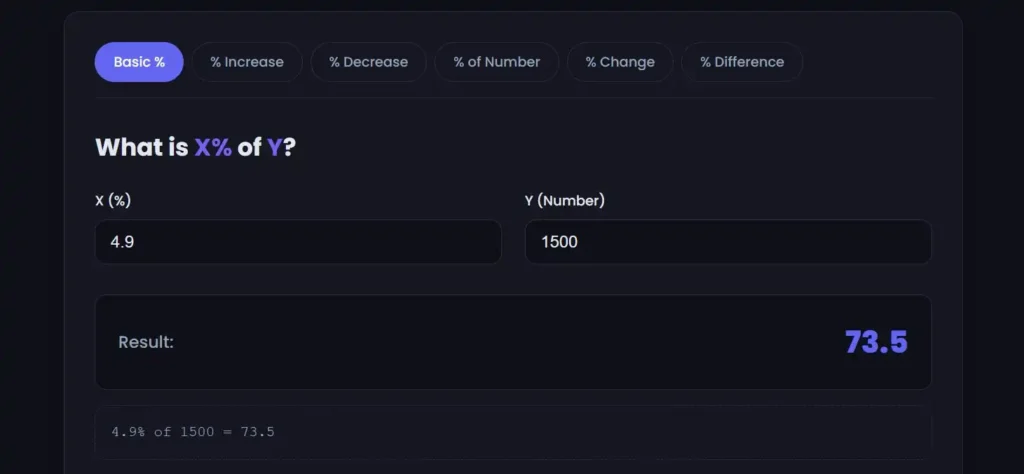
When working with percentages, it is also important to understand how percentage calculations differ from percentage points. If you are looking for a quick way to calculate common percentage problems before comparing percentages or percentage-point changes, use our Percentage Calculator. It can help you calculate percentages quickly and verify the numbers used in real-world comparisons.
Share this article 👇
0 Comments