
Table of Contents
You've probably seen percentages everywhere — sale signs, test scores, tax rates, and tip suggestions. But if someone asked you to explain what a percentage actually is, you might pause. There's a gap between seeing percentages daily and truly understanding how they work. In this guide, we'll close that gap with plain language, real examples, and zero unnecessary jargon.
Key Takeaways
- A percentage is a number expressed as a fraction of 100.
- The word "percent" literally means "per hundred" or "out of 100."
- Percentages make comparing different quantities simple and intuitive.
- The basic percentage formula is (Part ÷ Whole) × 100.
- Percentages are used in finance, shopping, grades, statistics, and everyday decisions.
- Understanding percentages helps you spot misleading data and calculate real value.
- You can solve most percentage problems using multiplication and division.
What Is a Percentage?
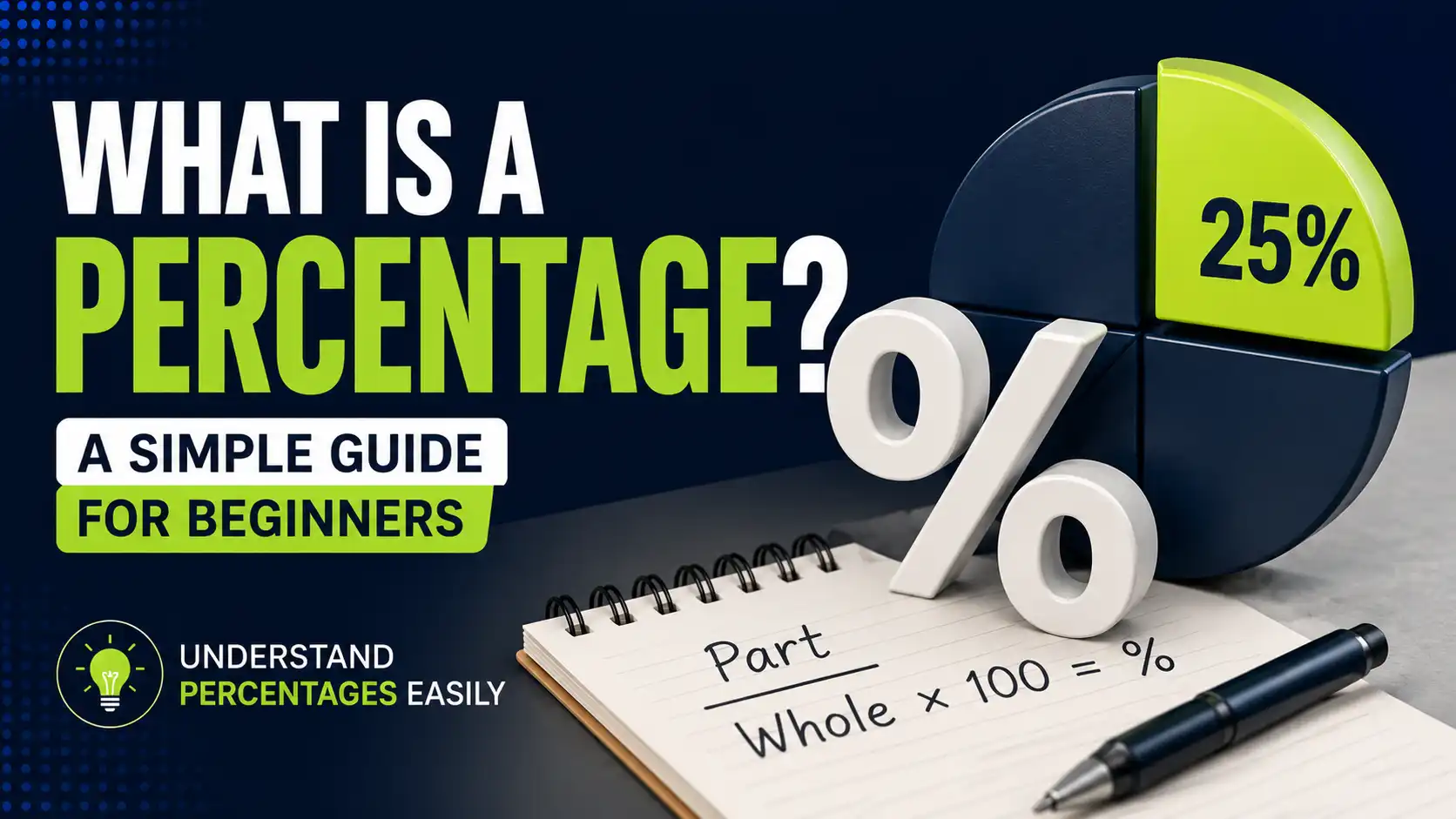
A percentage is a number or ratio expressed as a fraction of 100. For example, 45% means 45 out of every 100. The symbol "%" comes from the Latin phrase per centum, meaning "by the hundred."
Let's break that down. If you have a pizza cut into 100 equal slices and you eat 25 slices, you've eaten 25% of the pizza. That's the whole idea. Percentages standardize things so you can compare them on the same scale.
Here's another example. A student scores 17 out of 20 on a quiz. To express that as a percentage:
17 ÷ 20 = 0.85
0.85 × 100 = 85%
So the student scored 85%. That's higher than 80% and lower than 90% — a quick comparison that raw numbers don't always make obvious.
Where Did Percentages Come From?
Percentages weren't invented by one person. They evolved from ancient Roman taxation systems. The Romans used fractions based on 100 to calculate taxes on goods. Over time, this practice spread through trade and commerce.
By the 15th and 16th centuries, European merchants used percentage-like calculations for interest rates and profit margins. The percent sign (%) itself likely evolved from the Italian phrase per cento, which was gradually abbreviated and stylized.
Today, percentages are universal. They're used in every country, every economy, and nearly every profession.
Percentages vs. Fractions vs. Decimals
Percentages, fractions, and decimals are three ways to express the same thing: a part of a whole.
- Fraction: 1/4
- Decimal: 0.25
- Percentage: 25%
All three represent the same value. The difference is format and context. Fractions are common in recipes and measurements. Decimals appear in financial calculations. Percentages dominate comparisons and statistics.
To convert between them:
- Fraction to percentage: Divide the numerator by the denominator, then multiply by 100.
- Decimal to percentage: Multiply by 100.
- Percentage to decimal: Divide by 100.
For example, 0.75 × 100 = 75%. And 75% ÷ 100 = 0.75. That's the entire conversion system.
Why Are Percentages Important?
Percentages matter because they make comparisons meaningful. Saying "Store A dropped prices by $12" means nothing without context. Saying "Store A dropped prices by 30%" gives you an instant, comparable standard.
First, percentages normalize data. If one city has 2,300 cases of flu and another has 890, which is worse? You can't tell without knowing population sizes. But if City A has a 4.8% infection rate and City B has 6.2%, the comparison becomes clear.
Second, percentages reveal scale. A 2% interest rate on a $10,000 loan is $200. That same 2% on a $500,000 mortgage is $10,000. Same percentage, very different stakes.
Third, percentages drive real-world decisions. According to a 2023 survey, 68% of consumers say they're more likely to buy from a store offering a clear percentage discount. — Source: Statista, 2023
Plus, percentages appear in nearly every professional field. Marketers track conversion rates. Investors watch returns. Teachers calculate grades. Doctors evaluate risk. If you don't understand percentages, you're at a constant disadvantage.
Common Percentage Misconceptions
Plenty of smart people misunderstand percentages. Here are the most frequent errors:
- Adding percentages directly. A 10% discount plus another 20% discount isn't a 30% discount. The second discount applies to the already-reduced price.
- Confusing percentage points with percentages. Going from 10% to 15% is a 5 percentage point increase, but a 50% relative increase.
- Ignoring the base. A 50% increase from 2 to 3 is small. A 50% increase from 200 to 300 is huge. Always ask: "50% of what?"
- Assuming percentages can't exceed 100%. They can. A price can go up 150%. A population can grow 200%.
- Mixing up percentage change and percentage difference. These use different formulas and answer different questions.
Understanding these errors prevents costly mistakes. For a deeper dive into calculation methods, see our guide on how to calculate percentage.
How Do You Calculate a Percentage?
To calculate a percentage, divide the part by the whole, then multiply by 100. The formula is (Part ÷ Whole) × 100. That's it.
For example, you got 18 out of 24 questions correct on a test. Here's the math:
18 ÷ 24 = 0.75
0.75 × 100 = 75%
You scored 75%. That's a solid C+ in most grading systems.
Another example: You spent $27 from a $60 weekly grocery budget.
27 ÷ 60 = 0.45
0.45 × 100 = 45%
You've used 45% of your grocery budget. You have 55% remaining for the rest of the week.
How Do You Find What Percent One Number Is of Another?
This is the reverse question. Instead of "what is 20% of 80?" you're asking "what percent of 80 is 20?"
Same formula, just applied differently:
20 ÷ 80 = 0.25
0.25 × 100 = 25%
So 20 is 25% of 80.
This calculation is useful for budgets, grades, and progress tracking. For instance, if you completed 6 tasks out of 40 on your to-do list, you've finished 15% of the work.
How Do You Calculate a Percentage Increase or Decrease?
Percentage change measures how much something moved compared to where it started. The formula is:
((New Number − Old Number) ÷ Old Number) × 100
Always divide by the original number. Never the new one.
Example: Your utility bill went from $95 to $118.
118 − 95 = 23
23 ÷ 95 = 0.2421
0.2421 × 100 = 24.2%
Your bill increased 24.2%. That's a significant jump worth investigating.
For a decrease example: A $50 shirt drops to $35.
35 − 50 = −15
−15 ÷ 50 = −0.30
−0.30 × 100 = −30%
That's a 30% discount. The negative sign shows it's a decrease.
If you want more practice with these calculations, our percentage calculator handles the math instantly.
What Are the Most Common Uses of Percentages?
Percentages appear in more places than you probably notice. Here are the major categories:
Percentages in Shopping and Discounts
Retailers use percentages constantly. A sign says "40% off," but you need to know 40% of what. Is it 40% off the original price? The sale price? The manufacturer's suggested retail price?
Here's the thing: "40% off" a $90 item means you pay $54. But if the store raised the original price from $75 to $90 before the sale, you're actually only saving $21 from the original — about 28%. Not 40%.
Always calculate the final price, not the advertised discount. $90 × 0.60 = $54. Then add sales tax. If tax is 7%, the real total is $54 × 1.07 = $57.78.
Percentages in Finance and Interest
Interest rates are percentages. A savings account might offer 4% APY. A credit card might charge 22% APR. A mortgage might carry 6.5% interest.
The difference between 4% and 6.5% on a $300,000 loan is massive:
- At 4% over 30 years, total interest is about $215,000.
- At 6.5% over 30 years, total interest is about $383,000.
That's a $168,000 difference from just 2.5 percentage points. Percentages hide enormous dollar amounts.
Percentages in Statistics and Data
Statistical claims are often expressed as percentages. "75% of users prefer X." "3% of patients experienced side effects." "95% confidence interval."
Percentages in statistics require careful reading. A study might say "the risk doubled" when the risk went from 1% to 2%. That's a 100% increase, but the absolute risk is still only 2%.
Another example: A drug reduces heart attack risk by 50%. That sounds amazing. But if the baseline risk was 2%, the drug reduces it to 1%. You need to treat 100 people to prevent one heart attack. Context changes everything.
Percentages in Everyday Decisions
Tips, taxes, grades, and fitness all involve percentages:
- A 20% tip on a $58 meal is $11.60.
- An 8% sales tax on a $120 purchase is $9.60.
- A 92% on an exam is an A-.
- Losing 10% of your body weight when you weigh 200 pounds means losing 20 pounds.
These are practical numbers you encounter weekly. Knowing how to calculate them quickly saves money and prevents mistakes.
What Is the Difference Between Percentage and Percentage Points?
A percentage point is the unit difference between two percentages. Going from 10% to 15% is a 5 percentage point increase. But it's a 50% relative increase.
This distinction matters in news, finance, and politics. When a politician says "unemployment dropped 2%," they might mean it went from 10% to 8% (a 2 percentage point drop) or from 10% to 9.8% (a 2% relative drop). The two interpretations produce very different numbers.
For example, if the Federal Reserve raises interest rates from 2% to 3%, that's a 1 percentage point increase. But it's also a 50% relative increase. Both statements are technically true, but they frame the change differently.
Always clarify which one is being used. In professional contexts, "percentage points" is the safer term when you mean the absolute difference.
What Are Common Percentage Formulas?
Here's a quick reference table of the most useful percentage formulas:
| Calculation | Formula | Example | Answer |
|---|---|---|---|
| Find a percentage of a number | (Percentage ÷ 100) × Number | 15% of 200 | 30 |
| Find what percent one number is of another | (Part ÷ Whole) × 100 | 30 is what % of 200? | 15% |
| Percentage increase | ((New − Old) ÷ Old) × 100 | 60 to 75 | 25% increase |
| Percentage decrease | ((Old − New) ÷ Old) × 100 | 75 to 60 | 20% decrease |
| Percentage difference | A − B | ÷ ((A + B) ÷ 2) × 100 | |
| Convert decimal to percentage | Decimal × 100 | 0.35 | 35% |
| Convert percentage to decimal | Percentage ÷ 100 | 35% | 0.35 |
Keep this table handy. It covers about 95% of what you'll ever need.
How Do You Calculate a Percentage in Your Head?
Mental math for percentages is easier than you think. Start with 10%. To find 10% of any number, move the decimal one place left. 10% of $47 is $4.70.
From there:
- 5% is half of 10%. So 5% of $47 is $2.35.
- 20% is double 10%. So 20% of $47 is $9.40.
- 15% is 10% plus half of 10%. So 15% of $47 is $4.70 + $2.35 = $7.05.
- 25% is one-quarter. Divide by 4. So 25% of $48 is $12.
- 50% is half. Divide by 2. So 50% of $48 is $24.
These tricks work because percentages are just fractions. If you know the fraction equivalents, you can calculate most common percentages without a calculator.
What Tools Can Help You Calculate Percentages?
Plenty of tools exist for percentage calculations. Here are the best options:
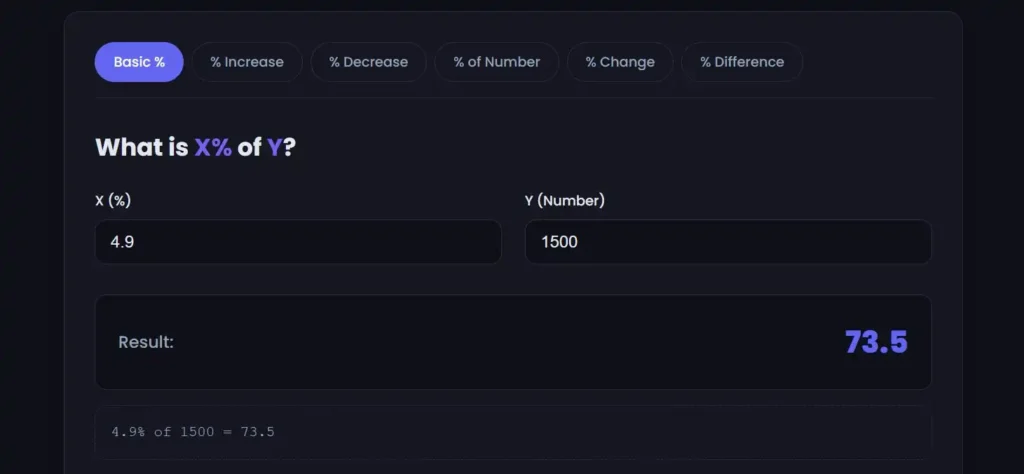
- MiniToolsPro Percentage Calculator — A free online tool that handles percentage calculations instantly. You type in two numbers, and it gives you the percentage. No mental math required. Try the percentage calculator here.
- Smartphone Calculator — Every phone has a built-in calculator with a % button. Just type the number, hit multiply, type the percentage, then hit %.
- Google Search — Type "what is 20% of 150" directly into Google. The search engine shows the answer instantly.
- Spreadsheet Software — Excel and Google Sheets have built-in percentage formatting. Use formulas like =A1*0.20 to calculate 20% of the value in cell A1.
- Mental Math — For common percentages like 10%, 20%, 25%, and 50%, your brain is faster than any tool.
[Insert image: Screenshot of MiniToolsPro percentage calculator showing input fields and result | Alt text: "Calculate percentage with MiniToolsPro free online calculator"]
For more complex calculations like percentage change over time or weighted averages, an average calculator can help you organize the numbers.
What's Next After Learning Percentage Basics?
Once you understand percentages, the next step is applying them regularly. Start with small daily calculations. Calculate the tip at your next meal. Figure out the real discount on a sale item. Check the percentage change in your utility bill.
Then move to bigger applications. Build a simple budget using percentages. Track your savings rate. Calculate investment returns. Use percentages to compare options and make decisions.
Don't worry about mastering every formula at once. The core concept — part divided by whole, times 100 — carries you through most situations. When the numbers get tedious or you're double-checking something important, use a tool.
Conclusion
A percentage is simply a fraction of 100. Once that clicks, everything else follows. You can calculate discounts, compare interest rates, interpret statistics, and make smarter financial decisions.
The key is practice. Do a few calculations by hand. Use a calculator when speed matters. Check your work when the stakes are high. Percentages aren't complicated — they're just unfamiliar until you use them consistently.
Ready to try a quick calculation? Head over to the percentage calculator and test it with a real number from your life. You'll see how fast it works.
Written by Sami, a full-stack web designer and developer who often shares their expertise on different platforms
Reviewed by MiniToolsPro Editorial Team
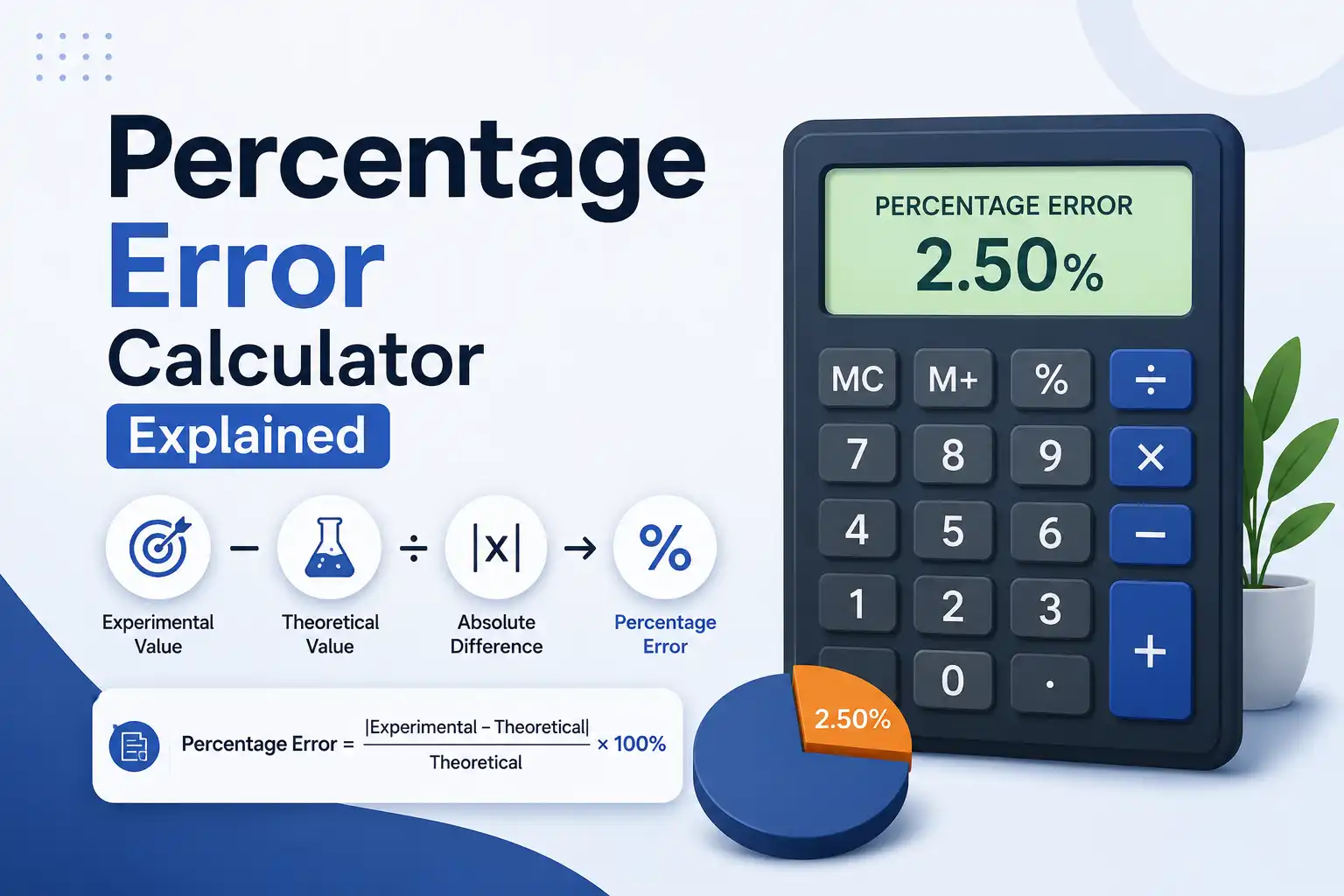
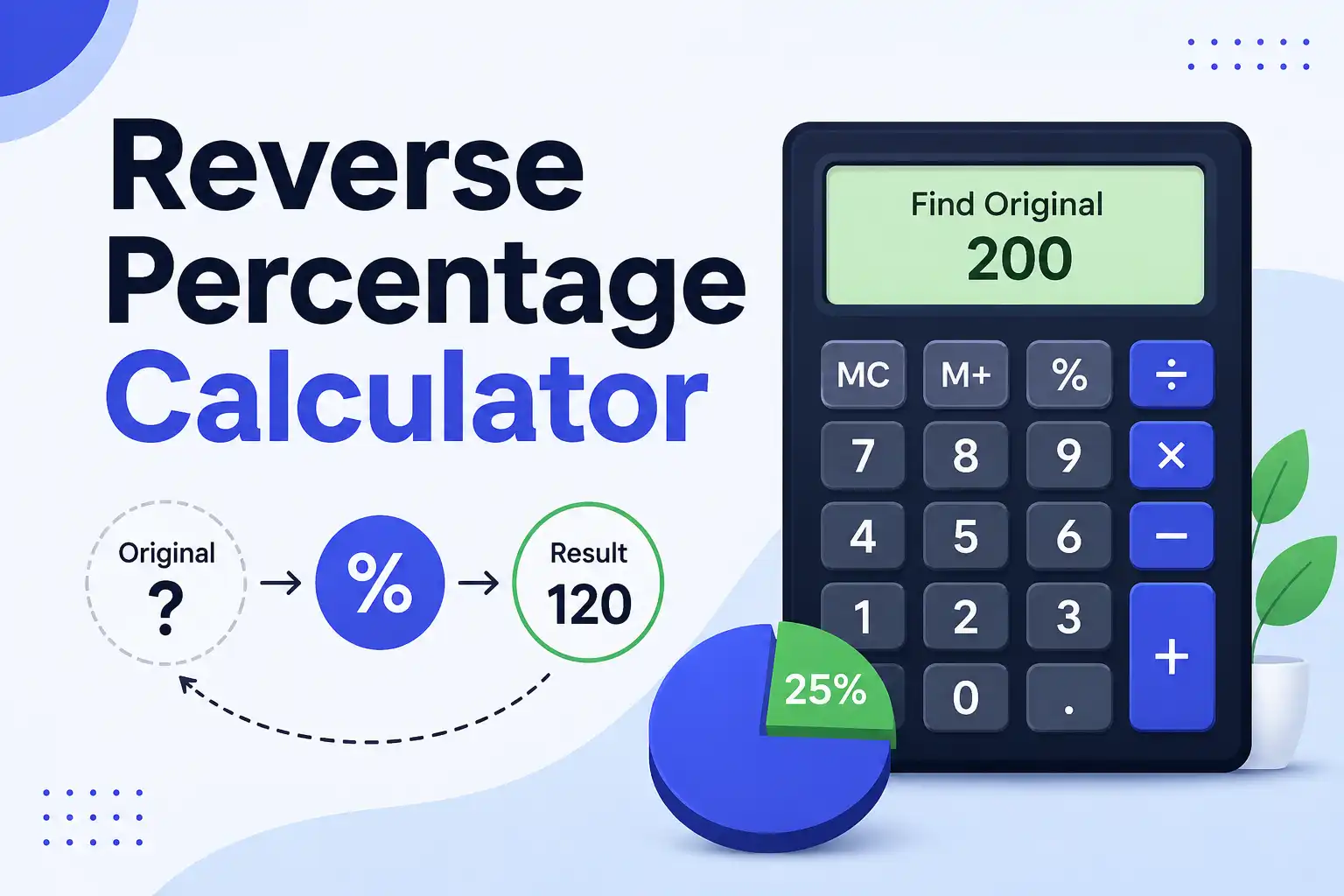
Once you understand what a percentage represents, the next step is learning how to use percentages in practical calculations. Our Percentage Calculator: How to Calculate Percentages Easily builds on these fundamentals by explaining common percentage formulas, including how to find a percentage of a number, compare values, and calculate percentage changes.
Share this article 👇
0 Comments