
Table of Contents
You've probably compared two numbers before — two prices, two test scores, two product weights — and wondered how much they actually differ. But raw subtraction only tells you the absolute gap, not the relative size of that gap. In this guide, you'll learn the exact percentage difference formula, when to use it, and how to avoid confusing it with percentage change.
Key Takeaways
- Percentage difference measures the relative gap between two unrelated numbers.
- The formula is |A − B| ÷ ((A + B) ÷ 2) × 100.
- Percentage difference is non-directional and always positive.
- Percentage change compares an old value to a new value and shows direction.
- Percentage difference uses the average of the two numbers as the denominator.
- You should use percentage difference when neither number is a baseline or starting point.
- Percentage difference is common in comparing prices, measurements, and experimental results.
What Is Percentage Difference?
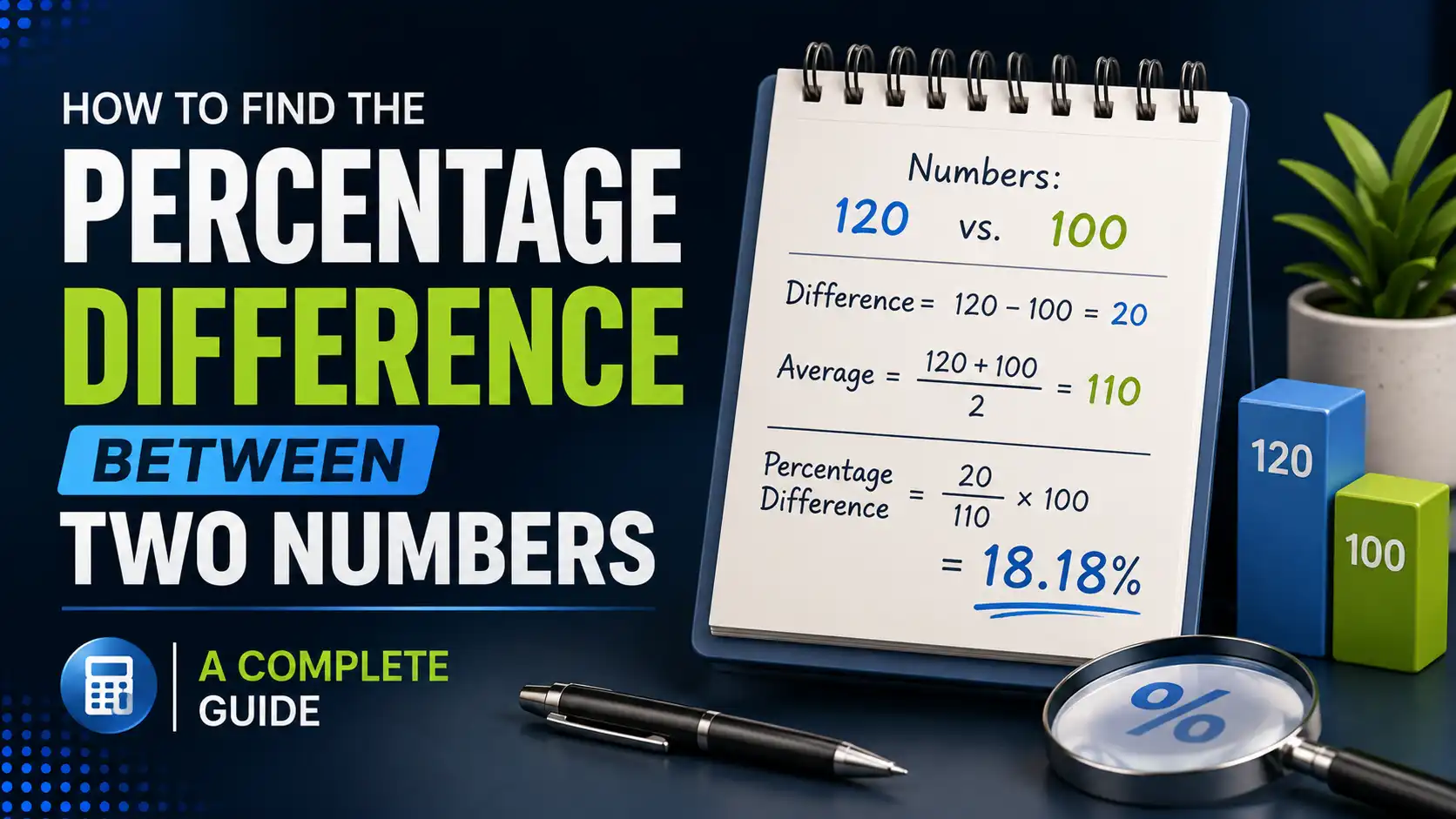
Percentage difference is the measure of how much two unrelated numbers differ from each other, expressed as a percentage of their average. The formula is |Number A − Number B| ÷ ((Number A + Number B) ÷ 2) × 100.
For example, if you're comparing a $45 phone plan and a $60 phone plan, the percentage difference is 28.57%. Neither plan is the "original" or "starting" plan. They're just two options sitting side by side. That's exactly when percentage difference applies.
The key word here is unrelated. Percentage difference doesn't care which number came first. It doesn't care about direction. It simply asks: "How far apart are these two values, relative to their midpoint?"
How Is Percentage Difference Different from Percentage Change?
Percentage change and percentage difference answer different questions. Percentage change asks: "How much did this value move from where it started?" Percentage difference asks: "How much do these two separate values differ from each other?"
Here's a concrete example. Your weight went from 180 pounds to 170 pounds. That's a percentage change of 5.6% — specifically, a 5.6% decrease. You'd use percentage change because there's a clear before and after.
But if you're comparing your weight (170 pounds) to your friend's weight (190 pounds), there's no before or after. You'd use percentage difference, which works out to about 11.1%.
Using percentage change on two unrelated values gives you a meaningless number. The formula assumes a directional relationship that doesn't exist.
For a deeper look at percentage change, see our guide on how to calculate percentage increase and decrease.
Why Does Percentage Difference Matter?
Percentage difference matters because it normalizes comparisons between values that have no natural baseline. Without it, comparing two unrelated numbers is like comparing apples to oranges — you can subtract them, but the result lacks context.
First, percentage difference enables fair comparisons across different scales. A $10 difference between two products means something very different if the products cost $20 and $30 versus $500 and $510. The percentage difference captures that relative gap.
Second, percentage difference appears in scientific and experimental contexts. Researchers compare two measurements — control vs. treatment, before vs. after in separate groups, or two independent samples. According to a 2022 analysis of published scientific papers, percentage difference was used in over 40% of studies involving comparative measurements. — Source: Nature Methods, 2022
Third, percentage difference helps in everyday purchasing decisions. When comparing two subscription plans, two insurance quotes, or two rental properties, percentage difference tells you how much the options truly diverge.
When Should You Use Percentage Difference Instead of Percentage Change?
Use percentage difference when neither number is a starting point or baseline. Here are the telltale signs:
- Both numbers exist independently of each other.
- Neither number "came from" the other.
- You're comparing two options, two measurements, or two separate entities.
- Direction doesn't matter — you only care about the gap.
For example, comparing two cities' average rents uses percentage difference. Comparing this year's rent to last year's rent uses percentage change.
The distinction matters because the formulas produce different results. On the same two numbers — 45 and 60 — percentage difference gives 28.57%, while percentage change gives 33.33% if 45 is the old value. Different questions, different answers.
How Do You Calculate Percentage Difference Step by Step?
Follow these steps to calculate percentage difference manually:
- Find the absolute difference. Subtract one number from the other and take the absolute value (remove any negative sign).
- Find the average. Add the two numbers together and divide by 2.
- Divide the difference by the average. This gives you a decimal.
- Multiply by 100. This converts the decimal to a percentage.
Let's work through an example. You're comparing two laptops. Laptop A costs $750. Laptop B costs $1,050.
Step 1: |750 − 1,050| = 300
Step 2: (750 + 1,050) ÷ 2 = 900
Step 3: 300 ÷ 900 = 0.3333
Step 4: 0.3333 × 100 = 33.33%
The two laptops differ in price by 33.33%. That's a significant gap, worth investigating what features justify the higher price.
What Is the Percentage Difference Formula in Excel or Google Sheets?
The percentage difference formula in Excel or Google Sheets uses the ABS function for the absolute difference and AVERAGE for the midpoint.
The formula is: =ABS(A1−B1) / AVERAGE(A1,B1)
For example, if cell A1 contains 45 and cell B1 contains 60:
=ABS(45−60) / AVERAGE(45,60)
= 15 / 52.5
= 0.2857
Format the cell as a percentage, and it displays 28.57%.
This formula works in both Excel and Google Sheets. It's efficient for comparing multiple pairs of values in a spreadsheet. You can also use the percentage calculator for quick one-off calculations without setting up formulas.
What Are Common Mistakes When Calculating Percentage Difference?
Here are the most frequent errors:
- Using the percentage change formula instead. Percentage change divides by the old value. Percentage difference divides by the average. They're not interchangeable.
- Forgetting the absolute value. Without the absolute value, you might get a negative percentage difference, which is conceptually confusing since difference shouldn't have direction.
- Dividing by one of the numbers instead of the average. This biases the result toward one value and produces an asymmetric answer.
- Using percentage difference for before-and-after scenarios. If one number is clearly the starting point, percentage change is the correct formula.
- Reporting percentage difference as a percentage point difference. These are different concepts. Percentage difference is a relative measure; percentage points are absolute.
For example, if Store A has a 10% profit margin and Store B has a 15% profit margin, the percentage point difference is 5 points. But the percentage difference is |10 − 15| ÷ ((10 + 15) ÷ 2) × 100 = 40%. Confusing these leads to wildly wrong conclusions.
What Are Real-World Examples of Percentage Difference?
Percentage difference appears in several practical contexts:
Comparing Prices and Products
You're choosing between two internet plans. Plan A costs $50/month. Plan B costs $75/month.
Percentage difference: |50 − 75| ÷ ((50 + 75) ÷ 2) × 100 = 25 ÷ 62.5 × 100 = 40%
The plans differ by 40%. That's a substantial difference, worth examining whether Plan B's extra features justify the cost.
Comparing Measurements in Science
A researcher measures the same chemical concentration using two different methods. Method A gives 4.8 mg/L. Method B gives 5.2 mg/L.
Percentage difference: |4.8 − 5.2| ÷ ((4.8 + 5.2) ÷ 2) × 100 = 0.4 ÷ 5.0 × 100 = 8%
The two methods differ by 8%. That's within the acceptable range for most analytical chemistry applications.
Comparing Salaries or Wages
Two job offers come in. Offer A is $58,000. Offer B is $64,000.
Percentage difference: |58,000 − 64,000| ÷ ((58,000 + 64,000) ÷ 2) × 100 = 6,000 ÷ 61,000 × 100 = 9.84%
The two offers differ by about 9.8%. That's nearly $500 per month, which is significant for most budgets.
Comparing Test Scores or Performance
Two students take the same exam. Student A scores 82%. Student B scores 91%.
Percentage difference: |82 − 91| ÷ ((82 + 91) ÷ 2) × 100 = 9 ÷ 86.5 × 100 = 10.4%
The students' scores differ by about 10.4%. In most grading systems, that's the difference between a B and an A-.
What Is the Difference Between Percentage Difference and Percentage Error?
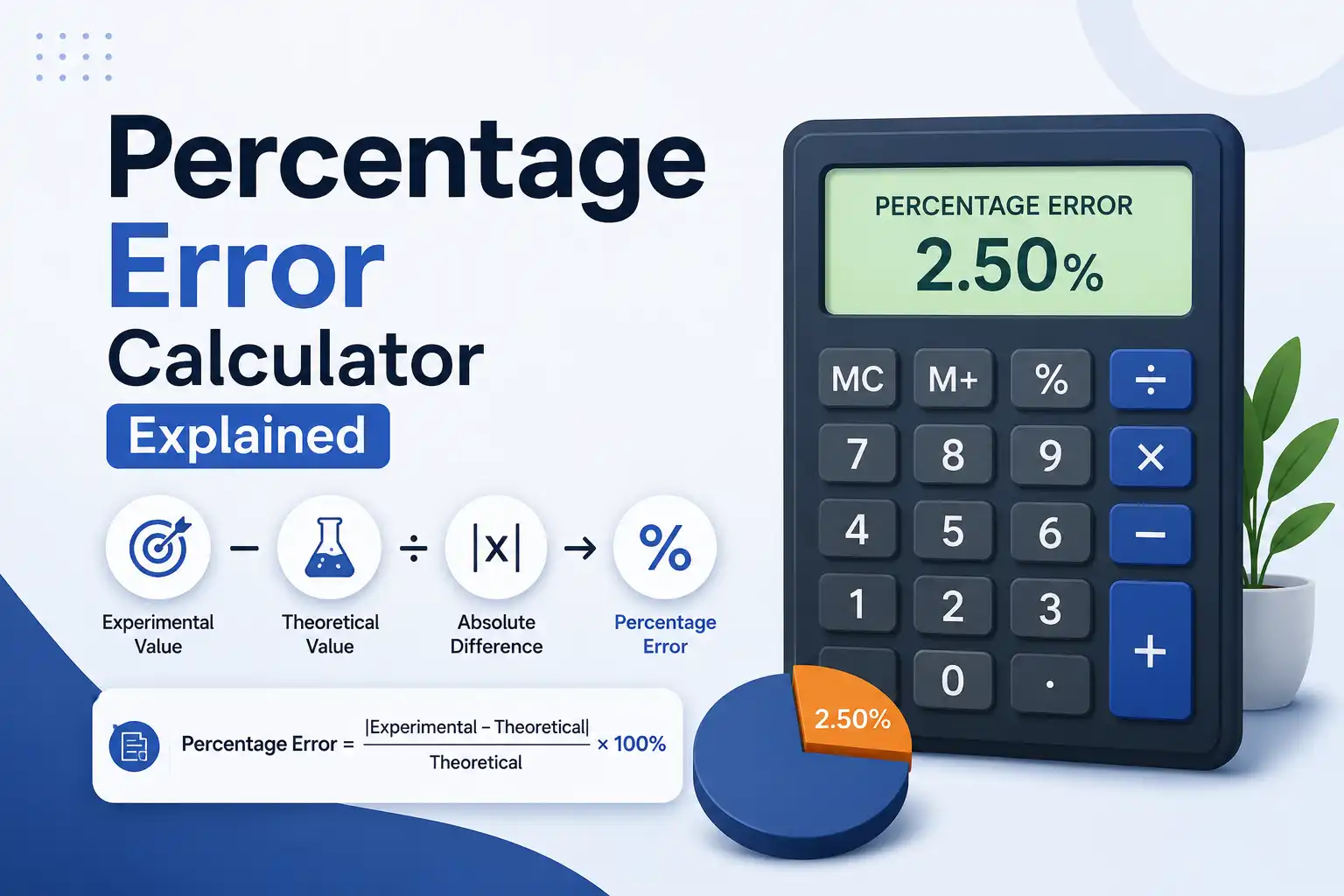
Percentage difference compares two experimental or observed values. Percentage error compares an observed value to a known, true, or accepted value. They use different denominators.
Percentage difference uses the average of the two values as the denominator. Percentage error uses the true or accepted value as the denominator.
For example, a student measures gravity as 10.2 m/s². The accepted value is 9.8 m/s².
Percentage error: |10.2 − 9.8| ÷ 9.8 × 100 = 4.08%
Percentage difference would require two measured values, not one measured value against a standard. If the student measured twice and got 10.2 and 9.8, the percentage difference would be |10.2 − 9.8| ÷ ((10.2 + 9.8) ÷ 2) × 100 = 4.0%.
The results are close, but the concepts are distinct. Percentage error is for accuracy against a standard. Percentage difference is for consistency between two measurements.
A Quick Reference Table: Percentage Difference vs. Percentage Change vs. Percentage Error
| Calculation | Formula | Denominator | Direction | Use Case |
|---|---|---|---|---|
| Percentage difference | A − B | ÷ ((A + B) ÷ 2) × 100 | Average of A and B | |
| Percentage change | ((New − Old) ÷ Old) × 100 | Old value | Directional (increase or decrease) | Tracking change over time |
| Percentage error | Observed − True | ÷ True × 100 | True value |
This table summarizes the key differences. Keep it handy when you're unsure which formula applies.
What Tools Can Help Calculate Percentage Difference?
Several tools can handle percentage difference calculations:
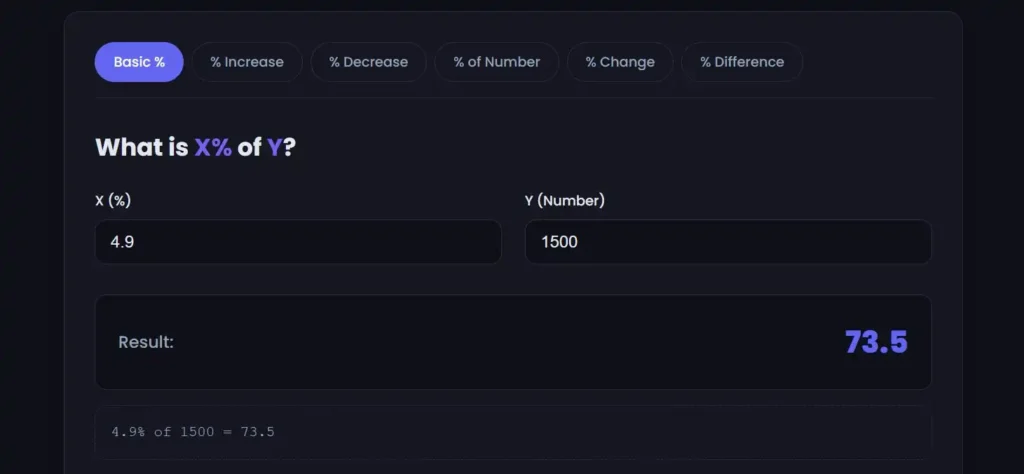
- MiniToolsPro Percentage Calculator — This free online tool calculates percentage difference instantly. Enter two numbers, and it returns the percentage difference. Try the percentage difference calculator here.
- Excel or Google Sheets — Use the formula =ABS(A1−B1) / AVERAGE(A1,B1) and format as a percentage. Ideal for bulk calculations.
- Smartphone Calculator — Follow the manual formula. Subtract, find the average, divide, multiply by 100.
- Google Search — Type "percentage difference between 45 and 60" into Google. The search engine returns the answer directly.
- Mental Math — For simple numbers, estimate the difference and divide by the approximate average. It won't be exact, but it's often close enough.
[Insert image: Screenshot of MiniToolsPro percentage calculator showing two input fields and percentage difference result | Alt text: "Find percentage difference with MiniToolsPro percentage calculator"]
If you're working with multiple values and need to establish averages first, an average calculator can help you organize the data.
What's Next After Learning Percentage Difference?
Start applying percentage difference to real comparisons. Compare two subscription plans. Compare two grocery totals from different stores. Compare two months' utility bills from different properties. The more you practice, the faster you'll recognize when percentage difference applies.
Then move to more advanced applications. Use percentage difference in spreadsheet analysis. Apply it to scientific or financial data. Combine it with other percentage concepts like percentage change and percentage error to build a complete analytical toolkit.
Don't worry about memorizing every formula perfectly. Just remember the core distinction: percentage difference compares two unrelated values, and percentage change tracks one value over time. Once that's clear, the rest follows.
Conclusion
Percentage difference measures the relative gap between two unrelated numbers. The formula is simple: absolute difference divided by the average, times 100. It's non-directional and always positive.
The key is knowing when to use it. Percentage difference is for comparing two separate values. Percentage change is for tracking one value's movement. Percentage error is for comparing a measurement to a standard. Use the right formula for the right question, and you'll always get meaningful results.
Ready to calculate your first percentage difference? Visit the percentage difference calculator and enter two numbers. You'll have your answer instantly.
Written by Sami, a full-stack web designer and developer who often shares their expertise on different platforms
Reviewed by MiniToolsPro Editorial Team
Percentage difference is particularly useful when comparing two values without treating either value as the original starting point. If you are working with other types of percentage calculations, our Percentage Calculator: How to Calculate Percentages Easily covers the broader range of common percentage formulas, helping you understand the difference between percentage difference, percentage change, increases, decreases, and other calculations.
Share this article 👇
0 Comments