
Table of Contents
Weight Converter Introduction
Have you ever stared at a weight in kilograms and needed it in pounds right away? Or maybe you have come across a recipe listing ingredients in grams, but your kitchen scale measures in ounces. These situations are more common than you might think. Whether you are tracking your fitness goals, cooking a new recipe, or shipping a package, converting weight units can quickly become a headache if you do not have the right tools.
This is exactly where a weight converter becomes your best friend. It takes the guesswork out of switching between metric and imperial units, giving you accurate results in seconds. Instead of struggling with formulas or searching for a conversion chart, you can simply enter a value and let the converter do the math [citation:11].
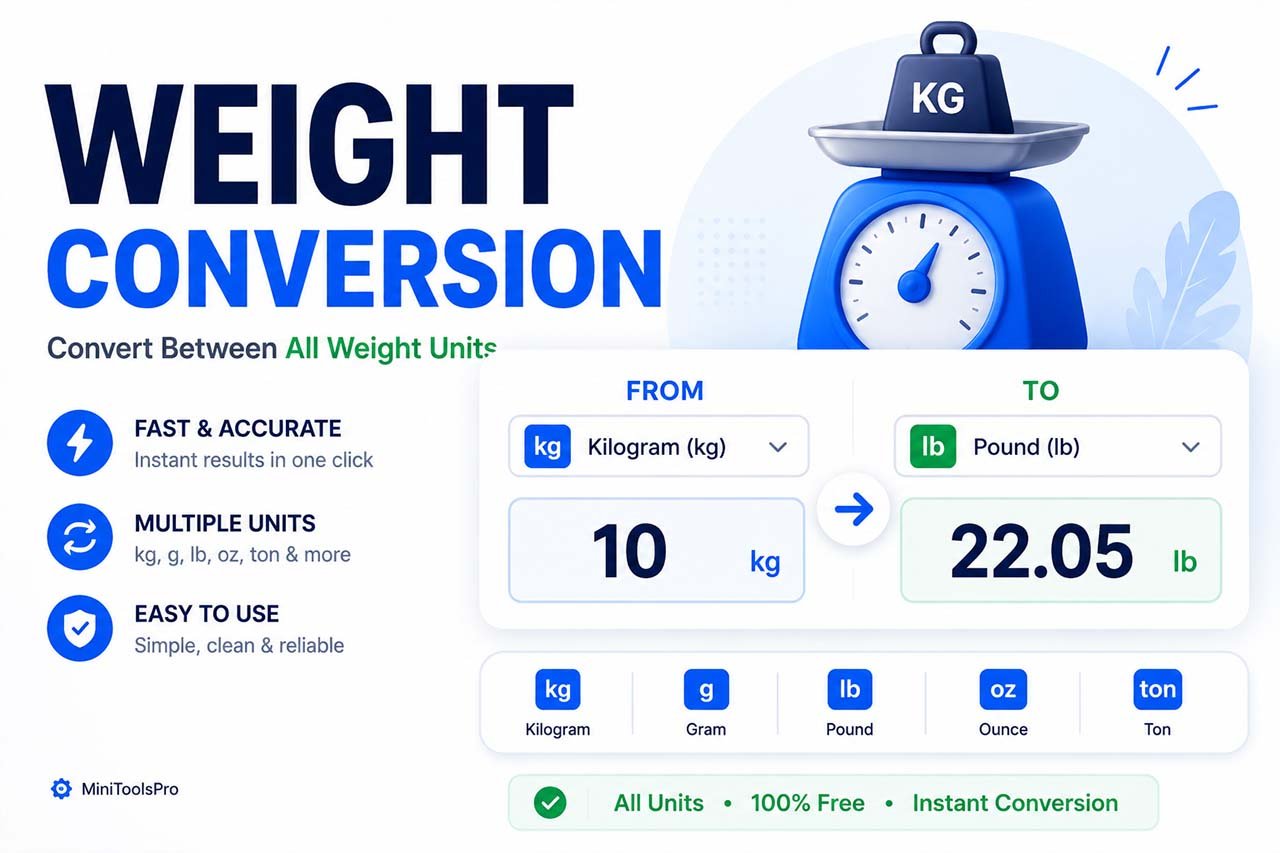
In this guide, we are going to walk you through everything you need to know about weight conversion. We will explain the common units, show you how conversions work, provide helpful reference tables, and introduce you to the MiniToolsPro Weight Converter—a free tool designed to make your life easier.
Quick Answer: What is a Weight Converter?
A weight converter is a tool or calculation method used to change a measurement of weight from one unit to another. It uses standardized conversion factors to ensure accuracy. For example, to convert kilograms to pounds, you multiply the weight in kilograms by 2.20462 [citation:8].
What is a Weight Converter?
At its core, a weight converter is a simple yet powerful utility that translates a weight value from one unit of measurement to another. These units can belong to different systems, most commonly the metric system (like kilograms and grams) and the imperial system (like pounds, ounces, and stones) [citation:1].
While the math behind conversion is straightforward, doing it manually for every single value can be tedious and prone to error. A digital weight converter automates the process, giving you instant, accurate results every time. Whether you are converting 90 kg to lbs, figuring out how many pounds are in stone, or needing a conversion calculator for a specific recipe, an online tool handles it all in a fraction of a second.
Why Weight Conversion Matters
Weight conversion is something we encounter in daily life more often than we realize. It is not just an abstract mathematical concept; it has real-world applications that affect everyday decisions.
- Fitness and Health: If you are following an international fitness program or monitoring your weight, you might see body weight in kilograms while your scale at home measures pounds. A weight converter helps you track your progress accurately [citation:11].
- Cooking and Baking: Recipes often use different units. A European recipe might call for 500 grams of flour, but your measuring cups are in ounces. Converting these ingredients correctly is essential for the dish to turn out well [citation:7].
- Travel and Shipping: Airlines have strict baggage weight limits, often in kilograms. Shipping companies may charge based on weight. Knowing the exact conversion helps you avoid excess fees and ensure your packages meet the requirements [citation:14].
- Education and Work: Students studying science or engineering frequently need to convert units for their homework or experiments. Professionals in logistics, construction, and manufacturing also depend on accurate weight conversions daily [citation:11].
How Weight Conversion Works
Understanding the basic principles behind weight conversion can give you confidence in your results. Every unit of weight is defined by a fixed relationship to other units.
For example:
- 1 kilogram (kg) is equal to 2.20462 pounds (lbs) [citation:8].
- 1 stone (st) is equal to 14 pounds (lbs) [citation:5].
- 1 pound (lb) is equal to 0.453592 kilograms (kg) [citation:8].
- 1 ounce (oz) is equal to 28.3495 grams (g) [citation:7].
When you use a weight converter, it applies these fixed conversion factors to give you the equivalent value in the unit you need [citation:6].
Metric vs. Imperial Units
The metric system (grams, kilograms, metric tons) is used by most countries worldwide. It is based on powers of ten, making it simple to move between units. The imperial system (ounces, pounds, stones) is still used in the United States and sometimes in the United Kingdom and Ireland for specific purposes like body weight [citation:1].
Most conversions happen between these two systems. For instance, converting weight lbs to kg is a common task for international travelers, students, and professionals.
Technical Explanation (Optional)
Modern weight converters, including the MiniToolsPro Weight Converter, perform calculations using high-precision constants. The exact conversion factor for kg to lbs is 2.20462262185. The tool calculates the result by multiplying the input value by this constant. For lbs to kg, it divides the input value by the same constant [citation:4].
This ensures that every conversion is accurate to several decimal places. This level of precision is particularly important in scientific or commercial settings where even small errors can have consequences.
Quick Reference Conversion Tables
Here are some quick reference tables for the most common weight conversions you might need.
Kilograms (kg) to Pounds (lbs)
| Kilograms (kg) | Pounds (lbs) |
|---|---|
| 1 kg | 2.20 lbs |
| 5 kg | 11.02 lbs |
| 10 kg | 22.05 lbs |
| 14 kg | 30.86 lbs |
| 50 kg | 110.23 lbs |
| 70 kg | 154.32 lbs |
| 90 kg | 198.42 lbs |
| 100 kg | 220.46 lbs |
Stone (st) to Pounds (lbs)
| Stone (st) | Pounds (lbs) |
|---|---|
| 1 st | 14 lbs |
| 5 st | 70 lbs |
| 8 st | 112 lbs |
| 10 st | 140 lbs |
| 12 st | 168 lbs |
| 15 st | 210 lbs |
| 20 st | 280 lbs |
Step-by-Step Guide to Converting Weight
You can convert weight in two main ways: manually or using a tool. Here is how both methods work.
Manual Method
- Identify the units: Determine the unit you have and the unit you need.
- Find the conversion factor: Look up the relationship between the two units (e.g., 1 kg = 2.20462 lbs).
- Apply the formula: Multiply or divide based on the conversion factor. For example, to convert 14 kg to lbs, you would multiply 14 by 2.20462, which equals approximately 30.86 lbs.
Modern Method (Using a Tool)
- Go to the MiniToolsPro Weight Converter.
- Select the unit you want to convert from: Choose from options like kilograms, pounds, stone, grams, or ounces.
- Enter the value: Type in the number you want to convert.
- View the result: The converted value appears instantly in the target units.
Common Mistakes to Avoid in Weight Conversion
Even simple conversions can go wrong. Here are some common mistakes to watch out for.
Rounding Too Early
If you need a precise answer, avoid rounding off your numbers until the final step. For example, if you are converting 1.6kg in pounds, use the full conversion factor (2.20462) before rounding. Doing 1.6 × 2.2 gives you an approximate answer, but the exact result is 3.527 lbs.
Confusing Mass with Volume
Weight (mass) and volume are different. An ounce of weight is not the same as a fluid ounce of volume. Confusing the two can ruin a recipe or a calculation. For instance, if you are measuring flour, you need weight ounces (oz), not fluid ounces (fl oz) [citation:7].
Mixing Up Stones and Pounds
The most common mistake in the UK and Ireland is forgetting that one stone equals 14 pounds, not 10. If someone asks how much is a stone in pounds, the answer is always 14. For example, 10 stone in pounds is 140 lbs, not 100 lbs [citation:5].
Real-World Use Cases for Weight Conversion
Weight conversion is used in nearly every industry and by people from all walks of life.
1. Fitness Enthusiasts and Personal Trainers
If you are tracking your body weight, you might want to convert between kilograms and pounds. For example, if your goal is to reach 70 kg, knowing that this equals 154 lbs can help you if you are using a different scale. Personal trainers also use converters to track client progress across measurement systems [citation:11].
2. Home Cooks and Professional Chefs
Baking a European cake recipe? The ingredients might be listed in grams or kilograms. A weight converter lets you measure the correct amount in ounces or pounds, which is crucial for baking where precision is key [citation:7].
3. Logistics and Shipping Professionals
Shipping companies often use both metric and imperial units. If a package weighs 5.5 kg, and the shipping label requires weight in pounds, you can convert it quickly. The 5.5kg to lbs conversion is approximately 12.13 lbs, helping you accurately fill out shipping documents [citation:14].
4. Students and Academics
Students often need to convert units for science experiments, math problems, or engineering projects. Knowing how to use a conversion calculator saves time and reduces the chance of calculation errors [citation:14].
5. International Travelers
When traveling, you might encounter luggage weight limits in kilograms but your home scale measures in pounds. Converting between the two can help you pack correctly and avoid overweight baggage fees at the airport.
Use the MiniToolsPro Weight Converter
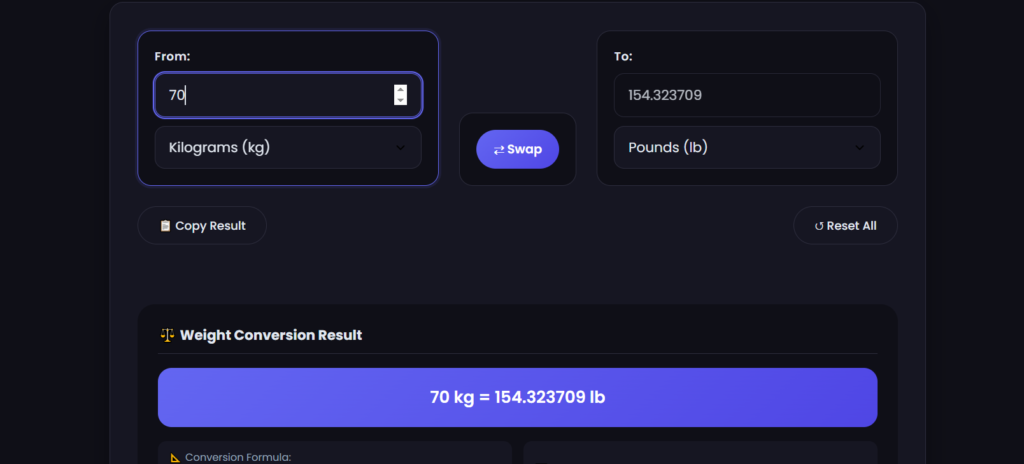
Instead of doing these calculations manually, you can use our free Weight Converter.
It is designed to be simple and accurate. You just select the unit you have, type in the value, and see the conversion instantly. This tool is perfect for anyone who needs quick, accurate results for any of the common conversions: kg to pounds stone, lbs to kg, stone to pounds, and more.
Why You Will Love This Tool
- Saves Time: No more manual math or searching for conversion charts.
- Eliminates Errors: The tool uses precise conversion factors to ensure accuracy every time.
- User-Friendly: The interface is clean and straightforward, so anyone can use it.
- Supports Multiple Units: Convert between kilograms, pounds, stone, grams, and ounces with ease.
Advanced Tips & Best Practices for Using a Weight Converter
These tips will help you get the most out of a weight converter and avoid common pitfalls.
Use the Right Conversion Factor
Always ensure your tool uses up-to-date, standardized factors. For example, the international agreement on the pound as exactly 0.45359237 kg was established in 1959, and this standard is still used today [citation:4].
Double-Check for Critical Tasks
If you are using a weight for shipping, a recipe, or a scientific experiment, it is a good habit to double-check your result. Using a reliable tool like the MiniToolsPro Weight Converter gives you this peace of mind.
Know the Context
Be aware of what you are measuring. Weight ounces and fluid ounces are not interchangeable, and tons are different depending on whether you mean a US ton, UK ton, or metric tonne [citation:1].
Frequently Asked Questions (FAQ)
How many pounds are in a stone?
There are exactly 14 pounds in 1 stone. This conversion is fixed and used for body weight measurements in the UK and Ireland [citation:13].
How do I convert kilograms to pounds?
To convert kilograms to pounds, multiply the weight in kilograms by 2.20462. For example, 70 kg × 2.20462 = 154.32 lbs [citation:4].
How do I convert pounds to kilograms?
To convert pounds to kilograms, divide the weight in pounds by 2.20462. For example, 150 lbs ÷ 2.20462 = 68.04 kg [citation:8].
Is 1 kg equal to 2.2 lbs?
Yes, 1 kilogram is approximately equal to 2.20462 pounds. The 2.2 figure is a commonly used approximation for quick mental calculations [citation:4].
What is 90 kg to lbs?
90 kilograms is equal to 198.42 pounds. You can calculate this by multiplying 90 by 2.20462 [citation:4].
What is 10 stone in pounds?
10 stone is equal to 140 pounds. This is calculated by multiplying 10 by 14 (the number of pounds in a stone) [citation:5].
Why do we use stones for body weight?
Stones are traditionally used for body weight in the UK and Ireland. One stone, equal to 14 pounds, is a convenient unit for measuring human body weight as it keeps the number within a smaller range (e.g., 10 stone vs. 140 lbs) [citation:10].
What is the difference between a US ton and a metric ton?
A US short ton is equal to 2,000 pounds (907.18 kg), while a metric tonne is equal to 1,000 kilograms (2,204.62 lbs). They are not the same [citation:1].
Final Thoughts
Converting between different weight units is a common task that does not have to be complicated. Whether you are converting kilograms to pounds for a fitness goal, understanding how many pounds is a stone for a health metric, or measuring ingredients for a new recipe, accuracy is key.
Instead of wrestling with formulas or mental math, use a reliable weight converter to get instant, accurate results. The MiniToolsPro Weight Converter is a free, easy-to-use tool that handles all your conversion needs. Give it a try and make your weight conversion tasks effortless.
Related Tools You May Find Useful
- BMI Calculator – Check your Body Mass Index based on your weight and height.
- Area Converter – Convert between different area units like square meters and square feet.
- Length Converter – Convert between meters, feet, inches, and more.
- Volume Converter – Convert between liters, gallons, and other volume units.
- Temperature Converter – Convert between Celsius, Fahrenheit, and Kelvin.
Last Updated: July 4, 2026
Share this article 👇

0 Comments