
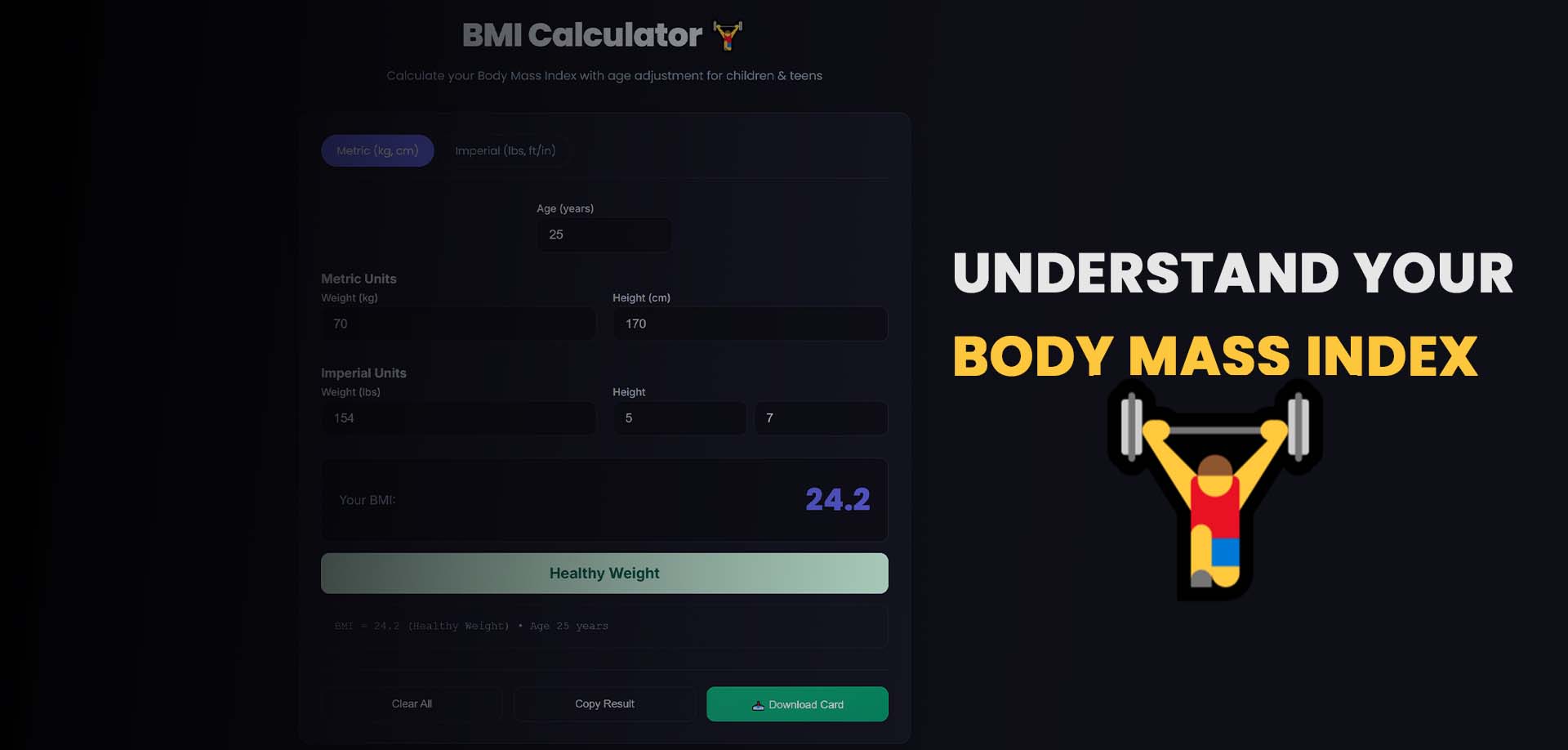
Introduction: Why You Need a BMI Calculator 🔗
In today's health-conscious world, understanding your body composition is more important than ever. With obesity rates tripling globally since 1975 and over 1.9 billion adults classified as overweight, tracking your health metrics has become essential for preventive care and wellness management.
Your Body Mass Index (BMI) is one of the most widely used tools for assessing whether your weight falls within a healthy range. It's a simple calculation that provides valuable insights into your overall health status and potential risks associated with being underweight, overweight, or obese.
Did you know that individuals with a BMI above 30 have a 50-100% higher risk of premature death compared to those with a healthy BMI? Conversely, being underweight (BMI below 18.5) can indicate nutritional deficiencies and weakened immune function.
Enter the BMI calculator—your essential tool for quickly assessing your weight status, setting health goals, and tracking progress over time.
What is BMI (Body Mass Index)? 🔗
Body Mass Index (BMI) is a measure of body fat based on your height and weight. Developed by Belgian statistician Adolphe Quetelet in the 1830s, BMI has become the international standard for classifying weight categories in adults.The BMI Formula 🔗
The calculation is straightforward: Metric Formula: BMI = weight (kg) ÷ height² (m²)
Imperial Formula: BMI = (weight (lbs) ÷ height² (in²)) × 703
Example Calculations 🔗
Metric Example:- Weight: 70 kg
- Height: 1.75 m
- Calculation: 70 ÷ (1.75 × 1.75) = 70 ÷ 3.0625 = 22.9 BMI
- Weight: 154 lbs
- Height: 69 inches (5'9")
- Calculation: (154 ÷ (69 × 69)) × 703 = (154 ÷ 4761) × 703 = 0.0323 × 703 = 22.7 BMI
BMI Categories: What Your Number Means 🔗
The World Health Organization (WHO) and major health organizations classify BMI into the following categories:
| BMI Range | Category | Health Risk Level | What It Means | |-----------|----------|-------------------|---------------| | Below 18.5 | Underweight | Increased Risk | May indicate malnutrition, eating disorders, or underlying health conditions | | 18.5 – 24.9 | Normal Weight | Low Risk | Considered healthy weight range for most adults | | 25.0 – 29.9 | Overweight | Moderate Risk | Excess weight that may increase risk of chronic diseases | | 30.0 – 34.9 | Obesity Class I | High Risk | Significantly increased risk of health complications | | 35.0 – 39.9 | Obesity Class II | Very High Risk | Severe obesity requiring medical attention | | 40.0 and above | Obesity Class III | Extremely High Risk | Morbid obesity; urgent medical intervention needed |
Visual Reference: BMI Chart 🔗
Height (ft) 5'0" 5'3" 5'6" 5'9" 6'0" 6'3" Weight (lbs) BMI Values ------------- ------------------------------------- 140 27.3 24.8 22.6 20.7 19.0 17.5 160 31.2 28.3 25.8 23.6 21.7 20.0 180 35.1 31.9 29.1 26.6 24.4 22.5 200 39.0 35.4 32.3 29.5 27.1 25.0 220 42.9 39.0 35.5 32.5 29.8 27.5 240 46.8 42.5 38.8 35.4 32.5 30.0
Green = Normal Weight (18.5-24.9) | Yellow = Overweight (25-29.9) | Red = Obese (30+) | Blue = Underweight (<18.5)Why Your BMI Matters for Health 🔗
📊 1. Disease Risk Assessment 🔗
BMI strongly correlates with risk for numerous health conditions:
- Cardiovascular Disease: BMI > 25 increases risk by 32%
- Type 2 Diabetes: BMI > 30 increases risk by 80-90%
- High Blood Pressure: 70% of hypertension cases linked to excess weight
- Sleep Apnea: 3x more common in individuals with BMI > 30
- Certain Cancers: Breast, colon, and kidney cancer risks increase with BMI
🫀 2. Heart Health Indicator 🔗
Your BMI directly impacts heart function:
- Higher BMI increases workload on the heart
- Elevated BMI linked to cholesterol abnormalities
- Weight reduction of 5-10% can significantly reduce cardiovascular risk
🦴 3. Joint and Mobility Impact 🔗
Every pound of excess weight adds approximately 4 pounds of pressure on your knees:
- BMI > 30 increases osteoarthritis risk by 60%
- Weight loss reduces joint pain and improves mobility
- Lower BMI associated with better physical function in aging
🧠 4. Mental Health Connection 🔗
BMI affects psychological well-being:
- Higher BMI linked to increased depression rates
- Weight stigma can impact self-esteem
- Achieving healthy BMI often improves quality of life
How to Use Our BMI Calculator: Step-by-Step Guide 🔗
Our free online BMI calculator makes health assessment simple and accurate:
Step 1: Access the Tool 🔗
Visit our BMI Calculator Tool - completely free, no registration required.
Step 2: Choose Your Measurement System 🔗
Select either:
- Metric: Enter height in centimeters (cm) and weight in kilograms (kg)
- Imperial: Enter height in feet/inches and weight in pounds (lbs)
Step 3: Enter Your Details 🔗
- Height: Input your exact height (e.g., 175 cm or 5'9")
- Weight: Enter your current weight accurately
- Age: (Optional) For pediatric BMI calculations
- Gender: (Optional) For context-specific insights
Step 4: Get Instant Results 🔗
Click "Calculate BMI" to receive:
- Your exact BMI number
- Weight category classification
- Healthy weight range for your height
- Risk assessment summary
Step 5: Understand Your Results 🔗
Review the detailed analysis:
- Where you fall on the BMI scale
- Recommended weight range for optimal health
- Health risk factors based on your category
- Personalized recommendations
Step 6: Track Your Progress 🔗
- Save your results to track changes over time
- Set realistic weight goals
- Recalculate monthly to monitor progress
BMI Calculator for Different Populations 🔗
BMI for Adults (Ages 20+) 🔗
Standard BMI categories apply to all adults regardless of gender. However, interpretation should consider:
- Muscle mass: Athletes may have higher BMI without excess fat
- Body composition: BMI doesn't distinguish between muscle and fat
- Ethnicity: Some ethnic groups have different risk thresholds
BMI for Children and Teens (Ages 2-19) 🔗
Children's BMI is calculated differently:
- Percentile-based: Compared to children of same age and gender
- Growth charts: Account for developmental stages
- Categories:
- Underweight: < 5th percentile - Healthy weight: 5th to 84th percentile - Overweight: 85th to 94th percentile - Obese: ≥ 95th percentile
BMI for Seniors (Ages 65+) 🔗
For older adults, healthy BMI ranges shift slightly:
- Slightly higher BMI (23-27) may be protective
- Weight loss in seniors can indicate malnutrition
- Muscle loss (sarcopenia) affects BMI accuracy
BMI for Athletes and Bodybuilders 🔗
Athletes may have misleading BMI results:
- Higher muscle mass increases BMI without health risks
- Body fat percentage provides more accurate assessment
- Waist circumference should be measured alongside BMI
BMI Limitations: What BMI Doesn't Tell You 🔗
While BMI is a valuable screening tool, it has important limitations:
❌ Doesn't Measure Body Fat Percentage 🔗
- Athletes may have high BMI with low body fat
- Older adults may have normal BMI with high body fat
- Body composition varies by individual
❌ Doesn't Account for Fat Distribution 🔗
- Visceral fat (around organs) is more dangerous than subcutaneous fat
- Waist circumference provides additional risk information
- Apple-shaped vs. pear-shaped bodies have different risk profiles
❌ Not Accurate for All Populations 🔗
- Pregnant women (BMI not applicable)
- Bodybuilders and athletes
- Very tall or very short individuals
- Certain ethnic groups have different risk thresholds
❌ Doesn't Consider Overall Health 🔗
- Someone with healthy BMI can have poor health habits
- Fitness level matters more than weight alone
- Blood markers, blood pressure, and lifestyle matter
Complementary Health Metrics to Track 🔗
For a complete health picture, use these additional measurements alongside BMI:
| Metric | Healthy Range | How to Measure | |--------|---------------|----------------| | Waist Circumference | Men: < 40 inches
Women: < 35 inches | Measure at belly button level | | Waist-to-Height Ratio | < 0.5 | Waist (in) ÷ Height (in) | | Body Fat Percentage | Men: 10-20%
Women: 18-28% | Bioelectrical impedance, calipers | | Blood Pressure | < 120/80 mmHg | Medical device at home or pharmacy | | Resting Heart Rate | 60-100 bpm | Pulse measurement | | Blood Glucose | < 100 mg/dL fasting | Blood test |
How to Improve Your BMI 🔗
If BMI is Overweight or Obese: 🔗
1. Nutrition Adjustments- Reduce calorie intake by 500-750 calories/day for 1-2 lb weekly loss
- Increase protein intake (20-30% of calories)
- Fill half your plate with vegetables
- Limit added sugars and processed foods
- Aim for 150-300 minutes of moderate exercise weekly
- Include strength training 2-3 times per week
- Increase daily steps to 8,000-10,000
- Find activities you enjoy for sustainability
- Prioritize 7-9 hours of quality sleep
- Manage stress through meditation or relaxation
- Stay hydrated (2-3 liters of water daily)
- Track progress beyond the scale
If BMI is Underweight: 🔗
1. Calorie Increase- Add nutrient-dense foods (nuts, avocados, olive oil)
- Eat smaller, more frequent meals (5-6 per day)
- Include protein with every meal
- Consider smoothies for easy calorie intake
- Build muscle mass through resistance exercises
- Work with trainer if needed
- Focus on progressive overload
- Rule out underlying conditions
- Check for nutritional deficiencies
- Consult registered dietitian
Frequently Asked Questions 🔗
Is BMI accurate for everyone? 🔗
BMI is a good screening tool but not a diagnostic measure. It's most accurate for sedentary adults with average muscle mass. Athletes, pregnant women, children, and older adults may need additional assessments.
What's the difference between BMI and body fat percentage? 🔗
BMI uses height and weight only. Body fat percentage directly measures fat mass vs. lean mass. Two people with the same BMI can have very different body compositions.
How often should I check my BMI? 🔗
For healthy adults, checking BMI every 3-6 months is sufficient. If you're actively working on weight management, monthly checks can help track progress.
Can I be healthy with an overweight BMI? 🔗
Yes. BMI is just one indicator. Some people with BMI in overweight range have excellent blood pressure, cholesterol, and blood sugar levels. Focus on overall health markers, not just weight.
Does BMI apply to children? 🔗
Yes, but with different interpretation. Pediatric BMI uses percentiles based on age and gender. Always consult your pediatrician for children's growth assessment.
Why does my BMI say I'm overweight when I look fine? 🔗
BMI doesn't account for muscle mass, body shape, or fat distribution. If you're physically active and healthy, focus on other health metrics like waist circumference and fitness levels.
BMI Calculator Apps and Tools Comparison 🔗
| Tool | Features | Best For | |------|----------|----------| | Our BMI Calculator | Free, no registration, instant results | Quick assessment | | Smart Scale Apps | Syncs with scale, tracks history | Regular monitoring | | Fitness Trackers | Combined with activity data | Holistic tracking | | Medical Apps | Integrates with health records | Clinical monitoring |
The Future of Body Composition Assessment 🔗
Health assessment technology continues to evolve:
AI-Powered Analysis 🔗
Machine learning algorithms now provide personalized insights based on individual health data patterns.
3D Body Scanning 🔗
Mobile apps using smartphone cameras can estimate body composition with increasing accuracy.
Genetic Testing 🔗
DNA analysis can reveal genetic predispositions to weight-related conditions.
Wearable Technology 🔗
Continuous health monitoring provides real-time insights beyond periodic BMI checks.
Conclusion: Take Control of Your Health Today 🔗
Your BMI calculator is more than just a number—it's a starting point for understanding your health and making informed decisions about your wellness journey. While BMI has limitations, it remains one of the most accessible and valuable tools for weight assessment available today.
By using our free BMI calculator and combining it with other health metrics, you can:
- Understand your current health status
- Identify potential risk factors early
- Set realistic and achievable health goals
- Track progress over time with confidence
Remember that health is about more than a number on a scale. Focus on sustainable habits, regular physical activity, balanced nutrition, and overall well-being. Use your BMI as one tool in your complete health toolkit.
Ready to assess your health? Try our BMI calculator today and take the first step toward understanding your body better.---
Calculate your BMI now: Get your instant BMI result →