
Table of Contents
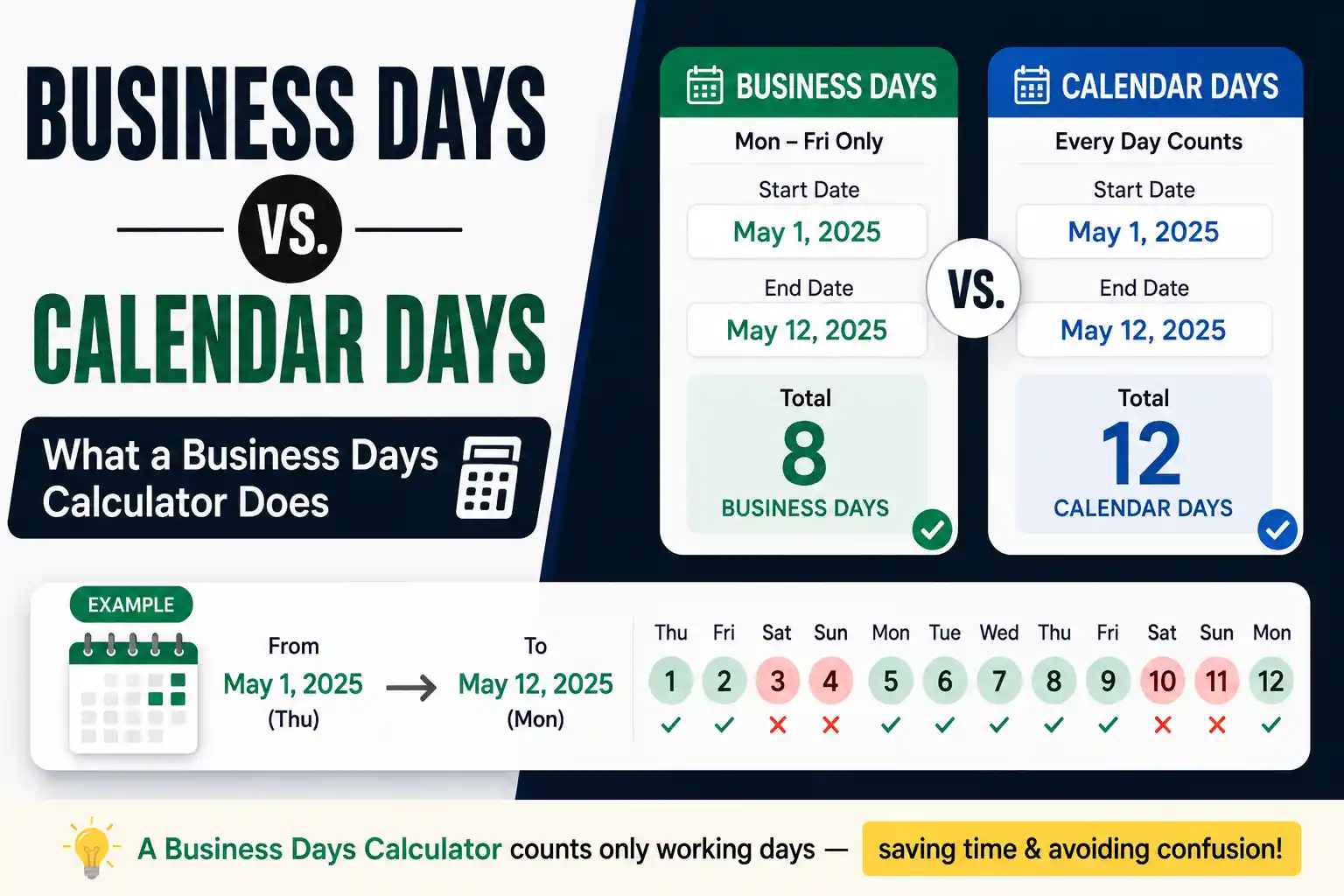
A business days calculator counts only the weekdays between two dates, skipping Saturdays and Sundays by default. Some also let you exclude specific holidays. If you've ever been told "it'll arrive in 5 to 7 business days" and wondered what calendar date that actually lands on, this is the tool that answers it. The number you get will always be smaller than total calendar days for any span longer than a few days, because weekends eat into the count.
Our date-to-date calculator handles business day counts alongside regular calendar day calculations, so you don't need a separate tool for each.
Why "Business Days" Trips Everyone Up
Calendar days are straightforward — every day on the wall counts. Workdays between dates follow a different rulebook. Monday through Friday count. Saturday and Sunday don't. Public holidays may or may not count depending on your jurisdiction, your company policy, or the specific service you're dealing with. A "7 to 10 business day" shipping estimate that starts on a Friday before a holiday weekend can stretch across nearly three calendar weeks. Without a business days calculator, mentally mapping that to a real delivery date is error-prone at best.
Different countries also observe different public holidays. A US-based business day count that skips Thanksgiving won't match a UK-based count for the same date range. Even within the same country, state or provincial holidays can vary. The calculator handles the baseline weekend exclusion automatically; holiday exclusions usually need to be specified separately depending on which tool you're using.
Worked Example: Shipping Estimate to Real Date
Let's say you place an online order on Wednesday, 12 August 2026. The retailer promises delivery within 7 business days. What calendar date should you circle on your calendar?
We count forward from the start date, skipping weekends:
- Day 1: Thursday, 13 August 2026
- Day 2: Friday, 14 August 2026
- Saturday 15 and Sunday 16: skipped (weekend)
- Day 3: Monday, 17 August 2026
- Day 4: Tuesday, 18 August 2026
- Day 5: Wednesday, 19 August 2026
- Day 6: Thursday, 20 August 2026
- Day 7: Friday, 21 August 2026
Seven business days from 12 August lands on Friday, 21 August 2026. That's 9 calendar days total — two weekend days got skipped. If a public holiday falls within that range, the delivery would push to the following Monday or Tuesday, adding even more calendar days. A business days calculator does this counting instantly and lets you toggle holidays on or off depending on what applies to your situation.
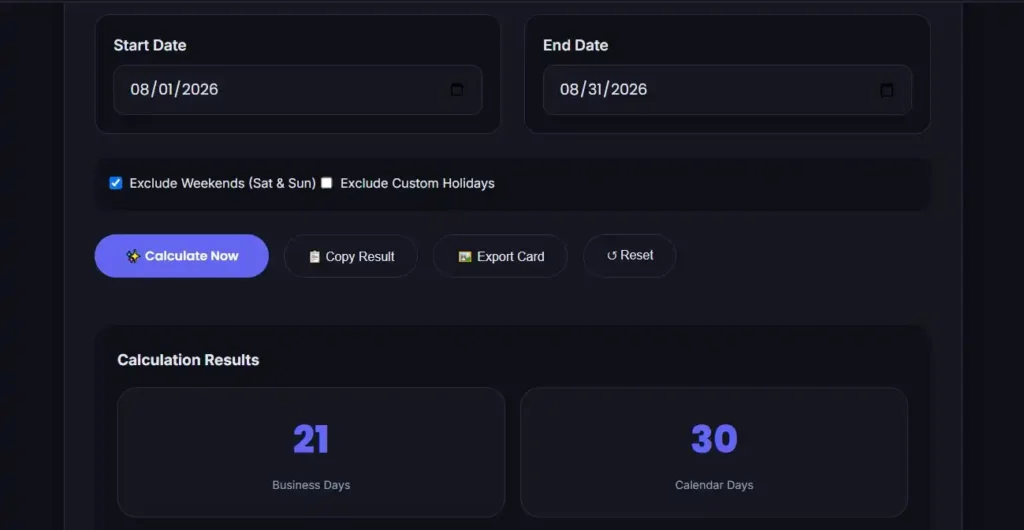
Try the same dates in our date calculator tool — it shows both the calendar day count (9 days) and the business day count (7 days) side by side, so you can see the weekend gap at a glance.
When Counting Workdays Between Dates Matters
Plenty of real-world processes run on business day schedules. Missing the distinction between calendar days and workdays creates real problems:
- Payroll processing. "Paid within 10 business days" means something very different from "paid within 10 days." One includes weekends; the other doesn't. If you're budgeting around a pay date, that gap matters.
- Legal and contract deadlines. Many contracts specify "business days" for responses, notices, and cure periods. Filing on day 31 when the contract said 30 business days could be late by over a week in calendar terms.
- Shipping and logistics. Carriers almost always quote transit times in business days. A package shipped Thursday with a 2-business-day estimate arrives Monday, not Saturday — unless the carrier operates on Saturdays, which some do for certain service levels.
- Real estate closings. Escrow periods, inspection contingencies, and financing deadlines often run on business day counts. Miscalculating by including weekends can mean missing a contractual deadline.
- HR and onboarding. Notice periods, benefits eligibility waiting periods, and background check turnaround times frequently use business day language.
Manual Business Day Counting: Possible but Painful
You can count workdays between dates by hand if the span is short. For anything beyond a couple of weeks, it gets tedious fast. The manual method goes like this: count every weekday in the range, one by one, skipping Saturdays and Sundays. Then check a holiday calendar for the relevant jurisdiction and subtract any public holidays that fall on weekdays within your range.
A 30-day calendar span typically contains 8 or 9 weekend days, leaving about 21 or 22 business days depending on where the weekends fall within the range. But that's an estimate — the exact count shifts based on which day of the week your start date lands on. A span starting on Monday gives you one count; the same number of calendar days starting on Thursday gives you a different count because the weekend placement changes.
The Friday Problem and Other Edge Cases
Business day calculations have quirks that don't exist with calendar day counting. The most common one I call the Friday problem: if you start a business day count on a Friday, day one is typically the following Monday. Some services count Friday itself as day zero or day one depending on their specific policy. The difference between "5 business days from Friday" and "5 business days starting Friday" can be an entire week in calendar terms.
Another edge case: what counts as a business day? Most of the English-speaking world treats Monday through Friday as business days. But in some Middle Eastern countries, the workweek runs Sunday through Thursday. In parts of the world with a six-day workweek, Saturday counts too. A globally aware business days calculator should at minimum let you specify which days count as weekends, even if it defaults to Saturday and Sunday.
Holidays Are the Silent Complication
Even a perfect weekend-skipping manual count falls apart if you forget a public holiday that falls on a weekday. Christmas Day on a Wednesday removes one business day from that week. New Year's Day on a Friday does the same. In the US, Thanksgiving always lands on a Thursday. When multiple holidays cluster — think Christmas and New Year's — a "10 business day" period in late December can span nearly three calendar weeks.
Most free online business day counters don't include holiday exclusions by default because holidays are jurisdiction-specific. If your deadline is tied to a legal or financial context, check whether holidays matter and, if so, which ones. Our calculator gives you the baseline Saturday-Sunday exclusion, which covers the vast majority of everyday use cases. For formal contract work, you might need to manually subtract any additional holidays that apply to your situation.
Related Date Calculation Guides
Business-day calculations are different from ordinary date differences because weekends and, depending on the calculation, holidays may need to be excluded. For general date calculations, see our Date Calculator. For calendar-day calculations, explore our Date Difference Calculator Explained guide or learn how to find the days between two dates.
Frequently Asked Questions
How do I calculate business days between two dates?
Take the total calendar days between your two dates, then subtract every Saturday and Sunday that falls within that range. For a precise count, also subtract any public holidays that land on weekdays within the span. A business days calculator automates this — you enter the start and end dates and it shows both the calendar day total and the business day total side by side, so you can see exactly how many weekends got removed.
Does a business day count include the start date?
It depends on the context. Shipping companies often treat the day an order ships as day zero, with day one being the next business day. Legal and contract deadlines sometimes include the start date, sometimes don't — the document should specify. When in doubt, check both counts (including and excluding the start date) and clarify which one applies. A good business days calculator lets you toggle that setting.
How many business days are in a calendar year?
In a typical year, there are 260 to 262 weekdays, depending on where the weekends fall. Leap years shift this slightly. Subtract public holidays that fall on weekdays, and the count drops further — in the US, federal holidays remove around 10 business days from the year, bringing the total to roughly 250. Individual companies may observe additional holidays, so the number varies by employer and country.
One Count, Two Ways: Always Check Both
A business days calculator does the weekend-skipping math so you don't have to trace your finger across a calendar month, second-guessing whether you counted a Saturday by accident. For any date span longer than a few days, it's faster and far less error-prone. The next time a shipping estimate, contract clause, or payroll timeline throws "business days" at you, you'll know the real calendar date behind it — and the gap between the two numbers.
For a broader look at how date calculations work across different scenarios, read our main guide to date calculators with more examples and common edge cases.
When a Free Business Days Calculator Saves You Real Money
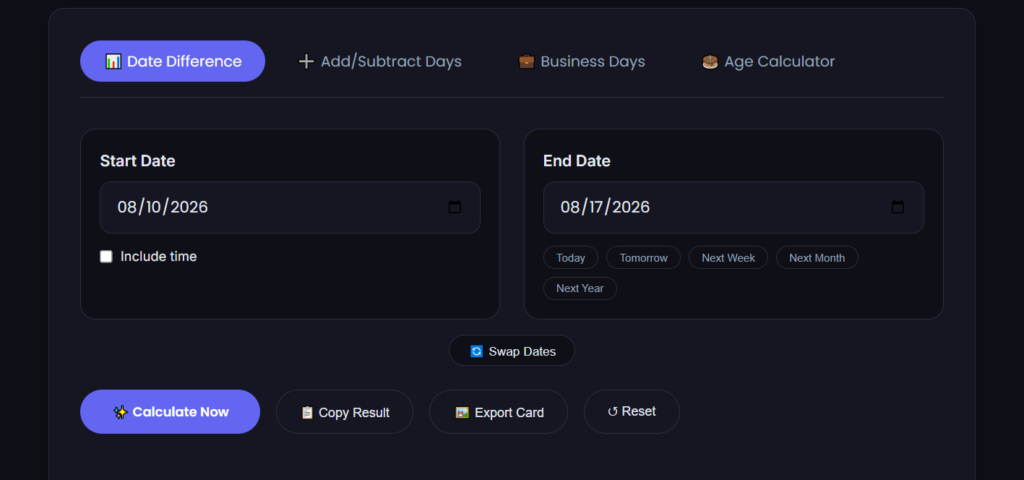
Miss a deadline by one day because you counted calendar days instead of business days, and the consequences can be expensive. Late filing penalties, missed contract options, interest charges on overdue payments — all of these run on schedules where weekends don't count. A free business days calculator takes about five seconds to use and removes the guesswork that causes those mistakes. If you're handling multiple deadlines across different date ranges, bookmarking one becomes a genuine time-saver rather than just another browser tab you forget about.
How an Online Business Days Calculator Handles Edge Cases
Not every date range fits neatly into a Monday-to-Friday pattern. Public holidays that land on a Tuesday or Thursday create irregular gaps. End-of-year periods where Christmas and New Year's both land on weekdays can turn a 5-business-day window into nearly two calendar weeks. A well-designed business days calculator lets you account for these — either by building in common holiday calendars or by making it easy to manually exclude specific dates. When you're dealing with payroll runs, shipping cutoffs, or legal notice periods, those edge cases stop being minor details and start being the thing that determines whether you're on time or late.
Why Saturday and Sunday Are the Default Weekend
The standard Monday-through-Friday workweek isn't universal, but it's the default most business-day calculators use. The two-day weekend emerged from a mix of religious observance and labor movements in the 20th century. If you're curious how that became the global business norm, the Wikipedia entry on the workweek and weekend covers the history and regional variations — including which countries run on a Sunday-through-Thursday or Friday-through-Saturday schedule.
When you need to check if a specific date falls on a weekend, a quick search like "what day of the week is 21 August 2026" gives you an instant answer without counting through a calendar. Useful as a spot check against whatever your calculator shows.
Share this article 👇
0 Comments