

Table of Contents
You see a sign that says "25% off." Your item costs $120. How much do you actually pay? Many people guess wrong.
This is where a discount calculator becomes useful. It tells you exactly what you'll pay and how much you save. No guessing. No math mistakes.
This guide explains how discount calculators work, why they matter, and how to use them effectively. Whether you shop online, manage a business, or just want to understand your savings better, you'll find practical answers here.
What Is a Discount Calculator?
A discount calculator is an online tool that determines the final price of an item after applying discounts. You enter the original price and discount details. The tool calculates your savings and what you pay.
These tools handle different types of discounts: percentage-based, fixed amount, or even multiple discounts stacked together. Some also include tax calculations and reverse discount calculations.
For shoppers, this means knowing exactly what you'll pay before you reach the checkout. For business owners, it means setting accurate sale prices and understanding margins.
The best part? You don't need to remember formulas or do mental math. The tool does everything for you in seconds.
Types of Discount Calculators
Different situations call for different discount calculations. Here are the main types you'll encounter.
Percentage Discount Calculator
This is the most common type. It calculates savings based on a percentage. For example, if an item costs $100 and has a 20% discount, the calculator shows you pay $80 and save $20.
This type works for most retail sales, seasonal promotions, and coupon codes that offer a percentage off.
Fixed Amount Discount Calculator
Sometimes you get a specific dollar amount off, like "$25 off your purchase." A fixed amount discount calculator applies this directly. The math is simple, but the tool makes it instant and error-free.
For example, a $100 item with $25 off becomes $75.
Multiple Discount Calculator
Some sales stack discounts. You might get a store-wide 20% off plus an additional 10% coupon. A multiple discount calculator applies these in sequence.
It calculates the first discount, then applies the second discount to the reduced price. This prevents the common mistake of adding percentages together (which gives the wrong answer).
Example: 20% off $100 = $80. Then 10% off $80 = $72. The final price is $72, not $70.
Reverse Discount Calculator
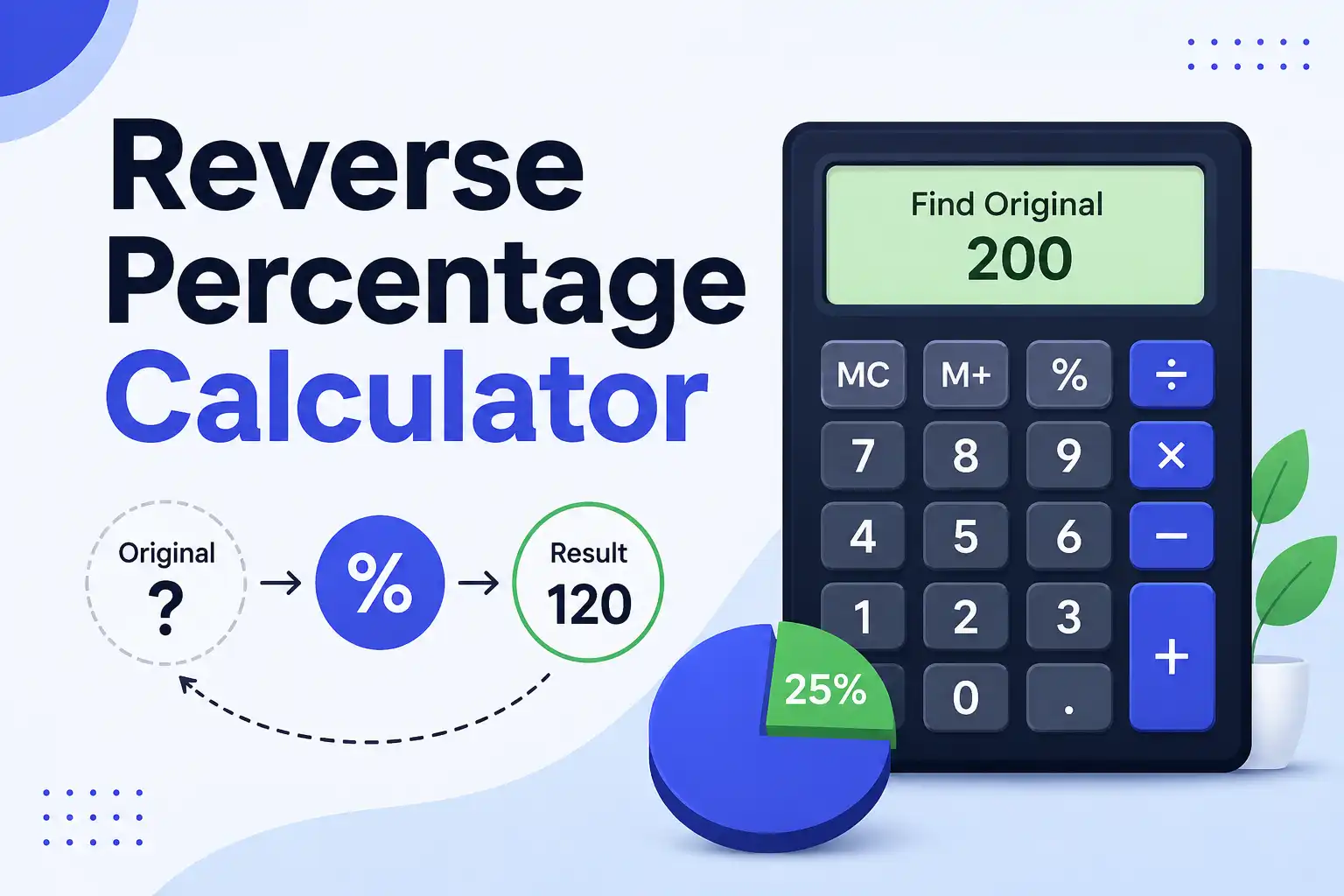
What if you know the final price but want to find the original? A reverse discount calculator does this. Enter the sale price and discount percentage, and it tells you the original price.
Example: You paid $80 for an item that was 20% off. The original price was $100. This is useful for understanding true savings and comparing deals.
Discount Formulas
Understanding the math behind discount calculators helps you verify results and makes you a more confident shopper.
Percentage Discount
Final Price = Original Price × (1 − Discount Percentage ÷ 100)
Example: $100 × (1 − 20 ÷ 100) = $100 × 0.80 = $80
Fixed Discount
Final Price = Original Price − Discount Amount
Example: $100 − $25 = $75
Reverse Discount
Original Price = Final Price ÷ (1 − Discount Percentage ÷ 100)
Example: $80 ÷ (1 − 20 ÷ 100) = $80 ÷ 0.80 = $100
Multiple Discounts
Apply discounts sequentially. First discount reduces the price. Second discount applies to the reduced price.
Example: $100 with 20% off = $80. Then 10% off = $80 × 0.90 = $72.
These formulas are simple but can be tedious to calculate manually, especially for multiple discounts. A discount calculator handles the arithmetic instantly.
Why Use a Discount Calculator?
There are several reasons to use a discount calculator instead of doing the math yourself.
Avoid Overpaying
Retailers sometimes advertise discounts that sound bigger than they are. A calculator helps you verify the actual price. You'll know immediately if a deal is real or not.
Compare Deals Easily
Which is better: 25% off or $30 off a $120 item? A discount calculator shows you the exact final price for both, so you can compare accurately.
Budget Accurately
When you know the final price before you buy, you can plan your spending. No surprises at checkout.
Perfect for Business
Business owners use discount calculators to set sale prices, calculate profit margins, and manage promotions. Getting the math wrong can cost money.
Saves Time
Mental math takes time and can be incorrect. A discount calculator gives you an answer in seconds.
How to Use a Discount Calculator
Using a discount calculator is straightforward. Follow these steps:
- Enter the original price of the item.
- Enter the discount percentage or fixed amount.
- If applicable, enter any additional discounts.
- Add tax if the calculator offers that option.
- Click "Calculate" or wait for the automatic result.
- Review the final price and your total savings.
Most online discount calculators work this way. You can use them on phones, tablets, or computers. They're available 24/7 and free to use.
If you're looking for a discount calculator, MiniToolsPro offers one that handles all the types mentioned above. It's fast, free, and works on any device.
Real-Life Examples
Here are practical examples of discount calculations in everyday shopping.
Example 1: Clothing Sale
A jacket costs $120. The store offers 25% off. Original price: $120 Discount: 25% Final price: $90 Savings: $30
Example 2: Fixed Discount
A pair of shoes costs $200. You have a $50 off coupon. Original price: $200 Discount: $50 Final price: $150 Savings: $50
Example 3: Multiple Discounts
A $150 item has a 20% store discount and an additional 10% coupon. First discount: $150 × 20% = $30 off → $120 Second discount: $120 × 10% = $12 off → $108 Final price: $108 Total savings: $42
Example 4: BOGO (Buy One, Get One)
Two items cost $80 each. BOGO 50% off means you get one at full price and the second at half price. First item: $80 Second item: $80 × 50% = $40 Total: $120 Regular price for two: $160 Savings: $40
Example 5: Stacked Percentage Discounts
A $200 item has 40% off plus an extra 15% off. First discount: $200 × 40% = $80 off → $120 Second discount: $120 × 15% = $18 off → $102 Final price: $102 Total savings: $98
These examples show how discounts apply differently in various situations. Using a discount calculator ensures you get the right answer every time.
Business Use Cases
Discount calculators are not just for shoppers. Businesses use them too.
Retail Pricing
Retailers use discount calculators to determine sale prices. They input the original price and desired discount to see the final price and margin. This helps them run promotions without losing money.
eCommerce Promotions
Online stores run complex promotions: coupon codes, flash sales, and seasonal discounts. A discount calculator helps them check the math and ensure promotions are profitable.
Financial Forecasting
Financial professionals use discount calculations when forecasting revenue. Understanding how discounts affect income helps with planning and budgeting.
Wholesale Pricing
Wholesale buyers often get volume discounts. A discount calculator helps calculate bulk order prices quickly.
Promotion Planning
When planning a sale, businesses need to know the final price after discounts. They use calculators to simulate different discount scenarios and choose the best one.
Discount Calculator vs Manual Calculation
Here's a comparison of using a discount calculator versus doing the math manually.
| Factor | Manual Calculation | Discount Calculator |
|---|---|---|
| Speed | Slower, especially for complex discounts | Instant |
| Accuracy | Prone to errors, especially with multiple discounts | 100% accurate |
| Multiple discounts | Easy to make mistakes | Handles automatically |
| Tax inclusion | Requires additional calculation | Optional tax feature |
| Mobile access | Requires doing math without tools | Works on any phone |
| Learning curve | Need to know formulas | No math knowledge required |
Manual calculation works for simple discounts. But for multiple discounts, comparisons, or tax calculations, a discount calculator is more reliable and faster.
Smart Shopping Tips
Use these tips to make the most of discounts and save money.
Compare Unit Prices
When buying bulk items, calculate the price per unit. A discount on a larger size might not be as good as it seems. Compare the actual price per item or per unit of weight.
Stack Discounts Strategically
Use store sales, coupons, and cashback offers together. Stacking discounts can create significant savings. But be careful—some stores don't allow stacking. Check the terms.
Calculate Before You Buy
Use a discount calculator before you reach the checkout. You'll know the final price and avoid impulse buying. If the deal isn't good enough, you can walk away.
Look for Cashback Opportunities
Cashback apps and credit card rewards add extra savings. Combine them with discounts for even more value. A discount calculator shows you the sale price; cashback adds another layer of savings.
Avoid Common Shopping Mistakes
Watch out for hidden shipping costs, expired coupon codes, and discounts that don't apply to all items. Read the fine print. Calculate the final price including shipping and taxes before deciding.
Advanced Strategies
For serious savers, these strategies go beyond basic discount calculations.
Combine Store Sales, Coupons, and Cashback
Start with the store's sale price. Apply coupon codes. Add cashback rewards. Each step reduces the final price. A discount calculator helps you see the combined effect.
Shop During Peak Sales Events
Seasonal sales like Black Friday, Cyber Monday, and end-of-season clearances offer the biggest discounts. Plan your purchases around these events.
Buy During Product Launches
New products often have introductory discounts. Old products get discounted when newer models arrive. Timing your purchases strategically can save money.
Compare Prices Across Stores
Use a discount calculator to compare final prices across different retailers. Include shipping and taxes for each option. The cheapest advertised price might not be the cheapest final price.
Frequently Asked Questions
What is a discount calculator?
A discount calculator is an online tool that shows you the final price after applying discounts. It calculates savings instantly and works for percentages, fixed amounts, and multiple discounts.
Are discount calculators accurate?
Yes, they are 100% accurate. The calculations follow the same formulas you would use manually, but without the risk of human error.
Can a discount calculator handle multiple discounts?
Yes. Many discount calculators process stacked discounts. They apply discounts in sequence to give you the correct final price.
Does a discount calculator include tax?
Some calculators include optional tax calculations. You can enter the tax rate to see the final total including tax. Others focus only on the discount and exclude tax.
Is it free to use a discount calculator?
Most online discount calculators are free. You can use them unlimited times without any cost. Some advanced tools may offer premium features, but basic discount calculations are usually free.
How do I calculate a 25% discount?
Multiply the original price by 0.75. For a $120 item, 25% off means you pay $90. You can also enter the original price and 25% into a discount calculator for an instant answer.
What is a reverse discount calculator?
A reverse discount calculator finds the original price when you know the sale price and discount percentage. It's useful for understanding how much you actually saved or for comparing deals.
Can I use a discount calculator on my phone?
Yes. Most online discount calculators work in mobile browsers. They're responsive and work on any device. Some apps also offer this feature.
How do multiple discounts work?
Multiple discounts apply sequentially. The first discount reduces the price. The second discount applies to the reduced price. This is different from adding percentages together, which is incorrect.
What is the formula for percentage discount?
Final Price = Original Price × (1 − Discount Percentage ÷ 100). Example: $100 × 0.80 = $80 when there's a 20% discount.
What is BOGO discount?
BOGO stands for Buy One Get One. Common variations include BOGO 50% (second item half price) or BOGO free (second item free). The discount applies to the second item.
Can I use a discount calculator for business?
Yes. Businesses use discount calculators for pricing, promotions, and profit margin analysis. They're useful for ecommerce stores, retailers, and financial planning.
What should I watch out for with discounts?
Watch for hidden shipping costs, expiration dates, and restrictions. Not all items qualify for all discounts. Always read the terms and calculate the final total including all fees.
How do I compare percentage and fixed discounts?
Enter both scenarios into a discount calculator. Compare the final prices. This is better than guessing which discount is larger, because the best option depends on the original price.
Does a discount calculator work for sale prices?
Yes. Enter the original price and discount percentage or amount. The calculator shows the sale price instantly. You can also use it to check if a listed sale price matches the advertised discount.
Key Takeaways
- A discount calculator tells you exactly what you'll pay after discounts and shows your total savings.
- It handles percentage discounts, fixed discounts, multiple discounts, and reverse calculations.
- Using a calculator is faster and more accurate than manual math, especially for complex deals.
- Smart shoppers use calculators to compare deals, stack discounts, and avoid hidden fees.
- Businesses use discount calculators for pricing, promotions, and margin analysis.
- Always check the final price including taxes and shipping before making a purchase.
Discount calculations are a practical example of how percentages are used in everyday situations. If you want to understand the wider range of percentage calculations beyond discounts, see our Percentage Calculator: How to Calculate Percentages Easily. The guide explains the fundamental formulas used for percentages, increases, decreases, comparisons, and other common problems.
Summary
Discount calculators help you shop smarter and manage business pricing better. You get accurate results instantly without doing complex math. This saves time and prevents expensive mistakes.
Whether you're checking a 25% off sale, comparing two deals, or calculating stacked discounts, a discount calculator gives you the answer in seconds. It's a simple tool that makes a real difference.
Start using a discount calculator before your next purchase. Know exactly what you'll pay and how much you save. It's one of the easiest ways to become a smarter shopper.
If you need a reliable tool, the MiniToolsPro Discount Calculator handles all the types and scenarios described in this guide. It's free, fast, and works on any device.

References
For further reading on consumer finance, discount strategies, and financial literacy, refer to these authoritative sources:
- Consumer Financial Protection Bureau – Shopping tips and consumer education – https://www.consumerfinance.gov/
- Federal Trade Commission – Consumer advice on saving money – https://www.ftc.gov/consumer-protection
- Investopedia – Discount calculations and formulas – https://www.investopedia.com/
- National Retail Federation – Sales and promotions data – https://nrf.com/
Share this article 👇
0 Comments