
Table of Contents
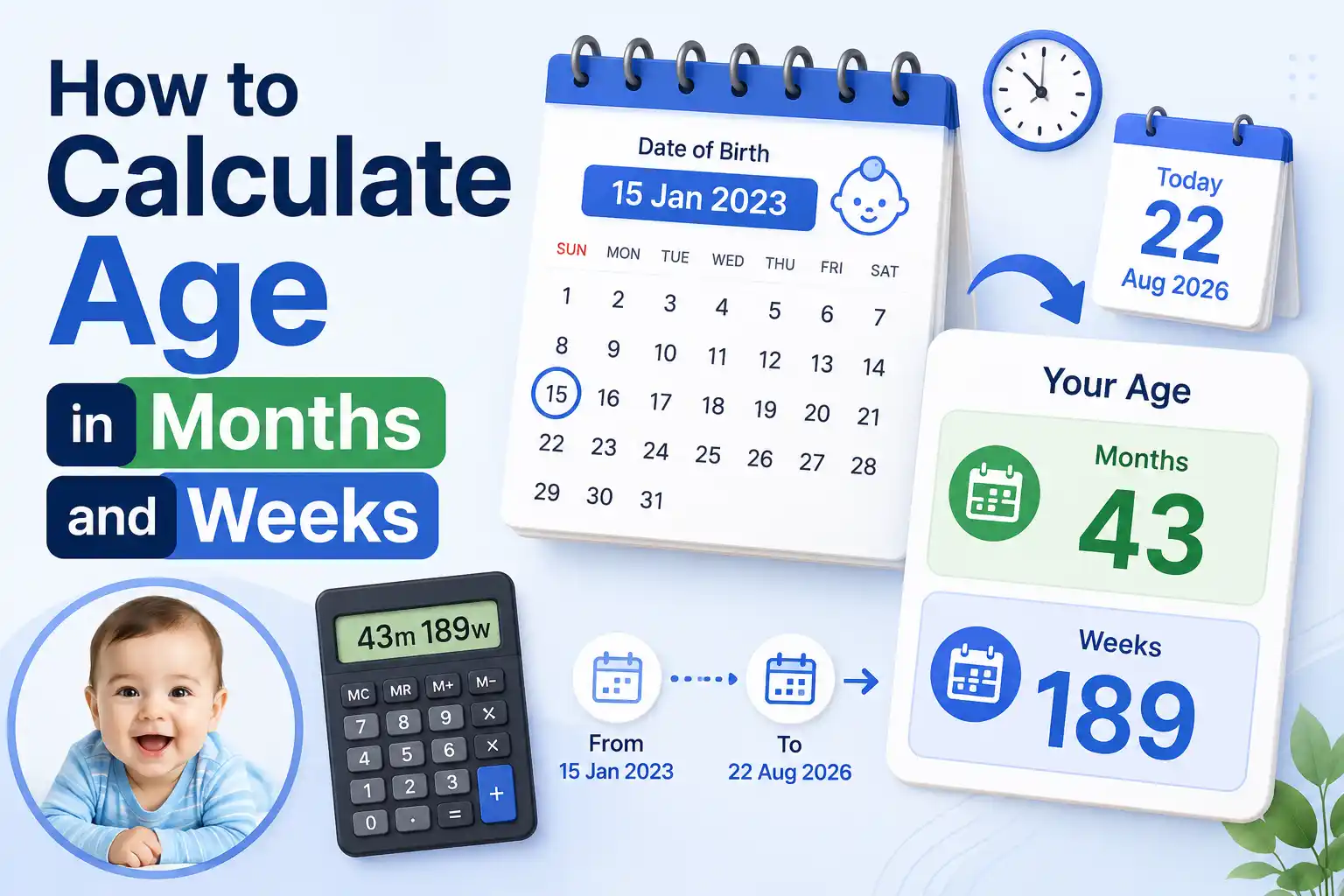
To calculate age in months and weeks, start with the total days between two dates, then divide by 7 for weeks or by 30.44 for months. For example, if someone is 1,095 days old, that's approximately 156 weeks or 36 months. But the exact calculation depends on whether you're counting calendar months (with varying lengths) or using a standardized month length. Here's exactly how to do both.
Why Calculate Age in Months and Weeks?
Years are convenient for adults, but months and weeks matter a lot for babies, young children, and developmental milestones. Pediatricians track growth in months. Parents count weeks during pregnancy. Employers calculate maternity or paternity leave in weeks. And sometimes, you just want a more precise answer than "2 years old" when someone is 26 months.
There are two common ways to calculate age in months and weeks. One uses exact calendar dates. The other uses standardized averages. The right method depends on the context.
Method 1: Calculating Age Using Exact Calendar Dates
This is the most accurate method. It uses the actual calendar to determine how many full months and weeks have passed between two specific dates.
Step-by-Step Process
- Count the full years – Subtract the birth year from the current year. If the birthday hasn't occurred yet this year, subtract one.
- Count the remaining months – From the last birthday to today, count the full calendar months.
- Count the remaining days – From the last completed month to today, count the days.
- Convert total days to weeks – Divide the total days by 7 to get weeks and remaining days.
Worked Example
Let's calculate the age of a child born on March 15, 2024, with today's date being August 22, 2026.
- From March 15, 2024 to March 15, 2026 = 2 full years
- From March 15, 2026 to August 15, 2026 = 5 full months (March→April, April→May, May→June, June→July, July→August)
- From August 15, 2026 to August 22, 2026 = 7 days
So this child is 2 years, 5 months, and 7 days old.
To express this in months only: 29 months and 7 days (2 years × 12 months + 5 months).
To express this in weeks: 127 weeks and 0 days (2 years × 365 days + 5 months × 30.44 days + 7 days, divided by 7).
Let's do the exact week count properly. The total days from March 15, 2024 to August 22, 2026 is 890 days (including leap year 2024).
- 890 ÷ 7 = 127 weeks with 1 day remaining
- So the child is 127 weeks and 1 day old
Method 2: Using Standardized Average Month Length
If you don't need exact calendar precision, you can use the average month length of 30.44 days (365.25 days per year ÷ 12 months). This method is faster and works well for estimates, but it's not as precise as the exact calendar method.
Formula for Months
Total Months = Total Days ÷ 30.44
For example, if someone is 800 days old:
800 ÷ 30.44 = 26.28 months
That's approximately 26 months and 8–9 days.
Formula for Weeks
Total Weeks = Total Days ÷ 7
Same 800-day example:
800 ÷ 7 = 114.29 weeks
That's 114 weeks and 2 days.
When to Use the Standardized Method
- Quick mental estimates
- General conversations where precision isn't critical
- Initial planning or rough calculations
- When you only have approximate dates
Exact Calendar Months vs Standardized Months
These two methods can produce different results. Here's why.
| Aspect | Exact Calendar Method | Standardized Method |
|---|---|---|
| Month lengths | Varies (28–31 days) | Fixed (30.44 days) |
| Leap years | Accounted for | Approximated |
| Precision | Exact | Approximate |
| Best for | Official records, medical use | Quick estimates, planning |
For a child born on March 15, 2024, the exact calendar method gave us 29 months and 7 days. The standardized method (890 ÷ 30.44) gives 29.24 months — close but slightly different.
Common Mistakes When Calculating Age in Months and Weeks
- Using 30 days for every month – This underestimates actual age for longer periods. Use 30.44 for standardized calculations or count calendar months exactly.
- Forgetting leap years – February 29 adds an extra day. If your date range includes a leap day, your day count will be off by one.
- Counting inclusively vs exclusively – For example, from January 1 to January 2 can be counted as 1 day or 2 days depending on whether you include both endpoints. In age calculation, the standard is exclusive of the start date and inclusive of the end date.
- Confusing "months old" with "months since birth" – A child born on January 31 is 1 month old on February 28 (not March 1) in some counting systems. The exact calendar method handles this correctly.
Practical Scenarios Where Month/Week Age Matters
Baby Development Milestones
Pediatricians track developmental milestones at 2 months, 4 months, 6 months, 9 months, 12 months, and so on. A baby who is 14 weeks old is developmentally different from one who is 16 weeks old, even though both are "3 months" by rough count.
Pregnancy Tracking
Pregnancy is universally measured in weeks, not months. A full-term pregnancy is 40 weeks. Knowing how to calculate weeks from a conception date or due date is essential for expectant parents and healthcare providers.
Employment and Benefits
Some employers offer parental leave calculated in weeks. Others use months for tenure-based benefits. Knowing how to calculate both accurately ensures you get the correct entitlement.
School Enrollment
Some school systems have age cutoffs based on months and weeks. A child who is 4 years and 11 months old may be eligible for kindergarten in one district but not another, depending on the cutoff date.
Manual Calculation vs Online Tools
Manual calculation is valuable for understanding the process. It helps you verify results and makes you less reliant on tools when you need a quick answer. But manual date arithmetic gets complicated quickly, especially when you're dealing with different month lengths, leap years, and multiple date ranges.
That's where an online age calculator becomes genuinely useful. It handles all the calendar logic instantly — months with 28, 29, 30, or 31 days, leap years, and precise day counting. If you need to calculate age in months and weeks without the mental math, the MiniToolsPro Age Calculator gives you the exact result in years, months, weeks, and days, all at once.
Frequently Asked Questions
How do you calculate age in months?
Subtract the birth month from the current month. If the current month is earlier than the birth month, borrow 12 months from the years. Then subtract days if needed. For example, August (8) − March (3) = 5 months. For a more precise result, count the exact number of days and divide by 30.44.
How do you calculate age in weeks?
Calculate the total number of days between two dates, then divide by 7. The remainder is the number of extra days. For example, 890 days ÷ 7 = 127 weeks with 1 day remaining.
How many weeks are in a month?
There are approximately 4.345 weeks in a month (30.44 days ÷ 7). Some months have exactly 4 weeks plus a few days, while February has about 4 weeks in common years and 4.14 weeks in leap years.
Why do different age calculators give different results?
Some calculators use exact calendar months, while others use average month lengths. Some include or exclude the start date differently. Always check which method the calculator uses and choose the one appropriate for your use case.
Is 12 weeks the same as 3 months?
Not exactly. Three calendar months can range from 12 weeks (February to April in a common year) to 13 weeks and 1 day (December to March). For practical purposes, 12 weeks is often considered "about 3 months," but it's not mathematically identical.
For the quickest and most accurate way to calculate age in months, weeks, and days — without the manual date math — use the MiniToolsPro Age Calculator. It's free, works instantly, and handles all the calendar complexity for you.
Share this article 👇
0 Comments