
Table of Contents
What Does Age Mean?
Age represents the length of time a person has lived. When someone asks you to calculate age from date of birth, they want the elapsed time between two calendar points. This is known as chronological age. It is the legal and social standard used on every official document you will ever encounter. Chronological age never changes based on how you feel. It is a fixed, verifiable number.
There is also biological age. That measures how old your body appears based on health markers. But when a job application requests your birthday age, it means chronological age. When a doctor records your history, they mean chronological age. This article focuses entirely on the age calculation formula used to find chronological age. You will learn the logic behind the numbers. You will understand why the formula works the way it does. By the end, manual age calculation will feel as natural as basic arithmetic.
Why Age Calculation Matters
Accurate age calculation affects real decisions. A school district determines kindergarten eligibility based on a cut-off date. The age by date of birth must be exact. A single day can change a child's enrollment year. HR departments verify retirement eligibility using precise age difference calculations. An error of even one month can delay pension benefits. Hospitals record exact chronological age for medication dosing. Pediatric prescriptions often depend on age in months, not just years.
Government forms for passports, identity cards, and visas demand accuracy. A mismatch between your stated age and your documented birthday age can cause application rejection. Immigration paperwork frequently asks for age in years months and days for minors. Parents tracking developmental milestones monitor age in weeks. Teachers calculate student age for grade placement. In all these cases, the underlying age calculation formula remains identical. Only the output format changes.
Want to calculate your exact age instantly? Use our Age Calculator.
How to Calculate Age Manually
Manual age calculation follows a logical three-step comparison. You start with the current date. You write the birth date directly beneath it. Align the years, months, and days in separate columns. The process begins with the years. Subtract the birth year from the current year. This gives you a starting number. But you cannot stop there. You must verify whether the birthday has occurred yet in the current year.
Look at the months next. If the current month is less than the birth month, you must subtract one from the year total. The birthday has not arrived. If the current month equals the birth month, you move to the day check. Compare the current day to the birth day. If the current day is less than the birth day, you subtract one from the year total. This three-step check is the heart of every age calculation. Ignoring it is the most common source of error.
After adjusting the years, you calculate the remaining months and days. Borrowing rules apply here. If the current month is smaller than the birth month, you add twelve to the current month before subtracting. The same logic applies to days. If the current day is smaller than the birth day, you borrow one month and add the days of the previous month. This systematic approach produces an exact age calculation every time.
The Age Calculation Formula
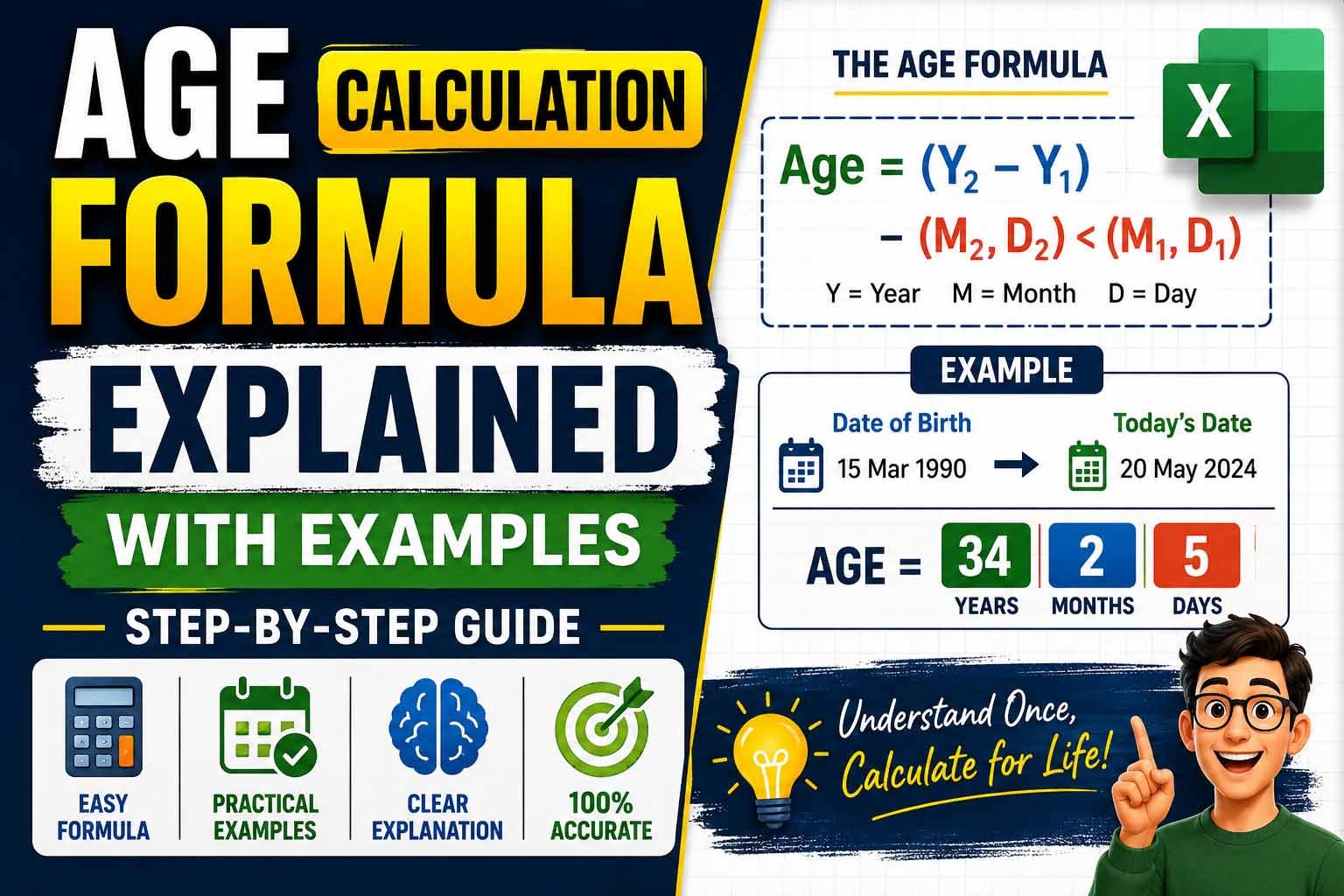
We can express the manual method as a clear, repeatable age calculation formula. Let us define the variables. Let CY be the current year. Let CM be the current month. Let CD be the current day. Let BY be the birth year. Let BM be the birth month. Let BD be the birth day. The first step is always the year subtraction. Age in years equals CY minus BY. But this is a provisional result. You must apply two conditional checks.
The first condition examines the month. If CM is less than BM, then Age equals Age minus one. The birthday has not yet occurred this year.
The second condition handles the case where CM equals BM. In that situation, you check the day. If CD is less than BD, then Age equals Age minus one. These two conditions form the complete age formula for completed years.
For the remaining months, you use a different calculation. If CM is greater than or equal to BM, then Months equals CM minus BM. If CM is less than BM, then Months equals 12 plus CM minus BM. The day calculation follows similar borrowing logic. This is the universal age calculation formula taught in mathematics and used in software everywhere.
Step-by-Step Examples
Let us apply the age calculation formula to a concrete example. Today is November 15, 2023. Maria was born on August 22, 1990. Start with the year. 2023 minus 1990 equals 33. Now check the month. November is month 11. August is month 8. Since 11 is greater than 8, the birthday has passed. The year remains 33. Calculate months. 11 minus 8 equals 3 months. Now check days. 15 minus 22. The current day is smaller. We borrow one month. The months become 2. October has 31 days. 31 plus 15 equals 46. 46 minus 22 equals 24 days. Maria is 33 years, 2 months, and 24 days old.
For a leap year birthday example, consider someone born on February 29, 2000. Today is March 1, 2025. Year subtraction gives 25. March is month 3. February is month 2. 3 is greater than 2. No year adjustment. Months equal 3 minus 2, which is 1 month. Days equal 1 minus 29. Borrow one month. Months become 0. January has 31 days. 31 plus 1 equals 32. 32 minus 29 equals 3 days. The person is 25 years, 0 months, and 3 days old. This shows how the age calculation formula handles February 29 seamlessly without any special rules.
How Leap Years Affect Age
Leap years add one extra day to the calendar every four years. This keeps our calendar synchronized with Earth's orbit around the sun. The rule is straightforward. A year is a leap year if it is divisible by 4. However, century years like 1900 are not leap years unless divisible by 400. The year 2000 was a leap year. The year 1900 was not. This exception affects long-range age calculation.
When you calculate age in days, leap years matter. Each leap year in the span adds one extra day. Ignoring leap years in a 40-year span creates an error of approximately ten days. For legal documents, this matters. For casual use, it might not. February 29 birthdays present a special case. People born on this day age legally on March 1 in non-leap years. Some countries recognize February 28. The age calculation formula handles this naturally because the borrowing logic accounts for February's actual length in any given year. An online age calculator automates all of this. When you perform a manual age calculation across many years, keep a leap year reference handy.
Manual vs Online Age Calculation
Both manual and digital methods have their place. Understanding the age calculation formula gives you independence. You can verify results without trusting a black box. Manual calculation builds mathematical confidence. It requires no internet connection. It works anywhere, anytime, with just a pen and paper. However, it is slow and prone to simple arithmetic errors. Borrowing days incorrectly or forgetting a leap year can throw off your result.
| Feature | Manual Calculation | Online Age Calculator |
|---|---|---|
| Speed | Slow and methodical | Instant |
| Accuracy | Subject to human error | Mathematically precise |
| Leap Year Handling | Requires manual checking | Automatic |
| Complex Outputs | Difficult for weeks and days | Instant breakdown |
| Availability | No tools needed | Requires internet |
| Learning Value | High understanding | Convenience focus |
An online calculator shines when you need speed. It handles leap years perfectly. It computes age in weeks or total days instantly. For professional settings where you process multiple records, digital tools save hours. The best approach is to know the formula and use the calculator as a verification tool.
Common Mistakes
Even careful people make predictable errors with the age calculation formula. The most frequent mistake is stopping after the year subtraction. Users subtract the birth year and assume the result is correct. If the birthday has not occurred yet, the age is off by one full year. This error appears on countless unofficial documents and casual conversations. Another common mistake involves the borrowing process for days. Users subtract a larger birth day from a smaller current day without adjusting the month. They get a negative number and become confused.
Forgetting leap years is another source of error. When calculating age in days, each forgotten February 29 adds a one-day drift. Miscounting the number of days in a month during the borrowing step also causes inaccuracies. People often remember the rhyme incorrectly. July has 31 days, not 30. Confusing chronological age with biological age is a conceptual mistake. One is a calendar fact. The other is a health estimate. Using an incorrect current date, perhaps from a time zone difference, also affects accuracy. Official documents rely on the local date of signing.
Related Age Calculation Resources
The age calculation formula is only one part of understanding your exact age. For a step-by-step practical method, see How to Calculate Age, or explore Age Calculator Explained to learn how online calculators handle dates and calendar differences. For the complete topic overview, visit our Age Calculator Guide.
Frequently Asked Questions
What is the age calculation formula?
The age calculation formula subtracts the birth year from the current year. Then it checks if the birth month and day have passed. If not, it subtracts one year. Months and days are calculated using borrowing logic similar to standard subtraction.
How do I calculate my age manually?
Write the current date and your birth date. Subtract years first. If today's month is before your birth month, subtract one year. If months are equal but today's day is before your birth day, also subtract one year. Calculate remaining months and days using borrowing.
What is chronological age?
Chronological age is the exact calendar time elapsed from your date of birth to a given date. It is measured in years, months, and days. It does not reflect physical health or development.
How do leap years affect age calculation?
Leap years add one day to the calendar. If your birth date falls on February 29, you age on March 1 in non-leap years. For calculating total days lived, each leap year in the span adds one extra day.
Can I calculate age without an online calculator?
Absolutely. The manual age calculation formula requires only basic subtraction and knowledge of month lengths. It is reliable and works anywhere without technology.
Why is my calculated age different from what I expected?
You probably ignored the birthday check. If your birthday has not occurred yet this year, subtracting only the birth year gives a number one year too high. Verify the month and day comparison.
How do I calculate age in months?
Multiply the completed years by twelve. Then add the remaining months since the last birthday. For a person 25 years and 7 months old, multiply 25 by 12 to get 300, then add 7 for 307 months total.
How do I calculate age in days?
Count the days in each full year between the dates. Add one extra day for each leap year in the range. Then add the days from completed months and the remaining days. This is tedious manually.
How do I calculate age between two dates?
Use the same age calculation formula. Replace the current date with your chosen end date. Apply the year, month, and day comparisons identically. This works for historical or future age queries.
Can age calculators make mistakes?
A properly coded calculator does not make arithmetic errors. However, if you enter the wrong date or the tool has a software bug, results can be wrong. Always sanity-check outputs against the manual formula.
Which age is used on official documents?
Official documents always use chronological age. This is the completed years and sometimes months and days from your date of birth. Biological age has no legal standing.
What is the difference between chronological age and biological age?
Chronological age counts calendar time since birth. Biological age estimates how old your body seems based on health markers. One is a fact. The other is an estimate.
Conclusion
You now understand the complete age calculation formula. You know why the birthday check matters. You can handle leap year edge cases. You can compute age in years, months, and days without any tools. This knowledge empowers you to verify official records, fill forms accurately, and help others who struggle with the concept. The formula is universal. It works for any date range, past or future.
Manual calculation builds deep understanding. But when you need a verified result in seconds, a digital tool saves time and eliminates doubt. You do not have to choose one or the other. Use both.
Try a Free Online Age Calculator
If you'd rather skip manual calculations, you can use our free Age Calculator to instantly calculate your exact age in years, months, weeks, and days. The tool applies the exact formula you have learned and handles every complexity for you.
Use the Free Age Calculator Now

Share this article 👇

0 Comments