
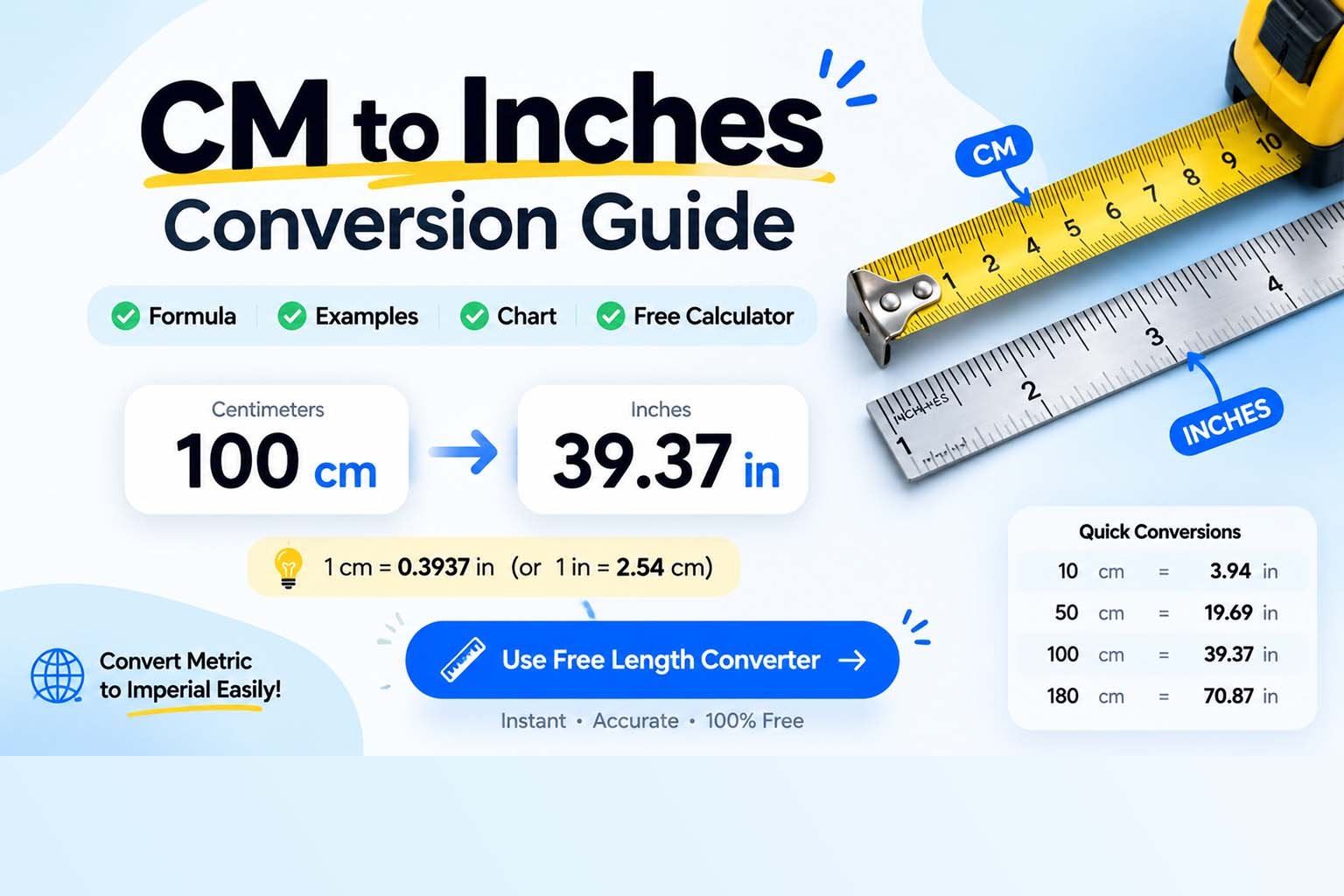
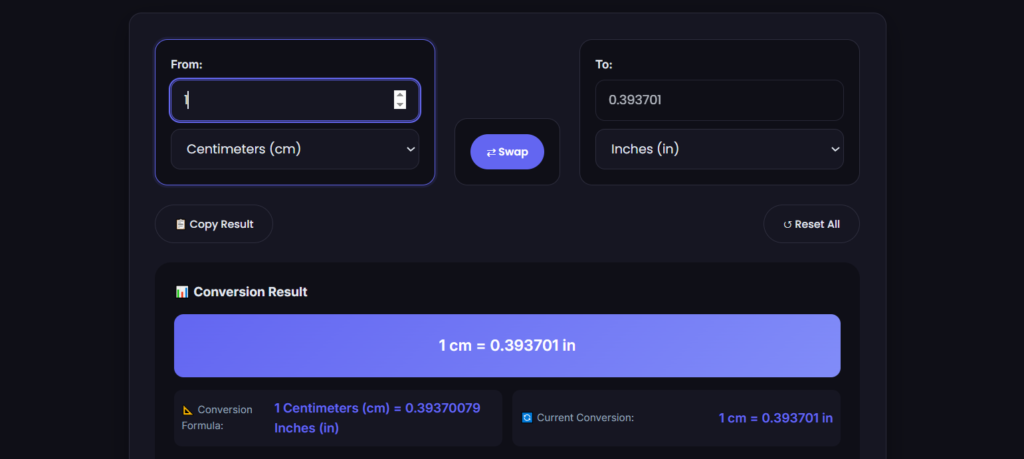
Need a quick conversion? If you're in a hurry, use our free Length Converter for instant, accurate results. Otherwise, read on to master the cm to inches conversion manually and understand the math behind it.
Table of Contents
Introduction
Converting centimeters (cm) to inches (in) is one of the most common measurement tasks in daily life. Whether you're reading a product description, following a DIY tutorial, or helping a child with homework, you will frequently encounter measurements in both metric and imperial units.
This guide provides a complete, step-by-step explanation of how to convert cm to inches, including the exact formula, worked examples, conversion tables, and answers to the most frequently asked questions. By the end, you will understand the process thoroughly and be able to perform conversions with confidence.
What is a Centimeter?
A centimeter (symbol: cm) is a unit of length in the metric system. It is defined as one-hundredth of a meter. There are exactly 100 centimeters in one meter.
The metric system is based on powers of 10, making it easy to scale measurements up or down. For example:
- 1 meter = 100 cm
- 1 cm = 10 millimeters (mm)
- 1 km = 100,000 cm
Centimeters are used worldwide for everyday measurements, including height, width, length of objects, clothing sizes, and furniture dimensions. Nearly every country except the United States, Liberia, and Myanmar uses the metric system as its primary standard.
Did You Know? The word "centimeter" combines the Latin centum (hundred) and the Greek metron (measure). It literally means "one-hundredth of a meter."
What is an Inch?
An inch (symbol: in or ") is a unit of length in the imperial system and the United States customary system. It is defined by international agreement as exactly 2.54 centimeters.
Historically, the inch was based on the width of a human thumb. The word comes from the Latin uncia, which means "one-twelfth" — because one foot equals 12 inches.
Inches are commonly used in the United States, Canada (partially), and the United Kingdom (for certain everyday measurements). Typical applications include:
- Screen sizes (TVs, monitors, smartphones)
- Construction materials (lumber, pipes)
- Personal height (in the U.S.)
- Automotive and mechanical parts
Pro Tip: On a standard ruler, each inch is divided into 16 equal parts. Each small tick mark represents 1/16 of an inch.
Why People Convert CM to Inches
Conversion between these two units is necessary for several practical reasons:
- International commerce: Products from different countries use different measurement systems.
- Travel and relocation: Moving between metric and imperial regions requires daily conversions.
- Construction and engineering: Blueprints often mix both unit systems.
- Education: Math and science curricula include unit conversion exercises.
- DIY and home improvement: Plans and materials may use different units.
Knowing how to convert cm to inches is not just a math skill — it is a practical life skill that saves time and prevents errors.
CM to Inches Formula
The conversion formula is straightforward and fixed by an international standard.
The Formula
Inches = Centimeters ÷ 2.54
This means that 1 centimeter equals exactly 0.393701 inches. For rough mental calculations, you can round to 0.39 inches.
Step-by-Step Examples
Example 1: Convert 10 cm to inches
- Take the number of centimeters: 10
- Divide by 2.54: 10 ÷ 2.54 = 3.9370
- Round to two decimal places: 3.94 inches
Example 2: Convert 50 cm to inches
- 50 ÷ 2.54 = 19.6850
- Rounded: 19.69 inches
Example 3: Convert 200 cm to inches
- 200 ÷ 2.54 = 78.7402
- Rounded: 78.74 inches
Real-World Applications
- A standard sheet of A4 paper is 29.7 cm wide → 29.7 ÷ 2.54 = 11.69 inches
- A basketball hoop is 305 cm high → 305 ÷ 2.54 = 120.08 inches (about 10 feet)
- A typical laptop screen is 33 cm diagonal → 33 ÷ 2.54 = 12.99 inches (a 13-inch screen)
Did You Know? The exact value of 2.54 is defined by international treaty. Therefore, 1 inch is always 2.54 cm, regardless of the country or context.
How to Convert CM to Inches (Step-by-Step Guide)
If you do not have a calculator, follow this simple manual method:
Step 1: Identify Your Measurement
Write down the number of centimeters you want to convert.
Step 2: Divide by 2.54
Use a calculator or do long division: divide the centimeter value by 2.54.
Step 3: Round the Result
- For general use: round to 2 decimal places.
- For construction: round to the nearest 1/16 of an inch.
- For schoolwork: keep the exact decimal.
Quick Mental Shortcut (Approximate)
For rough estimates, divide by 2.5 instead of 2.54. This is easier to do in your head and gives a close approximation. For example:
- 20 cm ÷ 2.5 = 8 inches (actual: 7.87 inches)
- 30 cm ÷ 2.5 = 12 inches (actual: 11.81 inches)
Worked Example (Full Walkthrough)
Convert 45 cm to inches:
- Write down: 45 cm
- Divide: 45 ÷ 2.54 = 17.7165
- Round to 2 decimals: 17.72 inches
Common Mistake: Do not multiply by 2.54 when converting from cm to inches. Multiplying is used for the reverse conversion (inches to cm). Always divide by 2.54 when going from cm to inches.
Common CM to Inches Conversion Table
Use this reference table for frequently needed conversions. Values are rounded to two decimal places for readability.
| Centimeters (cm) | Inches (in) |
|---|---|
| 1 cm | 0.39 in |
| 5 cm | 1.97 in |
| 10 cm | 3.94 in |
| 15 cm | 5.91 in |
| 20 cm | 7.87 in |
| 25 cm | 9.84 in |
| 30 cm | 11.81 in |
| 40 cm | 15.75 in |
| 50 cm | 19.69 in |
| 60 cm | 23.62 in |
| 75 cm | 29.53 in |
| 100 cm | 39.37 in |
| 120 cm | 47.24 in |
| 150 cm | 59.06 in |
| 180 cm | 70.87 in |
| 200 cm | 78.74 in |
Pro Tip: Bookmark this table or save a screenshot for quick reference without needing a calculator.
CM to inches and Feet
Many people need to convert centimeters to feet and inches, especially for measuring height. This requires a two-step process.
The Two-Step Formula
- Convert cm to total inches: Total inches = cm ÷ 2.54
- Convert total inches to feet and remainder inches: Feet = floor(total inches ÷ 12), and Remaining inches = total inches − (feet × 12)
Worked Height Examples
Example 1: 160 cm to feet and inches
- Total inches: 160 ÷ 2.54 = 62.9921
- Feet: 62.9921 ÷ 12 = 5.2493 → 5 feet
- Remaining inches: 0.2493 × 12 = 2.99 inches (≈ 3 inches)
- Result: 5 feet 3 inches
Example 2: 170 cm to feet and inches
- Total inches: 170 ÷ 2.54 = 66.9291
- Feet: 66.9291 ÷ 12 = 5.5774 → 5 feet
- Remaining inches: 0.5774 × 12 = 6.93 inches (≈ 6.9 inches)
- Result: 5 feet 7 inches
Example 3: 180 cm to feet and inches
- Total inches: 180 ÷ 2.54 = 70.8661
- Feet: 70.8661 ÷ 12 = 5.9055 → 5 feet
- Remaining inches: 0.9055 × 12 = 10.87 inches (≈ 10.9 inches)
- Result: 5 feet 11 inches
Example 4: 190 cm to feet and inches
- Total inches: 190 ÷ 2.54 = 74.8031
- Feet: 74.8031 ÷ 12 = 6.2336 → 6 feet
- Remaining inches: 0.2336 × 12 = 2.80 inches (≈ 2.8 inches)
- Result: 6 feet 3 inches
Quick Height Reference Table
| Height (cm) | Feet & Inches |
|---|---|
| 150 cm | 4' 11" |
| 155 cm | 5' 1" |
| 160 cm | 5' 3" |
| 165 cm | 5' 5" |
| 170 cm | 5' 7" |
| 175 cm | 5' 9" |
| 180 cm | 5' 11" |
| 185 cm | 6' 1" |
| 190 cm | 6' 3" |
| 195 cm | 6' 5" |
| 200 cm | 6' 7" |
Metric vs Imperial Measurements
Understanding the two systems provides helpful context for why conversions are needed.
The Metric System
- Based on: Decimals (powers of 10)
- Primary units: Meter (length), Gram (weight), Liter (volume)
- Used by: Approximately 95% of the world's population
- Countries: All of Europe, Asia, Africa, South America, Australia, and Canada (officially)
- Advantages: Easy scaling by moving decimal points
The Imperial System (U.S. Customary)
- Based on: Historical, non-decimal units (inches, feet, yards, miles)
- Primary units: Inch, foot, yard, mile
- Used by: United States, Liberia, Myanmar (and partially in the UK)
- Advantages: Familiar to American users, widely used in construction and manufacturing
The metric system was developed during the French Revolution for scientific precision and uniformity. The imperial system evolved over centuries from human body measurements. The United States remains the only major industrialized nation that has not fully adopted the metric system, making cm to inches conversion a practical necessity for international communication.
Common Uses for CM to Inches Conversion
Here are the most frequent real-world applications:
- Construction and Woodworking: Lumber dimensions are in inches, but plans may use cm.
- Furniture Shopping: Convert sofa, table, or shelf dimensions to ensure they fit your space.
- TV and Monitor Sizes: Screen sizes are in inches, but product dimensions are often in cm.
- Interior Design and DIY: Rugs, curtains, and shelving often require mixed-unit measurements.
- Fashion and Tailoring: European clothing patterns use cm, while U.S. patterns use inches.
- School and Education: Math and science problems regularly include unit conversions.
- Engineering and Manufacturing: Machine parts and components may use both systems.
Common Conversion Mistakes
Even experienced users make these errors. Here is how to avoid them:
| Mistake | Why It Is Wrong | Correct Method |
|---|---|---|
| Multiplying instead of dividing | Multiplying cm by 2.54 gives inches to cm, not cm to inches. | Always divide cm by 2.54. |
| Forgetting the decimal point | 10 cm is not 4 inches — it is 3.94 inches. | Double-check decimal placement. |
| Rounding too early | Rounding before division produces inaccurate results. | Complete the division first, then round. |
| Confusing mm with cm | 10 mm = 1 cm, so 100 mm = 10 cm = 3.94 inches. | Always confirm your original unit. |
| Using outdated conversion factors | Some sources use 2.5 for rough estimates, but 2.54 is exact. | Always use the exact factor: 2.54. |
Frequently Asked Questions (FAQ)
1. How many inches are in 1 cm?
There are 0.3937 inches in 1 centimeter. This is derived from the exact formula: 1 ÷ 2.54 = 0.3937007874 inches.
2. What is the formula for converting cm to inches?
The formula is Inches = Centimeters ÷ 2.54. For example, 10 cm ÷ 2.54 = 3.94 inches.
3. How do you convert centimeters into inches?
Take your centimeter measurement and divide it by 2.54. The quotient is the equivalent value in inches.
4. Is 2.54 cm equal to 1 inch?
Yes. By international agreement, 1 inch is exactly 2.54 centimeters.
5. What is 100 cm in inches?
100 cm ÷ 2.54 = 39.37 inches (or 3 feet 3.37 inches).
6. How many cm is 5 feet 9 inches?
First, convert feet to inches: 5 × 12 = 60, plus 9 = 69 inches. Then multiply by 2.54: 69 × 2.54 = 175.26 cm.
7. Is 2 cm the same as 1 inch?
No. 2 cm = 0.79 inches (about 3/4 inch). 1 inch is approximately 2.54 cm.
8. What is 6 feet in cm?
6 feet = 72 inches. 72 × 2.54 = 182.88 cm.
9. How do I convert cm to feet and inches quickly?
Divide cm by 2.54 to get total inches, then divide by 12. The whole number is feet, and the remainder is inches.
10. Which countries use centimeters vs inches?
Centimeters are used in all of Europe, Asia, Africa, South America, and Australia. Inches are used primarily in the United States, Liberia, Myanmar, and partially in the UK and Canada.
11. Is the metric system better than imperial?
Metric is easier for scientific calculations because it uses powers of 10. Imperial is more familiar for everyday U.S. measurements such as height in feet and distance in miles.
12. What is a centimeter used for?
Centimeters are used to measure everyday objects — height, width, length, clothing sizes, furniture, and more.
13. What is an inch used for?
Inches are used for screen sizes, pipe diameters, lumber dimensions, and personal height in the U.S.
14. Can I convert cm to inches on my phone?
Yes. Open your phone's calculator, type your cm value, press ÷, then 2.54. Alternatively, use a dedicated online converter for speed and accuracy.
15. What is 180 cm in feet and inches?
180 cm = 70.87 inches. 70.87 ÷ 12 = 5 feet with a remainder of 10.87 inches. Therefore, 5 feet 10.9 inches (commonly written as 5' 11").
Conclusion
Converting cm to inches is a straightforward process once you understand the formula: cm ÷ 2.54 = inches. Whether you are working on a construction project, shopping for furniture, or studying for a math exam, this knowledge is practical and widely applicable.
This guide has provided the formula, step-by-step examples, conversion tables, height conversions, and common use cases. You now have all the information needed to perform manual conversions with confidence.
For instant, error-free conversions, you can use the MiniToolsPro Length Converter. It supports centimeters, inches, feet, meters, kilometers, miles, and many other units — all at no cost and with no sign-up required.
Share this article 👇



0 Comments