
Table of Contents
What Is a Body BMI Calculator and Why Should You Care?
You step on the scale. You see a number. But what does it actually tell you? Not much, honestly. That's where a body BMI calculator changes the game. I've helped hundreds of people understand their health metrics, and the first thing I tell them is this: your weight alone is a liar. It doesn't tell you if you're carrying muscle, water, or fat. But your body mass index? That gives you context.
Here's the thing most people get wrong. They treat their BMI like a verdict. It's not. It's a screening tool—a starting point for a real conversation about your health. And whether you're trying to lose weight, gain muscle, or just understand where you stand, learning to use a body mass index calculator properly will save you from a lot of confusion.
In this guide, I'll show you exactly how to calculate your BMI, what the numbers actually mean, where this tool falls short, and how to use it without obsessing over it. Let's cut through the noise.
What Is a Body BMI Calculator? (Definition)
A body BMI calculator is a mathematical tool that estimates body fat based on your height and weight. It divides your weight in kilograms by your height in meters squared, producing a single number that places you into one of four categories: underweight, normal weight, overweight, or obese.
That number doesn't measure fat directly. Think of it as a quick filter. Doctors and researchers have used this formula since the 1830s because it's cheap, fast, and works reasonably well for most people. The formula itself is simple: BMI = weight (kg) / height (m²). For those using pounds and inches, the formula is weight (lb) / height (in²) × 703.
Why Your Body Mass Index Calculator Result Actually Matters
Ignoring your BMI won't make it less relevant. Here's what that number can tell you and why paying attention matters.
Health risk screening. Studies consistently show that people with BMIs above 30 have higher rates of heart disease, type 2 diabetes, high blood pressure, and certain cancers. Does that mean every person with a high BMI gets sick? No. But the statistical link is real, and your doctor uses your BMI as one signal among many.
Insurance and employment considerations. Some life insurance companies adjust premiums based on BMI. Certain corporate wellness programs use it too. Love it or hate it, your body bmi calculator result can have financial consequences.
Tracking progress over time. If you're on a weight loss or muscle gain journey, your BMI gives you a consistent metric to track. Unlike the scale which fluctuates daily with water weight, BMI smooths out some of that noise when you recalculate it every few weeks.
Identifying concerning trends. Maybe your weight hasn't changed much, but your height has (shrinkage happens as you age). Or perhaps you've lost muscle and gained fat while staying the same weight—your BMI might stay the same while your health declines. That's why you need context, not just the number.
The real consequence of ignoring your BMI? You miss an early warning signal. And catching problems early is always easier than fixing them late.
How a Body BMI Calculator Works (Step by Step)
Let me walk you through exactly how the math works. Don't worry—you won't need a calculus degree.
Step 1: Get your accurate height. Stand against a wall without shoes. Mark the spot. Measure from floor to mark in meters or inches.
Step 2: Get your current weight. Use a calibrated scale. Weigh yourself in the morning after using the bathroom but before eating or drinking for the most consistent reading.
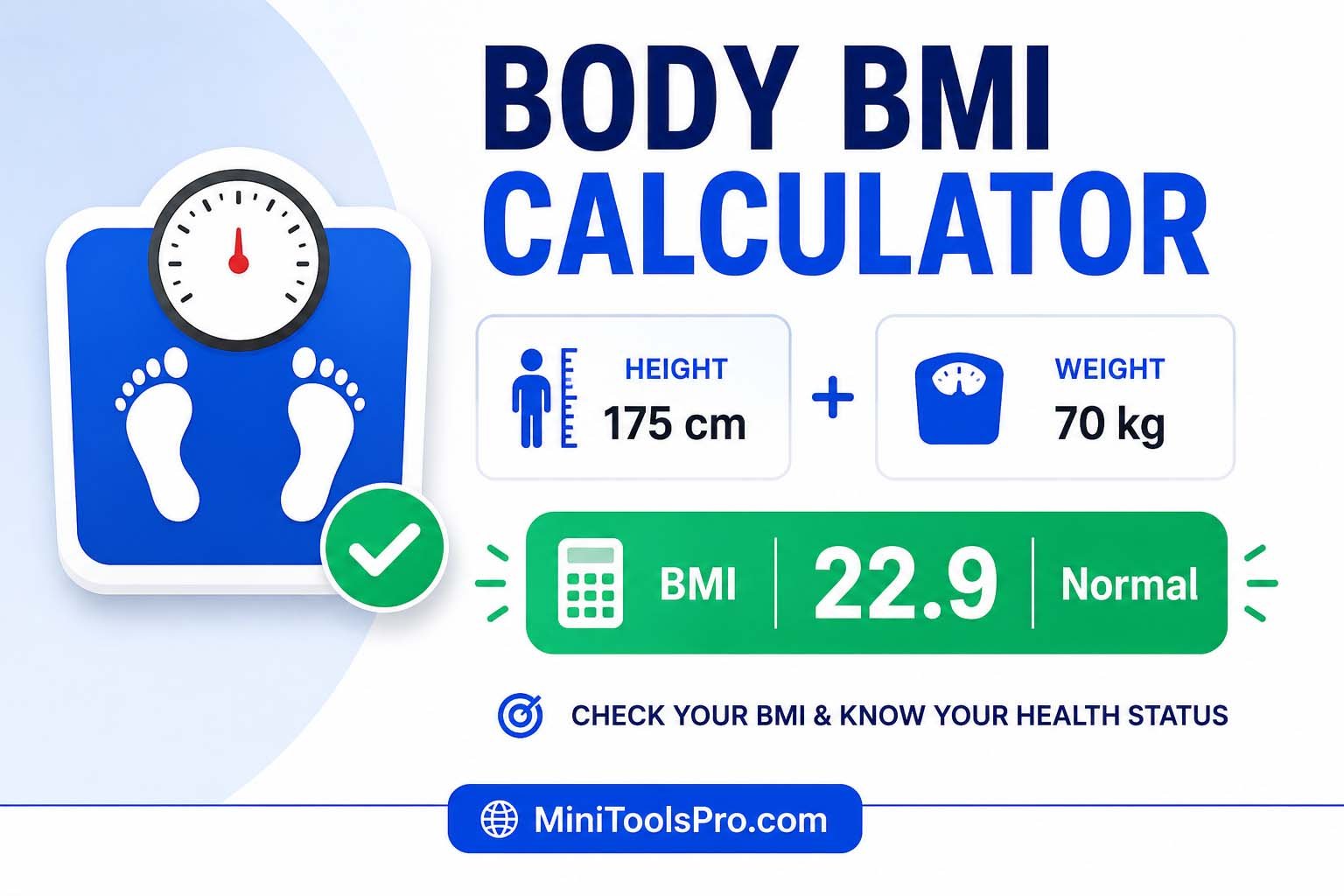
Step 3: Apply the formula. If you're using metric: divide your weight in kilograms by your height in meters squared. Example: 70kg ÷ (1.75m × 1.75m) = 70 ÷ 3.06 = 22.9 BMI.
Step 4: Find your category. Below 18.5 = underweight. 18.5–24.9 = normal. 25–29.9 = overweight. 30 and above = obese.
Step 5: Interpret with caution. That number means something different if you're an athlete, elderly, pregnant, or from certain ethnic backgrounds. More on that below.
Technical Explanation (For the Curious)
The BMI formula was developed by Adolphe Quetelet, a Belgian mathematician, not a doctor. He wasn't trying to measure individual health—he was looking for the "average man" to study population statistics. The formula assumes that weight scales with the square of height, which works reasonably well for average adults but breaks down at extreme heights or muscle masses. Modern researchers have proposed alternatives like the body adiposity index and waist-to-height ratio, but BMI remains the clinical standard because it's simple and has decades of population data behind it.
How to Calculate Your Body BMI Calculator Result: Two Methods
The Manual Approach (Paper and Calculator)
Grab a calculator or your phone. Write down your height in inches. Multiply that number by itself (square it). Write down your weight in pounds. Divide your weight by your squared height. Multiply that result by 703. That's your BMI. Example: Someone 5'6" (66 inches) and 150 pounds. 66 × 66 = 4,356. 150 ÷ 4,356 = 0.0344. 0.0344 × 703 = 24.2 BMI.
The problem with doing it manually? It's easy to mess up the math. One wrong number and you're in the wrong category, potentially worrying about nothing or ignoring something real.
The Smart Approach (Using a Digital Tool)
Instead of doing this manually and risking calculation errors, you can use our free Body BMI Calculator tool. Enter your height and weight once—no math required. The tool handles the formula instantly and shows you exactly where you fall on the BMI scale. Plus, you can switch between metric and imperial units without doing any conversions yourself.
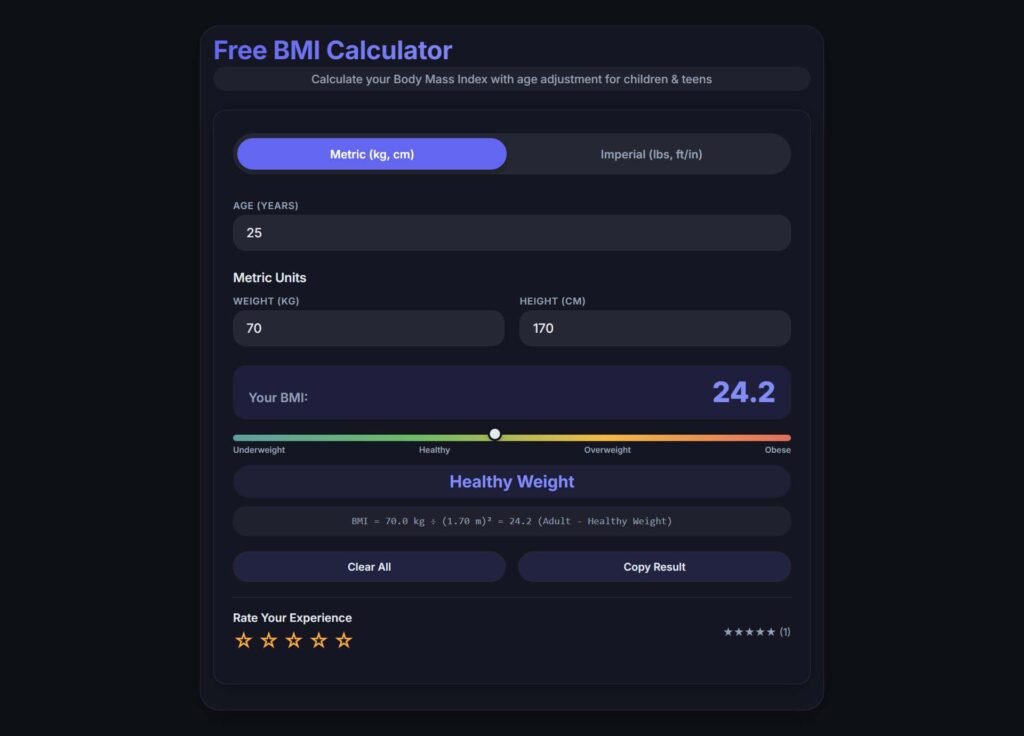
I recommend the digital approach for three reasons: you eliminate math errors, you get instant results, and you can easily recalculate as your weight changes without redoing the manual formula each time.
Best Practices for Accurate Results
Measure your height without shoes. Weigh yourself at the same time of day—morning is best. Use the same scale each time. Don't calculate right after a big meal or heavy workout. And don't bother calculating more than once every two weeks; daily fluctuations will drive you crazy without telling you anything useful.
7 Common Mistakes People Make With Their Body BMI Calculator
Mistake #1: Treating BMI as a diagnostic tool. Your BMI is a screening test, not a diagnosis. A high BMI doesn't automatically mean you're unhealthy. A normal BMI doesn't guarantee you're healthy. Your doctor needs blood work, blood pressure, family history, and lifestyle information to make real judgments.
Mistake #2: Using inaccurate measurements. Guessing your height or weight throws off everything. I've seen people claim they're two inches taller than they actually are. That changes their BMI category entirely. Be honest with the tape measure.
Mistake #3: Ignoring muscle mass. If you lift weights regularly, your body bmi calculator might label you overweight when you're actually lean. Muscle is denser than fat. A 200-pound bodybuilder and a 200-pound sedentary person have the same BMI but completely different health profiles.
Mistake #4: Applying BMI to children the same way as adults. Kids use a different chart—percentiles based on age and sex. A "normal" adult BMI might be concerning for a growing child. Pediatricians use growth charts, not the standard adult categories.
Mistake #5: Obsessing over the exact number. The difference between 24.9 and 25.1 is statistically meaningless. Yet people panic when they cross that threshold. The categories have boundaries, but your health doesn't change overnight because you gained a pound.
Mistake #6: Ignoring ethnic differences. Research shows that Asian populations face health risks at lower BMIs (starting around 23). Some guidelines recommend lower thresholds for Asian, South Asian, and Middle Eastern populations. The standard categories aren't one-size-fits-all.
Mistake #7: Using BMI during pregnancy. Your body mass index calculator result is useless when you're pregnant. Your body is doing something completely different. Doctors use pregnancy-specific weight gain charts instead.
Real-World Use Cases for BMI Tracking
Primary care patients. Your doctor checks your BMI at annual physicals because it's a quick signal. If your BMI jumps from 23 to 28 in a year with no lifestyle changes, that might indicate an underlying medical issue like thyroid problems or medication side effects.
Fitness beginners. Someone starting their fitness journey needs a baseline. Your starting BMI gives you a reference point. Three months later, recalculate. Even if your weight hasn't changed much, you might see your BMI shift as body composition changes.
Weight loss program participants. Programs like Weight Watchers and Noom use BMI categories to set initial goals. Moving from "obese" to "overweight" is a meaningful milestone, even if you're not yet at your ideal weight.
Life insurance applicants. When you apply for life insurance, the company runs your BMI. Being in the "obese" category might increase your premiums or require a medical exam. Knowing this ahead of time lets you plan accordingly.
Clinical research participants. Many medical studies use BMI as an inclusion or exclusion criterion. If you're interested in joining a weight loss or metabolic health study, your BMI determines eligibility.
Corporate wellness programs. Some employers offer premium discounts or incentives for completing health screenings that include BMI. Knowing your number helps you take advantage of those programs.
Bariatric surgery candidates. Most surgeons require a BMI of 35 or higher with comorbidities, or 40 or higher without, to qualify for weight loss surgery. Tracking your BMI helps you understand if you meet medical criteria.
College health courses. Health and physical education classes often include BMI calculation as part of their curriculum. Students learn to calculate and interpret their own numbers as part of health literacy.
Why Use Our Free Body BMI Calculator Tool?
You could pull out a calculator and do the math yourself. But here's why most people prefer using our BMI Calculator instead.
Zero calculation errors. The formula requires three separate math steps. Each step is an opportunity for a mistake. Our tool does the math instantly and perfectly every time.
Unit conversions handled automatically. Don't remember your height in meters? No problem. Enter feet and inches. Don't know your weight in kilograms? Enter pounds. The tool converts everything behind the scenes.
Visual category display. You don't just get a number. You see exactly where you fall on the BMI scale—underweight, normal, overweight, or obese—with clear visual indicators.
Completely free, no signup required. No email address. No credit card. No account creation. Enter your numbers, get your result, and move on with your day.
Works on any device. Whether you're on your phone in the bathroom after weighing yourself, or on your laptop at your desk, the tool works perfectly on every screen size.
Advanced Tips for Getting the Most From Your Body BMI Calculator
Track trends, not snapshots. One BMI reading tells you where you are. Five readings over six months tell you where you're going. Plot your BMI every two weeks on the same scale and same time of day. The trend line matters more than any single number.
Combine with waist measurement. BMI misses where you carry your fat. Waist-to-hip ratio catches what BMI misses. Measure your waist at belly button level. Divide by your hip measurement at the widest point. Below 0.85 for women and 0.90 for men is ideal, even if your BMI runs high.
Adjust for your activity level. If you exercise regularly, add 0.5 to your BMI before comparing to standard charts. This rough adjustment accounts for muscle mass without needing expensive body fat testing.
Use age-appropriate interpretations. BMI naturally increases with age. A BMI of 25 that concerns a 25-year-old is completely normal for a 65-year-old. Some calculators offer age-adjusted percentiles—use them if available.
Calculate for family members carefully. Children need pediatric BMI percentiles. Elderly adults lose muscle and bone density, so their BMI might look normal while they're actually overfat. Pregnant women shouldn't use BMI at all. Know who you're calculating for.
Cross-reference with blood work. The real value of your BMI appears when you look at it alongside your blood pressure, cholesterol, and blood sugar. A normal BMI with bad blood work is more concerning than a high BMI with perfect blood work. Talk to your doctor about the full picture.
Frequently Asked Questions About Body BMI Calculators
What is a healthy BMI for women?
A healthy BMI for most women falls between 18.5 and 24.9. However, women naturally carry more body fat than men, so the same BMI number means different body composition. Women also experience BMI changes during pregnancy, postpartum, and menopause. For women over 65, a BMI between 25 and 27 is associated with better health outcomes than lower numbers. Always discuss your specific situation with your healthcare provider.
How accurate is a body mass index calculator for athletes?
Not very accurate. BMI doesn't distinguish between muscle and fat. Athletes and regular weight trainers often fall into the "overweight" category despite having very low body fat percentages. LeBron James has a BMI around 27 (overweight) but is clearly in elite physical condition. If you exercise regularly, treat your BMI as a starting point but don't panic if it runs high. Consider body fat percentage testing for better accuracy.
Can I use a BMI calculator if I'm pregnant?
No. Standard BMI calculations don't work during pregnancy because your body weight includes the baby, placenta, amniotic fluid, and increased blood volume. Your pre-pregnancy BMI matters—doctors use that to recommend appropriate weight gain during pregnancy. But don't recalculate while pregnant. Use pregnancy-specific weight gain charts from your OB-GYN instead.
What's the difference between BMI and body fat percentage?
BMI estimates body fat indirectly using only height and weight. Body fat percentage measures it directly using calipers, bioelectrical impedance, or DEXA scans. BMI costs nothing and takes seconds. Body fat percentage requires special equipment or professional help. BMI works well for population studies and general screening. Body fat percentage matters more for individuals trying to optimize their physique or athletic performance.
Why does my BMI say I'm overweight but I look normal?
Several possibilities. You might have more muscle than average. You might be at the upper end of the "normal weight" range visually but BMI categories have hard cutoffs that don't reflect visual appearance. Or you might be what researchers call "normal weight obesity"—normal BMI but high body fat percentage due to low muscle mass. This is common in sedentary people and older adults. Ask your doctor about waist measurement and body composition testing.
What BMI is considered obese for seniors?
Standard obesity classification (BMI 30+) applies to seniors, but research suggests older adults have different mortality risks. A BMI between 25 and 27 is actually associated with the lowest death rates for people over 65. The "normal" range of 18.5–24.9 carries slightly higher mortality risk for seniors. Don't aggressively pursue weight loss in older adulthood without medical supervision. Maintain muscle and function first.
How often should I check my BMI?
Once every two to four weeks is plenty. Weight fluctuates daily due to water, food intake, and bowel movements. Checking more often creates unnecessary anxiety without giving useful information. Take measurements at the same time of day—morning after using the bathroom but before eating is ideal. Recalculate monthly if you're actively trying to change your weight. Recalculate quarterly for maintenance.
Do different ethnicities have different healthy BMI ranges?
Yes. Research shows that people of Asian, South Asian, Chinese, Japanese, and Middle Eastern backgrounds face increased health risks at lower BMIs. Many health organizations recommend lower BMI thresholds: overweight starting at 23 (not 25) and obesity starting at 27 (not 30) for these populations. Pacific Islander populations may have higher healthy ranges due to different body composition. Check guidelines specific to your ethnic background.
What's the ideal BMI for a 70-year-old woman?
Research suggests the optimal BMI for women over 70 is between 25 and 27—slightly above the standard "normal" range. Lower BMIs in older adults are associated with higher mortality from falls, fractures, and muscle wasting. Unless your doctor specifically recommends weight loss, focus on maintaining muscle strength and physical function rather than achieving a low BMI number.
Can my BMI change if I gain muscle but lose fat?
Possibly yes, possibly no. Muscle is denser than fat, so gaining muscle and losing fat can keep your weight stable while your body composition improves dramatically. Your BMI might stay exactly the same even though you're much healthier. This is the classic limitation of BMI. If you're strength training, track your waist measurement and how your clothes fit alongside your BMI.
Is there a Body BMI calculator that works for people with amputations?
Standard BMI calculators don't work accurately for people with limb loss or amputations. Your body weight doesn't match the assumptions built into the formula. Some specialized calculators offer amputation-adjusted BMI by estimating the percentage of body mass missing. Ask your prosthetist or rehabilitation doctor for recommendations. Without adjustments, expect your BMI to underestimate your actual body fat level.
Why do doctors still use BMI if it has so many limitations?
Because it's simple, free, fast, and works reasonably well for most people in a clinical setting. A doctor seeing 30 patients a day can't run body fat scans on everyone. BMI takes 10 seconds, requires no equipment, and flags potential problems for further investigation. It's not perfect, but it's useful as a screening tool. Good doctors treat BMI as one data point alongside blood work, blood pressure, family history, and physical exam findings.
Your Body Mass Index Number Is a Tool, Not a Judge
Here's what I want you to take away from this guide. Your body BMI calculator result is useful information. It's not your grade. It's not your worth. It's not a medical diagnosis. It's a single number derived from two simple measurements, and it has real limitations.
Check your BMI. See where you fall. If you're in the normal range, great—keep doing what works. If you're in the overweight or obese range, don't panic. Use that information as motivation to have an honest conversation with your doctor. Ask about your blood work. Get your blood pressure checked. Measure your waist. Look at the full picture.
And if you want the easiest way to calculate your BMI without doing any math yourself, try our free BMI calculator tool. It takes five seconds, gives you an instant result, and handles all the unit conversions automatically.
Your health journey is yours alone. Use every tool available—including BMI—but never let any single number define you.
Share this article 👇

0 Comments