
Table of Contents
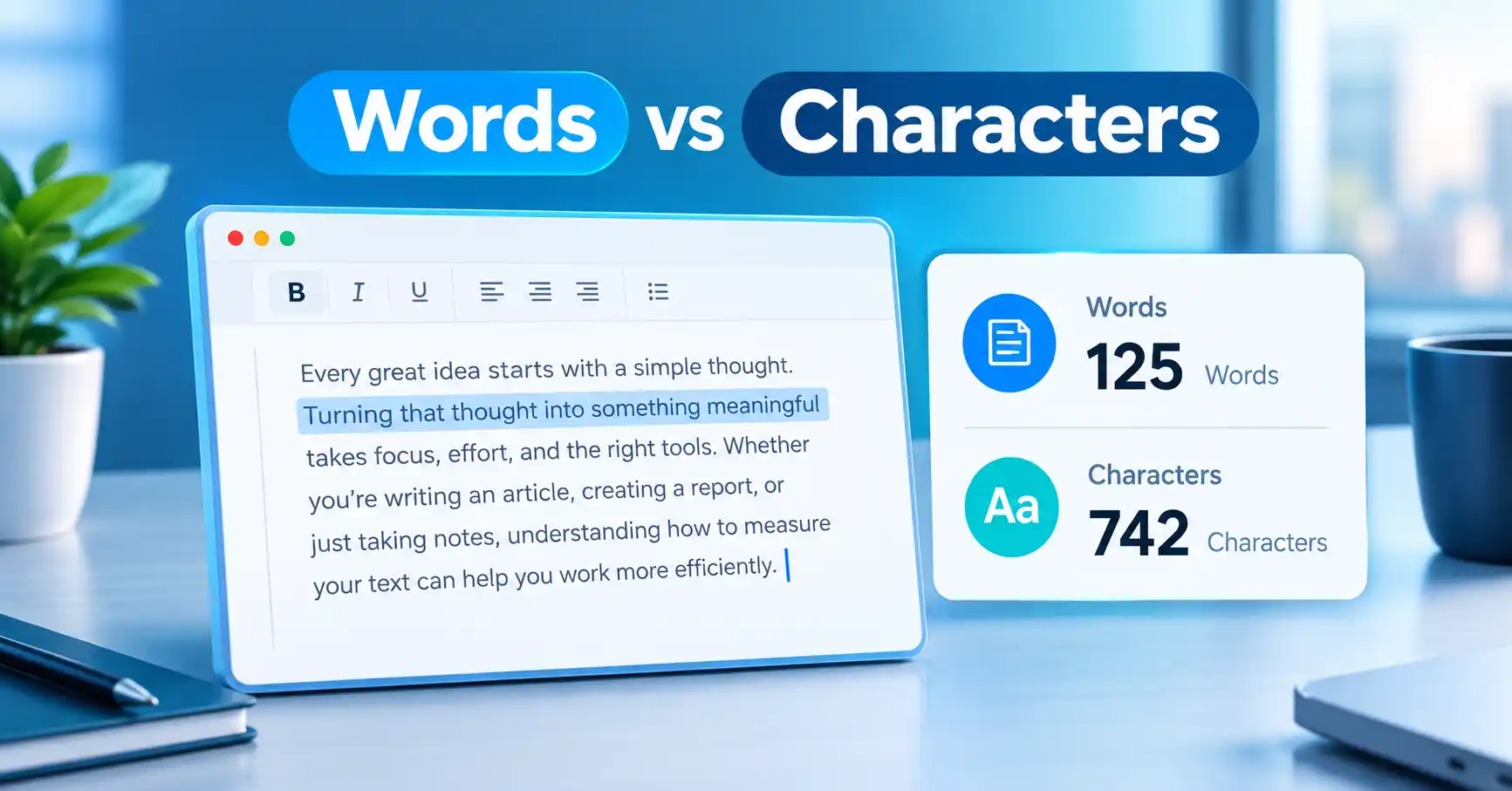
Word Count vs Character Count
A word count tells you how many words are in a piece of text, while a character count tells you how many individual characters it contains. They measure different things, so there is no exact conversion between the two.
For example, a short sentence might contain 8 words but more than 40 characters. The character total depends on the actual letters, numbers, punctuation, and spaces in the text.
This distinction matters whenever you're working with an essay, article, application, social media post, form, or any other writing with a specific limit.
Word Count vs Character Count: The Basic Difference
The simplest way to understand the difference is to think of words as groups of text and characters as the individual elements that make up that text.
| Measurement | What it counts | Example use |
|---|---|---|
| Word count | Words in the text | Essay or article limits |
| Character count | Individual characters | Short text or form limits |
| Character count with spaces | Characters plus spaces | Platforms with total-character limits |
| Character count without spaces | Characters excluding spaces | Certain writing requirements |
Consider this sentence:
The quick brown fox jumps.
It contains 5 words. Its character count is considerably higher because every letter, space, and punctuation mark can contribute to the total.
So if someone asks you to stay under 500 words, they are measuring something different from a requirement such as 3,000 characters.
What Is Word Count?
Word count is the number of words contained in a piece of text.
It is commonly used for longer forms of writing where the overall length matters. Essays, reports, articles, assignments, speeches, and other documents may have minimum or maximum word requirements.
For example:
- "The project was completed successfully." = 5 words
- "Please submit your assignment by Friday." = 6 words
A word counter generally identifies groups of text separated by spaces or other word boundaries and treats those groups as words. The exact treatment of unusual formatting, symbols, or punctuation can vary between counting systems.
That's why a word count from one application can occasionally differ from another when the text contains unusual formatting, symbols, URLs, or other special content.
For a broader explanation of how word counting works, see the Word Counter: How to Count Words, Characters, and Reading Time guide.
What Is Character Count?
Character count measures individual characters in a piece of text.
A character can be a letter, number, punctuation mark, or other text symbol. Depending on the requirement or tool, spaces may also be included.
For example, consider:
Hello world!
There are 12 characters when the space and exclamation mark are included:
- H
- e
- l
- l
- o
- space
- w
- o
- r
- l
- d
- !
There are fewer characters if spaces are excluded.
This is why it's important to check whether a requirement means characters including spaces or characters excluding spaces.
Characters vs Words: Why Are the Numbers So Different?
Words and characters don't have a fixed relationship.
A five-word sentence could be very short:
Cats sleep all day.
Or much longer:
International organizations frequently coordinate complex projects.
Both contain five words, but they have very different character counts.
This happens because words aren't all the same length. A word such as "a" contains one letter, while a word such as "international" contains many more.
Spaces and punctuation can also affect the character total.
As a result, you can't reliably say that a certain number of words always equals a specific number of characters.
Is There a Words-to-Characters Conversion?
There is no exact words-to-characters conversion that works for every piece of writing.
You can estimate an average character count for a particular type of text, but the actual number will vary depending on:
- Word length
- Number of spaces
- Punctuation
- Numbers
- Abbreviations
- Formatting and symbols
- The subject and writing style
For example, two 100-word articles can have noticeably different character counts even though their word counts are identical.
If a website or assignment gives you a character limit, the safest approach is to check the actual text rather than trying to convert the limit into an estimated word count.
How Many Characters Are in a Word?
There isn't a standard number of characters in every word.
A word can contain just one character, such as "I", or many characters, such as "characterization."
If you're wondering how many characters are in a word, simply count the letters and other characters that form that word according to the counting method being used.
For example:
| Word | Letters |
|---|---|
| I | 1 |
| cat | 3 |
| writing | 7 |
| computer | 8 |
| international | 13 |
These examples show why a fixed conversion between words and characters doesn't work.
Even punctuation can change the result. A word followed by a comma contains an additional character if punctuation is included in the count.
Character Count With Spaces vs Without Spaces
This distinction can confuse when you're trying to meet a character limit.
Suppose your text is:
Write clearly.
A character counter may provide two values:
Characters with spaces: includes the space between words.
Characters without spaces: excludes that space.
The difference becomes much more noticeable in longer documents because every space between words contributes to the total when spaces are counted.
If a form says "maximum 500 characters," check its instructions carefully. Some platforms count spaces, while others may describe the limit differently.
When the requirement is unclear, it's better to verify the exact counting method rather than assuming.
When Does Word Count Matter?
Word count is generally more useful when the requirement concerns the overall length of a piece of writing.
Common examples include:
- Essays
- Academic assignments
- Blog posts
- Articles
- Reports
- Speeches
- Personal statements
- Written responses
For example, an instructor might require an essay of 1,500 words. In that situation, the important measurement is the number of words, not simply how many characters the essay contains.
The exact requirement should always come from the assignment, institution, publisher, employer, or platform rather than from a general recommended word count.
When Does Character Count Matter?
Character count becomes particularly useful when a system limits the amount of text you can enter.
You may encounter character limits in:
- Online forms
- Short descriptions
- Profile fields
- Messages
- Applications
- Social media fields
- Titles or snippets
- Other text boxes with limited space
A character limit can be more precise for systems where the physical amount of text matters.
For example, two sentences can contain the same number of words but occupy very different amounts of text because their words have different lengths.
How to Check Both Word and Character Count
If you're unsure whether your text meets a word or character requirement, checking the actual text is more reliable than estimating.
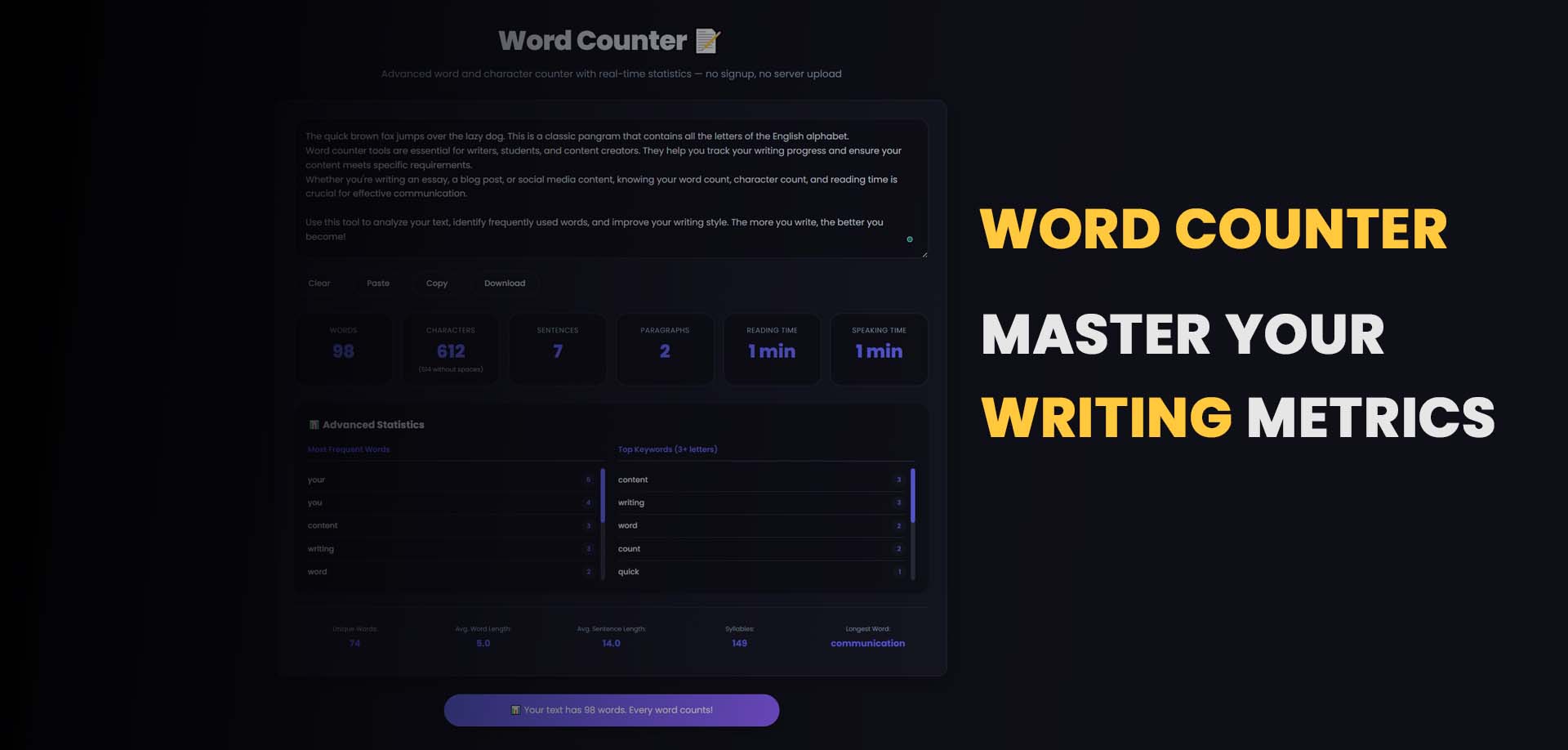
You can paste your writing into the MiniToolsPro Word Counter to quickly review its word and character counts.
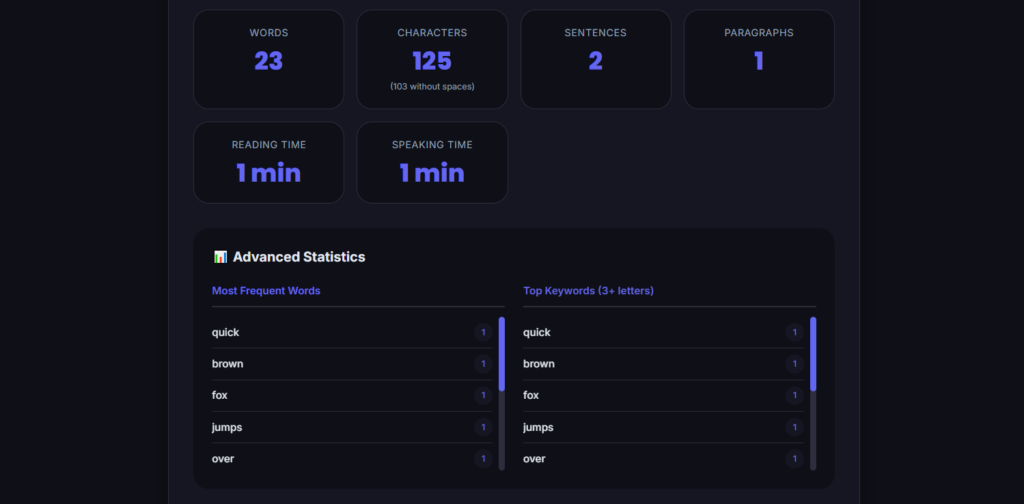
The tool can also provide other useful text statistics, including sentence and paragraph counts, estimated reading and speaking time, and frequent-word information.
This can be useful when you're preparing an essay, checking an article, or trying to stay within a specific text limit.
A Simple Example
Imagine you've written a short application response and the instructions say:
Maximum: 1,000 characters
Counting the words alone won't tell you whether you've exceeded the requirement. A 150-word response might fit, but another 150-word response could contain substantially more characters.
Instead of estimating, paste the actual response into a character-counting tool and check the result.
The same principle works in reverse: if the requirement is 1,000 words, character count isn't a substitute for checking the number of words.
Can You Convert Character Count to Word Count?
You can make a rough estimate, but it won't be exact.
The average number of characters per word changes depending on the writing. A technical document containing long terms may have more characters per word than a simple conversational text.
For that reason, formulas such as "X characters equals Y words" should be treated only as estimates.
If you need to satisfy an actual limit, use the measurement specified by the requirement.
For example:
- 1,000 words → check the word count directly.
- 5,000 characters → check the character count directly.
- 5,000 characters including spaces → make sure your counter uses the appropriate measurement.
- 5,000 characters excluding spaces → verify the count without spaces.
The actual text is always more reliable than a conversion estimate.
Word Count and Character Count Are Complementary
Word count and character count aren't competing measurements. They answer different questions.
Word count: How many words have I written?
Character count: How many individual characters does my text contain?
You may need one or both depending on the task.
For example, someone writing an essay may primarily care about word count, while someone completing a short online application may need to watch character count. An article writer might care about both when reviewing the overall length and text structure.
Understanding the difference prevents a common mistake: trying to satisfy one type of limit by estimating another.
Frequently Asked Questions
Is character count the same as word count?
No. Word count measures the number of words, while character count measures individual characters. A document can have a relatively small number of words but a much larger number of characters.
How many characters are usually in a word?
There is no fixed number. Words can range from a single character to many characters, and average word length varies depending on the type of writing.
Does character count include spaces?
It depends on the counting method. Some counters provide a character count that includes spaces and another count that excludes them. Always check which measurement a specific requirement uses.
Can I convert words to characters?
Only approximately. There is no universal conversion because word length, spaces, punctuation, numbers, and other characters vary from one piece of writing to another.
Should I use word count or character count?
Use whichever measurement the requirement specifies. Use word count for requirements based on the number of words and character count when a platform, form, or other requirement specifies a character limit.
How can I check word and character count quickly?
Paste your text into the MiniToolsPro Word Counter to check its word and character counts along with other text statistics.
Final Takeaway
The key difference is simple: word count measures words, while character count measures characters. Because words vary in length, there is no reliable one-to-one conversion between the two.
If you're working with a word limit, check the word count. If you're working with a character limit, check the character count using the measurement required by the platform or assignment.
When you need to check both quickly, the MiniToolsPro Word Counter lets you analyze your text directly instead of relying on estimates.
Share this article 👇
0 Comments