
Table of Contents
Checking Essay Word Count and Staying Within the Limit
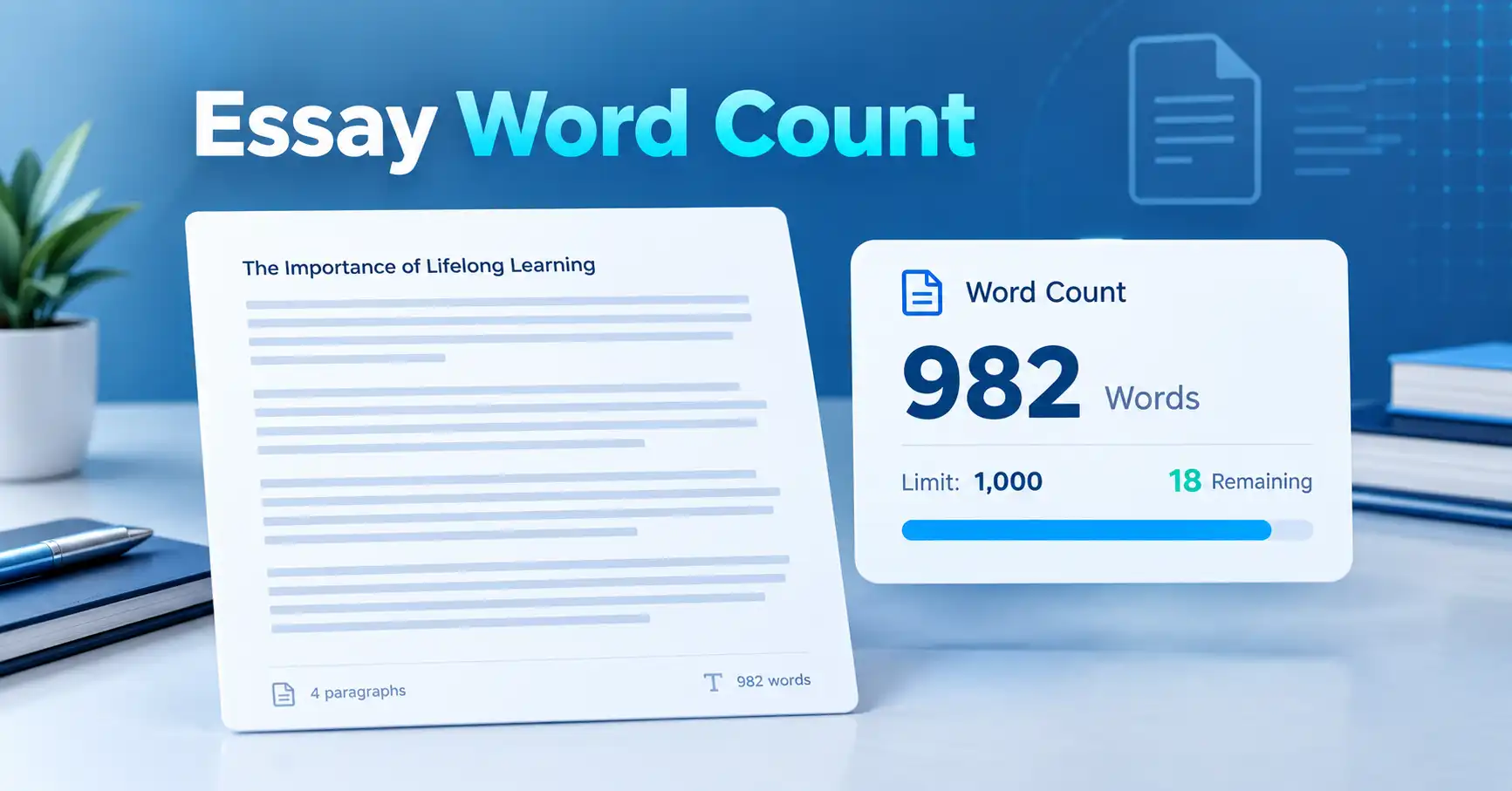
If your essay has a word limit, the quickest way to check it is to run the finished text through a word counter. You can paste your essay into the MiniToolsPro Word Counter and immediately see how many words it contains, along with other useful text statistics.
The harder part usually comes after the count.
If you're over the limit, you need to decide what can be removed without weakening the argument. If you're under it, you need to add useful substance rather than filler. And before making either change, it's important to understand exactly what your assignment means by its stated word limit.
For a broader explanation of word counts, character counts, and reading time, see our Word Counter guide.
How to Check the Word Count of an Essay
The simplest way to check an essay word count is to copy the essay text and paste it into a word-counting tool.
Step 1: Finish your working draft
Don't worry about getting the exact number of words perfect while writing your first draft.
Focus first on answering the assignment question, organizing your ideas, and supporting your main points. Once the draft is reasonably complete, checking the word count becomes much more useful.
Step 2: Copy the essay text
Select the portion of the essay you need to check and copy it.
Pay attention to your assignment instructions before doing this. Some assignments may have specific rules about whether titles, headings, quotations, references, footnotes, or other material are included in the official count.
Step 3: Paste it into a word counter
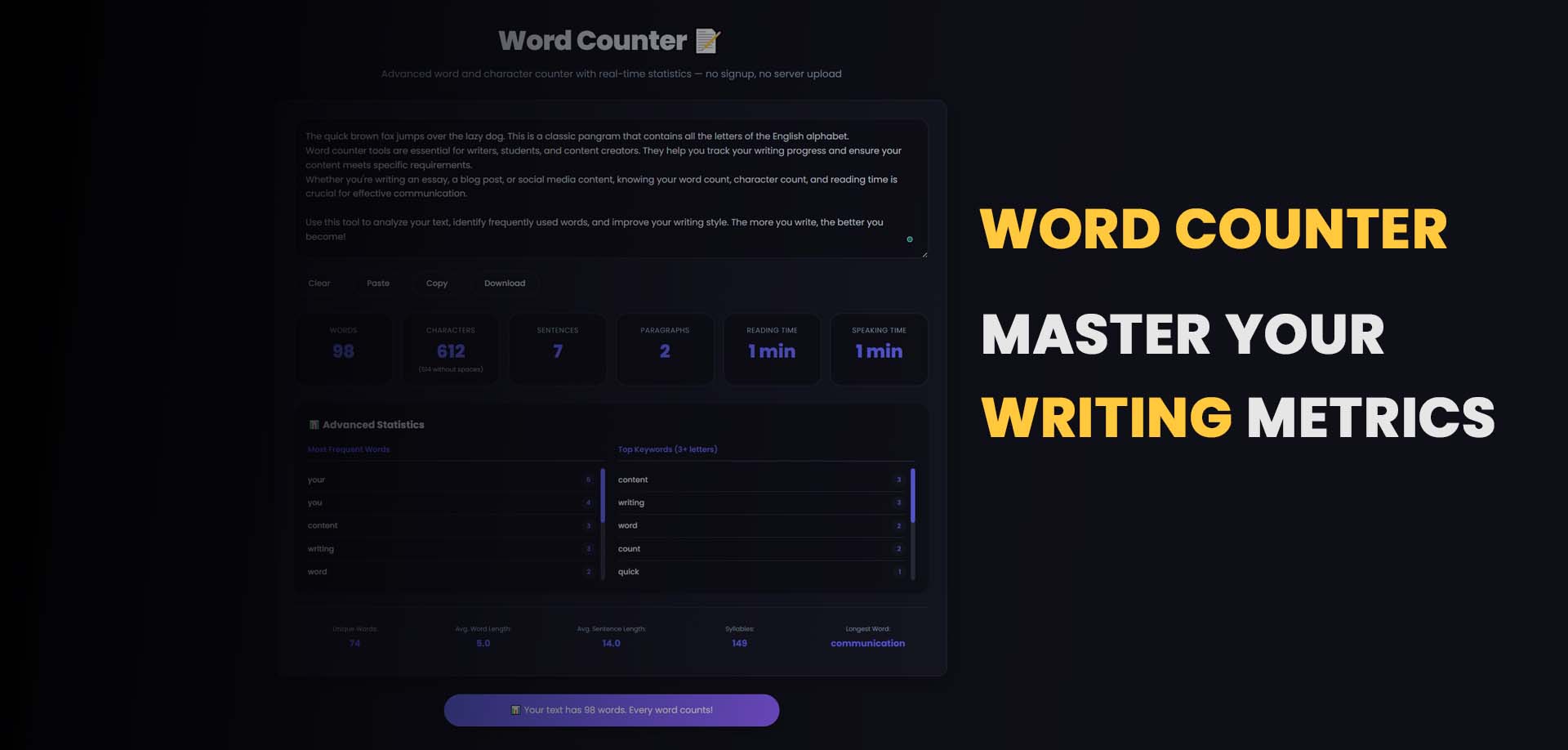
Open the MiniToolsPro Word Counter and paste your essay into the text area.
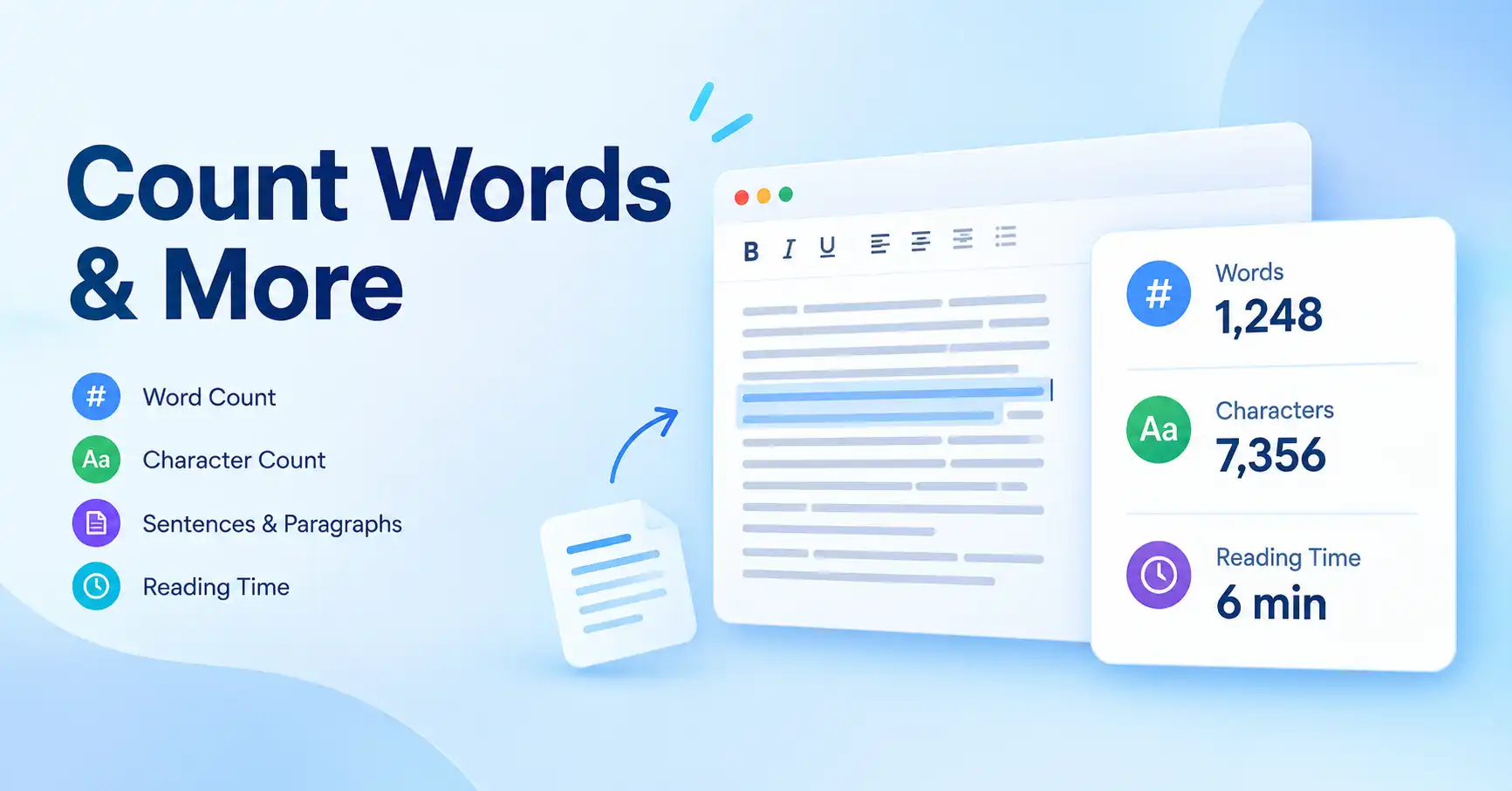
The tool can show:
- Word count
- Character count
- Characters with spaces
- Characters without spaces
- Sentence count
- Paragraph count
- Estimated reading time
- Estimated speaking time
- Frequent words
- Keyword statistics
This can be useful when you're checking more than just the final number.
Step 4: Compare the result with your requirement
Suppose your assignment asks for 1,000 words and your draft contains 1,126.
You now know that the essay needs some editing if 1,000 is a strict maximum.
On the other hand, if the draft contains 840 words and the requirement is approximately 1,000, you may have room to develop an important argument or explanation.
The number itself tells you where you stand. Your assignment instructions determine what you should do about it.
What Does an Essay Word Count Actually Mean?
An essay word count is the number of words contained in the text being counted.
That sounds straightforward, but the official count for an assignment can depend on its rules.
For example, an instructor or institution may provide specific instructions about whether certain elements are included. A general-purpose word counter counts the text you give it, while an assignment's official rules determine which parts of your submission should be counted.
That's why it's useful to distinguish between:
Tool word count: The number of words detected in the text you paste into the tool.
Official assignment word count: The count according to the rules specified for that particular assignment or submission.
For ordinary essay text, the two may be very close or identical. For documents containing references, footnotes, headings, quotations, or other special elements, the rules may matter more.
What If My Essay Is Over the Word Limit?
If your essay is too long, don't start deleting sentences at random.
First, look for parts that can be shortened without removing an important idea.
Remove repeated points
Read through the essay and look for places where the same argument is made more than once.
For example, you might explain an idea in one paragraph and then repeat almost the same explanation in the next paragraph.
If the second explanation doesn't add anything new, it may be possible to remove or shorten it.
Cut unnecessary background
Background information can be useful, but an essay can become unnecessarily long when it spends too much time explaining information that isn't central to the question.
Ask:
Does this information help answer the assignment?
If the answer is no, consider shortening it.
Make sentences more direct
Some sentences contain extra wording that doesn't change the meaning.
For example:
Due to the fact that the study was conducted over a long period of time...
can often be expressed more directly as:
Because the study lasted a long time...
The goal isn't to make every sentence as short as possible. It's to remove unnecessary wording while preserving the meaning.
Look at your examples
Examples are useful when they clarify an argument, but you may not need several examples that all demonstrate the same point.
Keep the examples that contribute the most and remove or shorten those that don't add much.
Check the conclusion
A conclusion can become repetitive if it restates every argument from the essay in detail.
A good conclusion should bring the discussion together without unnecessarily repeating entire sections of the essay.
What If My Essay Is Too Short?
Being below the target word count doesn't mean you should add filler.
Instead, look for parts of your argument that deserve more explanation.
You might:
- Explain an important idea in greater detail
- Add a relevant example
- Provide context for an argument
- Address a reasonable counterpoint
- Explain why a finding or argument matters
- Strengthen a transition between ideas
- Clarify a conclusion
For example, imagine that your essay makes a strong claim but gives only one sentence explaining why the claim matters.
Adding a few useful sentences that develop that point may improve the essay while naturally increasing its word count.
That's much better than adding unrelated information simply to reach a number.
How Many Words Should a 500-Word Essay Have?
A 500-word essay is generally expected to contain around 500 words, but the exact requirement depends on the assignment.
If the instructions say 500 words maximum, exceeding that number may not be acceptable.
If they say approximately 500 words, there may be more flexibility.
If they specify a particular range, follow that range.
For example:
| Current word count | Target | Difference |
|---|---|---|
| 460 | 500 | 40 fewer |
| 500 | 500 | On target |
| 540 | 500 | 40 more |
The table shows the numerical difference, but it doesn't determine whether that difference is acceptable. Your assignment instructions do.
A 500-word essay also leaves relatively little room for unnecessary introduction or repetition, so planning the main argument before writing can help.
How Many Words Should a 1000-Word Essay Have?
A 1,000-word essay is generally expected to be around 1,000 words unless the assignment specifies a different range or tolerance.
If your draft is 1,150 words, don't automatically remove 150 words from the conclusion.
Look at the entire essay.
You may find that:
- The introduction contains unnecessary background
- Two paragraphs make similar points
- An example can be shortened
- Several sentences can be made more direct
- The conclusion repeats earlier material
Similarly, if your essay is only 700 words, don't add 300 words of generic explanation. Look for important ideas that haven't been developed sufficiently.
What Is an Essay Word Limit?
An essay word limit tells you how much text an assignment expects or allows.
However, the exact meaning depends on the wording.
You might see instructions such as:
- Maximum 1,000 words
- Minimum 1,000 words
- Approximately 1,000 words
- 1,000 words ± a specified percentage
These aren't necessarily interchangeable.
A maximum establishes an upper boundary. A minimum establishes a lower boundary. An approximate target may allow more flexibility, while a stated percentage defines the permitted range.
Always follow the instructions attached to your assignment instead of relying on a general assumption about how many words are acceptable.
Does the Title Count Toward the Essay Word Count?
There isn't one universal rule.
Whether the title counts can depend on the institution, instructor, assignment, or submission system.
The same applies to other elements such as:
- Headings
- Quotations
- Footnotes
- References
- Bibliographies
- Captions
If your assignment provides counting instructions, those instructions should take priority.
A word counter can tell you how many words are present in the text you paste into it, but it cannot determine an institution's specific definition of an official assignment word count.
Word Count and Character Count Are Different
Word count tells you how many words are in a piece of text.
Character count measures individual characters and may be reported either with spaces or without spaces.
For example, a short sentence might contain only a handful of words but many more characters.
This distinction matters when an assignment or online submission form specifies a character limit rather than a word limit.
The MiniToolsPro Word Counter can show both word and character statistics, which makes it useful when you're checking different types of writing requirements.
Should You Check the Word Count While Writing?
You can, but you don't necessarily need to check it after every paragraph.
For most essays, a more practical approach is to:
- Plan the argument.
- Write a complete draft.
- Check the word count.
- Edit for length.
- Check the count again.
- Proofread the final version.
Constantly watching the number while writing can sometimes encourage you to focus on length before the argument is properly developed.
The better question during drafting is whether each section is doing useful work.
A Simple Essay Word-Count Workflow
If you're trying to stay within a specific essay word limit, this workflow keeps the process simple.
1. Read the requirement carefully
Find out whether the assignment specifies a maximum, minimum, approximate target, or permitted range.
2. Write the main argument first
Make sure the essay actually answers the question before worrying about its final length.
3. Check the current count
Paste the draft into the MiniToolsPro Word Counter and check the result.
4. Decide whether you need to cut or expand
If you're over the limit, look for repetition and unnecessary wording.
If you're under it, look for ideas that need stronger explanation.
5. Check the count again
After editing, run the essay through the word counter again.
A few rounds of editing can change the total more than you might expect.
6. Review the actual writing
Finally, check grammar, clarity, structure, citations, formatting, and the specific requirements of your assignment.
A correct word count is useful, but it doesn't make an essay effective by itself.
Why Page Count Is Not a Reliable Word Count
It can be tempting to estimate an essay's length by counting pages, but page count can change dramatically depending on formatting.
For example, changing the:
- Font
- Font size
- Line spacing
- Margins
- Paragraph spacing
can change how many pages the same text occupies.
The actual number of words doesn't change.
That's why checking the text itself is more reliable when an assignment specifies a word limit.
How to Cut Words Without Weakening Your Essay
When you're only slightly above the limit, small edits can make a significant difference.
Start with the easiest places to tighten:
Remove redundancy: Delete phrases that repeat an idea already expressed.
Shorten wordy sentences: Replace unnecessarily complicated constructions with direct language.
Combine related sentences: Two short sentences sometimes communicate better as one.
Remove unnecessary qualifiers: Words such as "very," "really," or "quite" aren't always needed.
Trim the introduction: Keep the context that helps the reader understand the argument and remove material that doesn't.
Review transitions: Some transition phrases can be shortened without affecting the logic of the essay.
Don't cut evidence or important reasoning simply because those sentences are longer. The purpose of editing is to make the essay more efficient, not merely smaller.
How to Add Words Without Adding Filler
If you're substantially below the required length, look for substance that deserves more attention.
Ask yourself:
- Have I explained my main argument clearly?
- Does every important claim have enough explanation?
- Could an example make this point clearer?
- Have I considered an important alternative view?
- Have I explained the significance of my argument?
- Does the conclusion adequately bring the discussion together?
These questions can reveal genuine opportunities for improvement.
Adding meaningful explanation is usually more valuable than inserting generic sentences that simply increase the number on the word counter.
Final Essay Word-Count Check
Before submitting your essay, make one final check.
Paste the final version into the MiniToolsPro Word Counter and review the word count.
You can also check characters, sentences, paragraphs, estimated reading time, speaking time, and other text statistics supported by the tool.
Then compare the result with the actual assignment requirements.
If the count is within the required range, move on to the final proofreading stage. Check the argument, grammar, citations, formatting, and anything else your assignment requires.
Frequently Asked Questions
How do I check the word count of an essay?
Copy your essay and paste it into a word-counting tool such as the MiniToolsPro Word Counter. It will analyze the text and show the number of words along with other text statistics.
How can I reduce my essay word count?
Start by removing repeated ideas, unnecessary background information, redundant examples, and wordy phrases. Then check the essay again to see whether it meets the required limit.
How can I increase my essay word count without adding filler?
Develop ideas that are already relevant to your argument. Add useful explanation, context, examples, evidence, or discussion of an important alternative perspective instead of repeating existing points.
Is a 500-word essay exactly 500 words?
Not necessarily. Whether you need exactly 500 words or a range around that target depends on the assignment instructions. Follow the stated requirement rather than assuming a universal tolerance.
Is a 1000-word essay exactly 1000 words?
Not always. Some assignments specify a maximum, minimum, approximate target, or permitted range. The assignment instructions determine what is expected.
Does the essay title count toward the word limit?
It depends on the assignment. Some requirements may exclude titles or other elements, while others may treat them differently. Check the instructions provided for your specific essay.
Conclusion
Checking an essay word count is straightforward. The more important part is knowing what to do with the result.
If you're over the limit, look for repetition, unnecessary wording, and material that doesn't directly support your argument. If you're under the limit, develop ideas that genuinely need more explanation rather than adding filler.
Once your essay is ready, use the MiniToolsPro Word Counter to check the final word count and review other useful text statistics.
And if you want a broader understanding of word counting, characters, and reading time, continue with the Word Counter guide.
Share this article 👇
0 Comments