
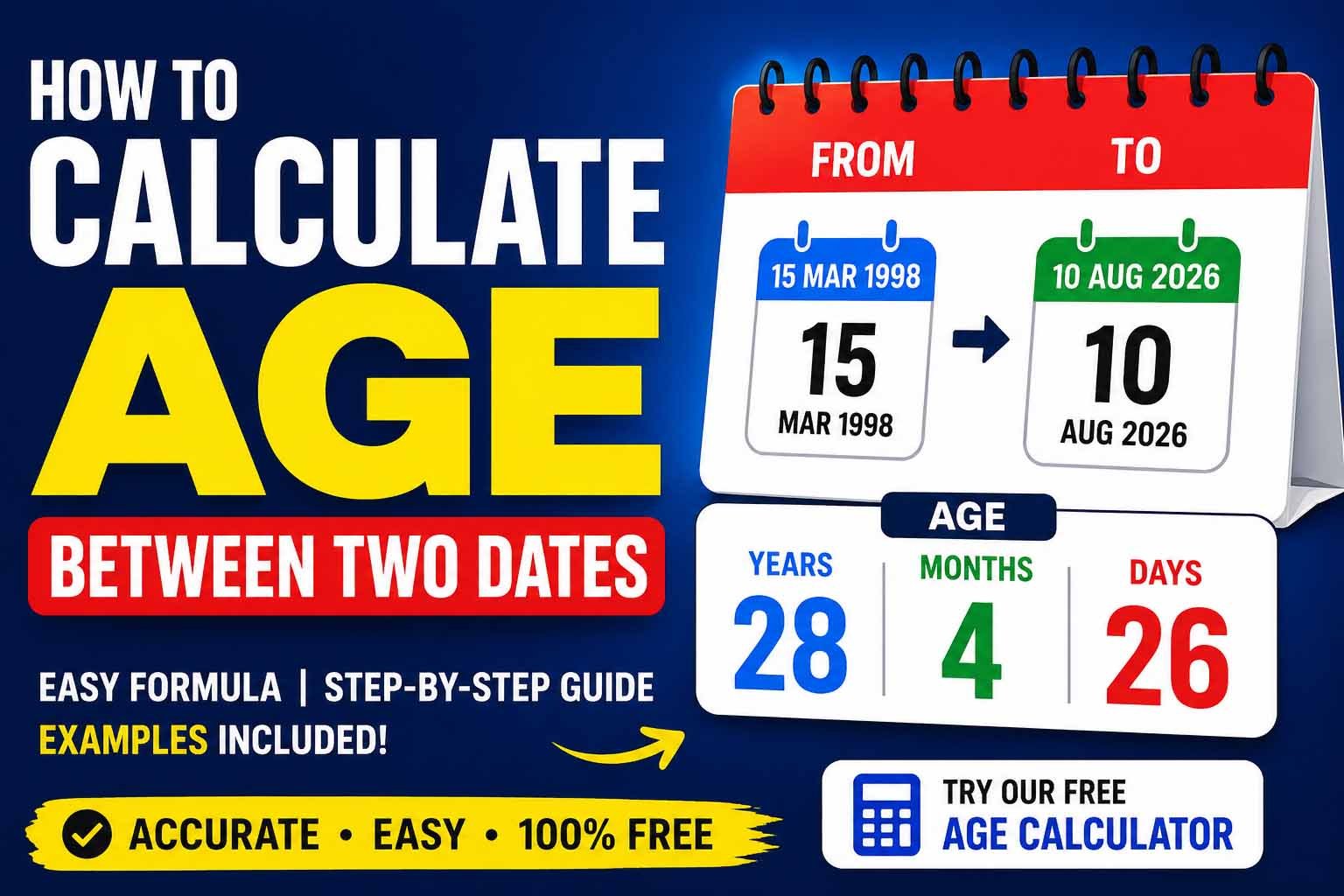
Calculate Age Between Two Dates
Knowing how to calculate age between two dates extends far beyond determining a current birthday age. You can apply the same logic to project forward and find out exactly how old someone will be on a specific future date. This helps plan retirement eligibility, schedule milestone celebrations, or determine when a child reaches a legal age threshold. The process remains identical. Treat the future date as the end date and the birth date as the start date. Simply ensure you are using the correct calendar year for the target date. Many people use this method to plan for pension qualification deadlines or to verify the exact date a minor becomes a legal adult. Unlike a standard birth-to-today calculation, future projections require you to remember that the end date has not happened yet. This means no borrowing adjustments are needed for a birthday that has not yet been reached in the current year. The arithmetic stays the same, but the perspective shifts from looking backward to looking forward.
Table of Contents
What Does Age Mean?
Age represents the length of time a person has existed. At its simplest, it is the duration between a date of birth and a specific date. When we ask to calculate age between two dates, we usually mean finding the elapsed time since birth. This is known as chronological age. It is the legal and social standard used across the world. Chronological age is fixed and measurable. It does not change based on health or lifestyle.
There is also biological age. This measures how old your body seems based on cellular health. This article focuses strictly on chronological age. We want to teach you how to find an exact age calculation using simple math. Understanding this distinction prevents confusion. When a government form asks for your age, it always means chronological age. It is a fundamental piece of personal data.
Knowing how to calculate age from date of birth gives you control over your records. You can verify information on applications, contracts, and medical forms. You no longer need to rely solely on technology. The ability to manually verify a birthday age is a practical life skill.
Why Age Calculation Matters
Accurate age calculation is critical in many real-world scenarios. HR professionals must verify employee eligibility. A small mistake in an age by date of birth check can lead to compliance issues. Teachers use age to determine school readiness. A child must meet a specific cut-off date to enroll. Parents monitor developmental milestones using exact weeks and months.
In healthcare, dosage calculations often depend on age in years, months, and days. An inaccurate chronological age could affect a pediatric prescription. Government applications for pensions or identity documents require precision. An error in your age difference calculation when verifying a birth certificate can cause lengthy delays. Immigration forms frequently ask for age in months for young children.
Even in social settings, we use an age formula to plan retirement parties or milestone birthdays. Without a clear method, confusion arises. Many people ask, "Am I older or younger than I think?" This happens when they use only the birth year. They ignore the day and month. Learning the proper manual age calculation removes doubt. It builds confidence in handling personal data.
How to Calculate Age Manually
The manual process is straightforward once you understand the logic. To calculate age between two dates, you start with the year. You subtract the birth year from the current year. However, this is only the first step. You cannot ignore the months and days. If the birth month has not yet arrived, you must subtract one year. The same rule applies if the birth month is the current month, but the day has not passed.
Want to calculate your exact age instantly? Use our Age Calculator.
Begin by writing down the current date. Write the birth date directly beneath it. Align the years, months, and days in columns. Start the age calculation by subtracting the years. Look at the month column next. If the current month is less than the birth month, reduce the year total by one. To find the months, you need to adjust. Add twelve to the current month if borrowing is required. Finally, check the days. If the current day is less than the birth day, borrow one month from the months column. This standard borrowing method is the core of manual calculation.
This approach gives you an exact age calculation. It works for any dates in history. You can use it to find the age in years, months, and days for a person, an antique, or a historical event. The logic remains identical.
Age Calculation Formula
We can express the method as a simple conditional formula. First, let Year = Current Year - Birth Year. Next, look at the Birth Month. If Current Month is less than Birth Month, then Year = Year - 1. Also, Month = (12 + Current Month) - Birth Month. If Current Month is greater than or equal to Birth Month, then Month = Current Month - Birth Month.
Now apply the rule to days. If Current Day is less than Birth Day, then Month = Month - 1. Then Day = (Days in previous month + Current Day) - Birth Day. If Current Day is greater than or equal to Birth Day, then Day = Current Day - Birth Day. This age formula accounts for the irregular lengths of months. You must know how many days were in the previous month. This is where online tools have an advantage. A human might forget if last month had 30 or 31 days.
This logic is the foundation of every age calculator. It is not magic. It is a systematic comparison of dates. When you calculate age in months, you can multiply the years by twelve and add the remaining months. To calculate age in weeks, you convert the total days. To calculate age in days, you must account for the exact number of days in each year between the dates.
Step-by-Step Example
Let’s walk through a specific date scenario. Assume today is October 5, 2023. The birth date is June 15, 1990. We want to calculate age between two dates: June 15, 1990, and October 5, 2023. Start with the years. 2023 minus 1990 equals 33.
Now look at the months. The current month is October (10). The birth month is June (6). October is later than June. We do not need to borrow a year. The months difference is 10 minus 6. That leaves 4 months. The age so far is 33 years and 4 months.
Next, we check the days. The current day is 5. The birth day is 15. The current day is less than the birth day. We must borrow one month from the month column. The 4 months become 3 months. We borrow the month of September. September has 30 days. We add these 30 days to the current day. 5 plus 30 equals 35. Now subtract the birthday. 35 minus 15 equals 20 days. The final exact age calculation is 33 years, 3 months, and 20 days.
Consider a second example where the birthday has already passed this year. Today is November 20, 2023. The birth date is March 10, 1985. The year difference is 38. November is after March. Month difference is 8. The day, 20, is after 10. Day difference is 10. The chronological age is 38 years, 8 months, and 10 days. No borrowing was necessary.
Now a third example where the birth date is in a future month. Current date is February 3, 2023. Birth date is November 22, 1970. The year starts at 52. The current month is February (2). Birth month is November (11). February is before November. We borrow a year. The years become 51. We add twelve months to February. 12 plus 2 equals 14. The month difference is 14 minus 11, which is 3 months. Then check the days. Current day 3 is less than birth day 22. Borrow a month. Months become 2. The previous month is January, which has 31 days. Add 31 to 3, giving 34. Subtract 22. The days equal 12. The age by date of birth is 51 years, 2 months, and 12 days.
How Leap Years Affect Age
A leap year contains an extra day, February 29. This exists to keep our calendar synchronized with Earth's orbit. A common misconception is that leap years make age calculation extremely complex. In reality, they add one specific complication. If someone is born on February 29, their birthday only exists on the calendar during leap years.
Legally, February 29 babies age one year on March 1 in non-leap years. Some systems treat them as aging on February 28. This is crucial for exact age calculation. A leap year age calculation works the same way as any other day. You still compare dates. However, when you calculate age in days, the total will be slightly higher if the period spans multiple February 29ths. The standard formula handles this naturally because you count specific days.
How does an online age calculator handle this? It uses built-in calendar tables. It knows exactly which years are divisible by 400 or by 4 but not by 100. When you manually calculate age in months or days across long spans, you must remember these exceptions. The common mistake is to treat February as always having 28 days. If the range includes a leap year, you will be off by one day. This small error matters in legal contexts. Always keep a chart of leap years handy if you regularly perform manual age calculation.
Manual vs Online Age Calculation
There is a distinct time and place for both methods. Here is a direct comparison to guide your choice.
| Feature | Manual Calculation | Online Age Calculator |
|---|---|---|
| Speed | Slow, requires concentration | Instant results |
| Accuracy | Prone to human-error borrowing errors | Perfect mathematical accuracy |
| Leap Year Handling | Requires manual checking | Automatically factored in |
| Complex Ranges | Difficult to calculate age in weeks | Instant age in months, days, weeks |
| Availability | Needs only a pen and paper | Requires an internet connection |
| Trust Factor | User relies on own logic | User relies on developer code |
Manual calculation builds excellent mental agility. It ensures you understand the underlying concept of chronological age. It is a vital backup skill. However, for professional purposes, time is money. A free age calculator eliminates the risk of tiny arithmetic errors. If you need a document-ready result, double-checking with a tool is wise. The age formula in a verified digital tool is bulletproof.
Common Mistakes
Even careful people make predictable errors. The most frequent is ignoring the birthday entirely. Users subtract the birth year from the current year and stop there. This gives a false age for the months leading up to the birthday. A person who is 40 for eleven months is often incorrectly labeled as 41. This is the single biggest source of age difference errors.
Miscounting months is another trap. People often count the birth month as a full month even if the date hasn't arrived. You must treat the month as zero until the exact day passes. The subtraction of days causes the most problems in manual age calculation. Borrowing days is not intuitive. Many users subtract a smaller day from a larger day without adjusting the month. They end up with a negative number and get confused.
Forgetting leap years when calculating age in days leads to a one-day drift. Confusing chronological age with biological age is a conceptual error. One is a fixed calendar event, the other a biological metric. Finally, using an incorrect current date, especially late at night or across time zones, can alter a calculation. When official forms require an age by date of birth, the local date of the signing matters. Attention to these details separates a rough guess from an exact age calculation.
Frequently Asked Questions
How do I calculate my age manually?
Write down today’s date and your birth date. Subtract the years. If today’s month is less than your birth month, subtract one from the years. Then add twelve to the current month. Do the same borrowing logic with days. If the current day is less than the birth day, subtract one month and add the days of the previous month to the current day. The result is your exact age.
What is chronological age?
Chronological age is the exact time elapsed from a person’s date of birth to a given date. It is measured in calendar units. It does not reflect health, physical capacity, or mental development. It is strictly a legal and social measure of time passed.
How do leap years affect age?
Leap years add one extra day to the calendar. If you were born on February 29, you typically celebrate your birthday on March 1 or February 28 in non-leap years. For calculation purposes, the extra day must be counted when finding the total age in days between two specific dates.
Can I calculate age without an online calculator?
Yes. You only need to know the current date and the birth date. Use the borrowing method for years, months, and days. Keep a simple reference of how many days are in each month. This manual method is reliable and requires no digital tools.
Why is my calculated age different from what I expected?
You likely subtracted only the birth year. If your birthday has not happened this year yet, the simple subtraction gives a number that is one year too high. Check the month and day. Also verify you are not accidentally counting the current month as completed.
How do I calculate age in months?
Multiply the total years by twelve. Then add the remaining months. For a person who is 25 years and 7 months old, multiply 25 by 12 to get 300 months. Add the 7 extra months to get 307 months.
How do I calculate age in days?
This is the most complex manual method. Count the days in each full year between the dates. Add an extra day for every leap year that occurred. Then add the days for the full months and the remaining days. Digital tools are faster for this specific request.
How do I calculate age between two specific dates?
The process is identical to calculating a birth date against today. If the end date is not today, simply substitute the end date as the "current date." Apply the same borrowing rules. This answers historical or future age difference questions.
Can age calculators make mistakes?
Yes, if they are poorly coded or do not account for time zones. However, a reputable online age calculator uses a verified date library. It does not make arithmetic errors. Human input errors are the main cause of inaccurate results from digital tools.
Which age is used on official documents?
Official documents always use chronological age. This is the age calculated based on the date of birth recorded on a birth certificate. Government bodies do not use biological age metrics for identity or legal rights. The completed years and months are the primary concern.
Related Age and Date Calculation Guides
Calculating age between two dates connects age calculation with date-based calculations. For more information about calculating the difference between dates, see our Date Difference Calculator Explained guide or explore the main Date Calculator. For other age-related calculations, visit our Age Calculator Guide.
Conclusion
Understanding how to calculate age between two dates is a fundamental skill. It combines simple arithmetic with logical date comparisons. Whether you are a student checking your math or an HR manager verifying a form, the manual method builds your confidence. The age formula based on borrowing days and months ensures you never have to guess again. You now know how to handle tricky situations like pre-birthday calculations and leap years.
The manual approach teaches you the core concept of chronological age. But in the real world, speed and precision matter. Long calculations for age in weeks or total days can become tedious. A small distraction can lead to a borrowing mistake. This is where a digital tool becomes your best ally.
Use a Free Age Calculator for Instant Results

If you’d rather skip manual calculations, you can use our free Age Calculator to instantly calculate your exact age in years, months, weeks, and days. This tool is designed to handle every complexity for you. It automatically adjusts for leap years and calendar irregularities. The output is precise and ready to use for any official requirement.
Feel free to explore the tool right here:
Use the Free Age Calculator Now
Suggested Internal Links
Authoritative References for Calendar and Date Standards
Understanding the logic behind age calculation relies on standardized timekeeping. The rules for leap years and calendar structures are maintained by globally recognized scientific bodies. You can explore detailed explanations of calendar algorithms and date computation methods through the educational resources published by the National Institute of Standards and Technology (NIST). For astronomical context regarding Earth's orbit and the exact length of a year, the research data provided by the National Aeronautics and Space Administration (NASA) offers valuable clarity. Additionally, foundational mathematical concepts that drive manual calculation can be reviewed through the open learning materials available at Khan Academy. These non-commercial, authoritative sources reinforce the trustworthiness of the formulas and methods used to accurately calculate age without relying on a specific calculator tool.
Share this article 👇
0 Comments