
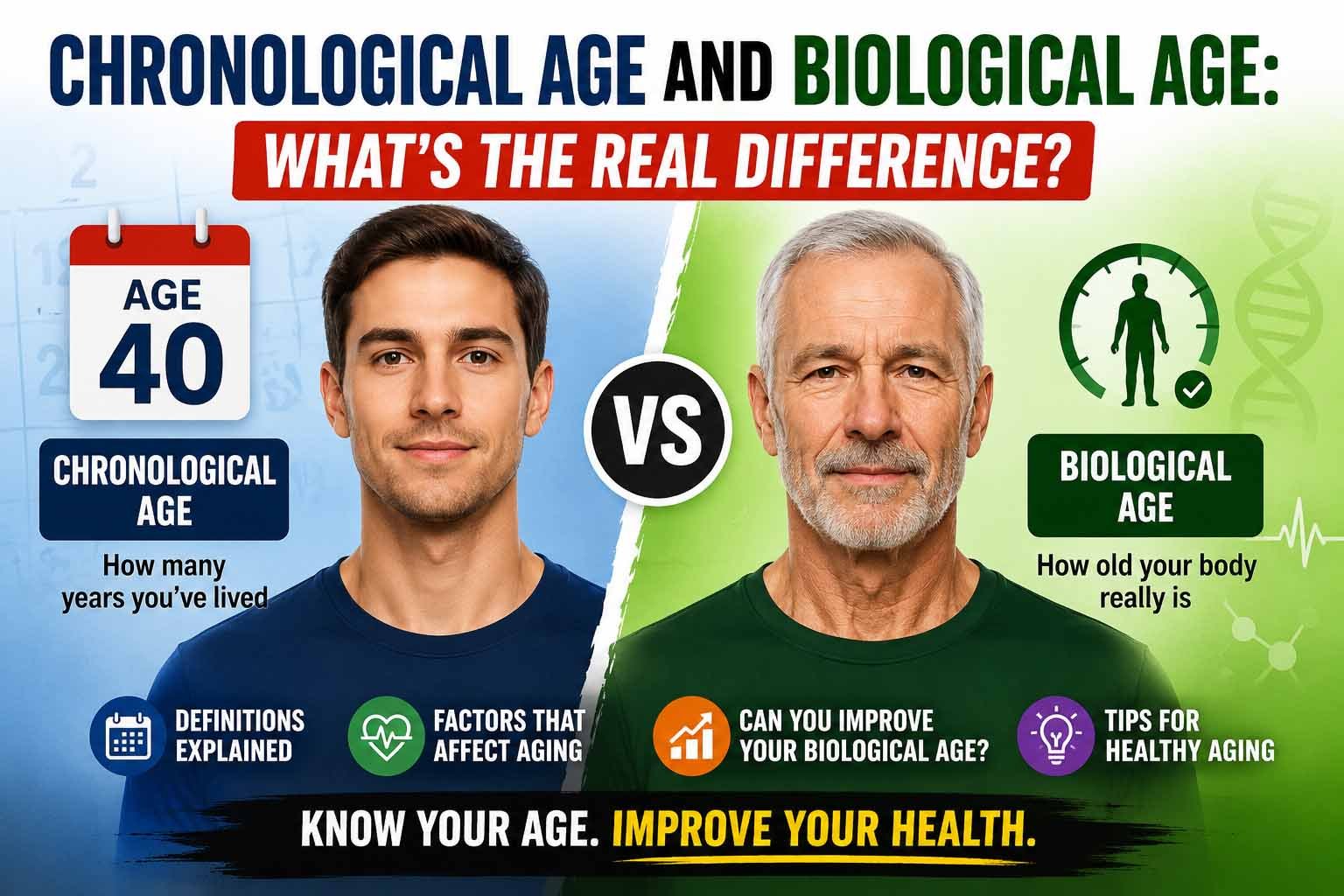
A 45-year-old marathon runner and a 45-year-old office worker who hasn't exercised in a decade. Both have the same birth year. Both are the same age on paper. But their bodies tell completely different stories.
This isn't a hypothetical. It's happening every day in clinics, research labs, and living rooms around the world. And it raises a question that science is only beginning to fully answer: if two people can be the same age yet age so differently, what does "age" even mean?
Here's what you need to know about the two types of age that shape your health, your lifespan, and how you feel every single day — and why understanding the difference between chronological age and biological age matters more than you might think.
Table of Contents
What Chronological Age Actually Tells You
Chronological age is the number of years, months, and days since you were born. It's the age on your driver's license. It's what you write on medical forms. It's what people ask when they say, "How old are you?"
It's simple. It's objective. And it's completely unchangeable.
Every birthday adds exactly one year. There's no negotiation. No exceptions. If you were born in 1980, you are 46 in 2026. That's not an opinion. It's arithmetic.
But here's what chronological age doesn't tell you:
- How much energy you have
- How well your heart functions
- How quickly your body repairs itself
- How vulnerable you are to disease
- How many healthy years you have ahead
Chronological age is useful for legal purposes, insurance calculations, and retirement planning. It tells society where you fit in various systems. But it tells you almost nothing about the actual condition of your body.
Your chronological age is a number. Your biological age is a story. And stories can change.
Why We Rely on Chronological Age
There are good reasons chronological age became the standard. It's easy to verify. It doesn't require medical tests. It's consistent across every person and every culture.
Want to calculate your exact age instantly? Use our Age Calculator.
Schools use it to place children in grade levels. Governments use it to determine voting eligibility. Insurance companies use it to calculate risk. The law uses it to define adulthood, retirement, and countless other milestones.
In all these cases, chronological age serves its purpose well. It's a convenient, universal metric.
But convenience and universality don't make it accurate when it comes to health. That's where the distinction between chronological age and biological age becomes critical.
What Biological Age Actually Tells You
Biological age measures how well your body is functioning compared to others of the same chronological age. It reflects the health of your cells, your organs, your metabolism, and your immune system.
Think of it this way: chronological age is how long you've been alive. Biological age is how much wear and tear your body has accumulated during that time.
Two cars from the same year can have vastly different conditions. One might have 50,000 carefully maintained miles. Another might have 200,000 hard-driven miles. Same model year. Different actual condition.
Your body works the same way. That's why the gap between chronological age and biological age can be so wide — and so revealing.
What Influences Biological Age
Biological age isn't determined by your birthday. It's determined by what happens between birthdays.
- Physical activity: Regular movement keeps your cardiovascular system efficient and your muscles strong.
- Sleep quality: Restorative sleep allows your body to repair cellular damage.
- Nutrition: What you eat provides the raw materials your body uses to maintain and rebuild itself.
- Stress levels: Chronic stress floods your body with hormones that accelerate cellular aging.
- Smoking: Tobacco introduces thousands of chemicals that damage DNA and accelerate aging at the molecular level.
- Alcohol consumption: Excessive drinking stresses your liver and other organs.
- Genetics: Your inherited traits set certain baselines, though lifestyle often matters more.
Some of these factors are within your control. Some aren't. But even the factors you can't change don't tell the whole story. Epigenetics — how your environment affects how your genes express themselves — means that lifestyle choices can influence your biological age regardless of your genetic starting point.
The Simple Difference: A Comparison
Here's a straightforward breakdown of how chronological age and biological age compare:
| Aspect | Chronological Age | Biological Age |
|---|---|---|
| What it measures | Time since birth | Body function and health |
| How it's determined | Simple date calculation | Medical tests and biomarkers |
| Can it change? | No. Always increases. | Yes. Can improve or worsen. |
| Accuracy | Exact | Estimated |
| Primary use | Legal, social, administrative | Health, wellness, longevity |
| Example | Born 1980 = 46 in 2026 | 46-year-old may function like 35 or 55 |
The difference between chronological age and biological age isn't complicated once you see it clearly. One is a count. The other is a condition.
Why Two People of the Same Age Can Have Completely Different Health
Let's make this concrete with two real-world examples.
Case 1: Sarah
Sarah is 52. She wakes up at 6 AM every morning without an alarm. She walks her dog for 45 minutes before breakfast. She eats mostly vegetables, fish, and whole grains. She sleeps seven hours each night. Her blood pressure is consistently in the healthy range. Her doctor once told her she has the cardiovascular system of a 40-year-old.
Case 2: Robert
Robert is also 52. He struggles to get out of bed. His job involves sitting at a desk for ten hours daily. His meals are often fast food or convenience items. He drinks two or three glasses of wine most evenings. His sleep is irregular and often interrupted. His blood pressure is borderline high. His doctor has warned him about his cholesterol levels.
Same chronological age. Radically different biological age.
Sarah's body has been maintained. Robert's body has been neglected. The calendar treats them equally. Their cells do not.
This isn't about morality or judgment. It's about cumulative effects. Small daily choices compound over decades. By the time you reach middle age, the difference between chronological age and biological age becomes impossible to ignore.
Which Age Matters More?
The honest answer: it depends on what you're trying to understand.
For Legal and Administrative Purposes
Chronological age matters exclusively. Courts don't care about your cellular health. They care about your birth certificate. The law operates on fixed milestones — voting at 18, drinking at 21, retirement at 67. Your biological age has no legal standing.
For Health and Longevity
Biological age matters more. It predicts disease risk. It predicts functional decline. It predicts how many healthy years you're likely to have ahead. Your doctor may not ask you about your biological age — but they're looking at markers that approximate it.
For Everyday Life
Both matter, but in different ways. Chronological age determines how society treats you. Biological age determines how you feel. A 60-year-old with a biological age of 50 may have more energy than a 50-year-old with a biological age of 60.
For Medical Research
Researchers study both. Chronological age helps with population-level statistics. Biological age helps scientists understand the mechanisms of aging. The two are complementary, not competing.
Think of it like a car's age versus its condition. Both are useful information. But one tells you what year it was made. The other tells you whether it's safe to drive.
Can You Improve Your Biological Age?
Yes. But there are important distinctions to make clear.
You cannot reverse your chronological age. That number will always increase. But you can improve your biological age — meaning you can make your body function more like someone younger.
When people talk about "slowing aging" or "reversing aging," they are usually talking about biological age, not chronological. And the evidence suggests that certain lifestyle interventions can genuinely improve how your body functions.
What the Evidence Shows
- Regular exercise improves cardiovascular fitness, muscle mass, metabolic health, and inflammation markers. Studies consistently show that active individuals have lower biological ages than sedentary peers.
- A nutrient-dense diet provides the micronutrients your cells need for repair and maintenance. Diets rich in vegetables, fruits, lean proteins, and healthy fats are associated with healthier aging.
- Quality sleep allows your body to perform critical maintenance processes. Chronic sleep deprivation accelerates cellular aging.
- Stress management reduces chronic cortisol exposure. High cortisol levels are linked to accelerated biological aging.
- Avoiding smoking and excessive alcohol prevents direct damage to DNA and organs.
These interventions don't promise immortality. They don't guarantee disease prevention. But they do shift your biological age in a healthier direction — narrowing the gap between chronological age and biological age.
Some emerging research suggests that certain interventions — like calorie restriction or specific supplements — may influence biological age markers. But much of this work is preliminary. Healthy lifestyle choices remain the most well-established approach.
How Is Biological Age Actually Measured?
If you want an accurate assessment of your biological age, you need more than a website quiz. You need medical testing.
Common Methods Include:
- Blood biomarkers: Tests for inflammation markers, cholesterol, blood sugar, and hormone levels.
- DNA methylation analysis: Often called "epigenetic clocks," these tests examine chemical modifications to your DNA that correlate with aging.
- Cardiovascular testing: Measures like VO2 max, resting heart rate, and blood pressure provide insight into heart health.
- Body composition analysis: Muscle mass versus body fat percentage.
- Clinical assessments: Cognitive function tests, lung function tests, and other clinical measures.
These tests provide estimates, not absolute numbers. Your biological age isn't a single precise figure. It's a range based on multiple markers.
And importantly: no online calculator can accurately measure your biological age. Any website claiming to do so with a few questions is misleading.
How to Calculate Your Chronological Age
Calculating chronological age is straightforward. You subtract your birth date from today's date.
For example:
- If today is August 5, 2026, and you were born on August 5, 1990, you are exactly 36 years old.
- If you were born on March 15, 1990, you are 36 years, 4 months, and 21 days old on this date.
You can also express your chronological age in:
- Years
- Months
- Weeks
- Days
- Hours
- Minutes
- Seconds
This is the simplest calculation in the article. And it's the only age you can determine without medical testing.
Common Myths About Age
There are plenty of misunderstandings about how age works. Here are the most common ones.
Myth: Biological age equals chronological age
It doesn't. They are different measurements entirely. Your biological age can be years higher or lower than your chronological age.
Myth: Only older people need to think about this
Your 20s and 30s are when your habits set the trajectory for later life. The choices you make early on compound over time.
Myth: Exercise completely stops aging
Exercise slows the aging process and improves biomarkers. But it doesn't stop aging. No intervention does.
Myth: Online calculators can measure biological age
They can't. Biological age requires medical testing and professional interpretation. Any website claiming otherwise is oversimplifying.
Myth: Your biological age is fixed
Your biological age can change. It responds to lifestyle, environment, and medical interventions. This is one of the most hopeful findings in aging research.
Frequently Asked Questions
What is the difference between chronological age and biological age?
Chronological age measures time since birth. Biological age measures body function. One is a calendar measurement. The other is a health measurement. Understanding both chronological age and biological age gives you a fuller picture of your health.
Can your biological age be lower than your chronological age?
Yes. Healthy lifestyle habits — exercise, nutrition, sleep, stress management — can lower your biological age below your chronological age.
How is biological age measured?
Through blood biomarkers, DNA methylation tests, cardiovascular fitness assessments, body composition analysis, and clinical evaluations. It requires professional medical testing.
Does chronological age matter for health?
Yes. It provides a baseline for screenings and risk assessments. Doctors use it alongside other metrics to make clinical decisions.
Can I measure my biological age at home?
Not accurately. Biological age requires laboratory tests and professional interpretation. You can, however, calculate your chronological age easily at home.
Why do two people of the same age have different health?
Because chronological age doesn't account for lifestyle, genetics, medical history, or environmental factors. These differences drive biological age.
Can exercise reduce biological age?
Regular exercise improves biomarkers associated with aging — cardiovascular fitness, muscle mass, metabolic health. It can lower biological age but does not reverse chronological age.
What is an epigenetic clock?
It's a tool that measures DNA methylation patterns to estimate biological age. It's one of the most accurate methods scientists currently have.
Is biological age more important than chronological age?
It depends. Chronological age matters for legal and social purposes. Biological age matters for health and longevity. Both are useful in different contexts.
How do I calculate my chronological age?
Subtract your birth date from today's date.
Related Age Calculation Guides
Understanding chronological age is useful when comparing different ways of measuring age. If you want to calculate chronological age from a birth date, see our Calculate Chronological Age guide. For the broader calculation process, visit our Age Calculator Guide or learn how the calculation works in our Age Calculator Explained guide.
What This Means for You
The most practical takeaway is simple: you have more control over your aging than your birthday suggests.
Your chronological age tells you how long you've been alive. Your biological age tells you how much life you've used up — and how much you might still have.
You can't change the year you were born. But you can influence how your body responds to each passing year.
Start with the basics. Move your body regularly. Eat food that nourishes. Prioritize sleep. Manage stress. Avoid tobacco. Limit alcohol. These aren't revolutionary suggestions. They're the foundation of healthy aging.
And if you want to know exactly how many years, months, and days you've been alive — your precise chronological age — our Age Calculator gives you a precise answer in seconds.
Your chronological age is just the beginning of the story. The rest depends on what you do between birthdays.
Outbound Links (Authoritative Sources)
- World Health Organization (WHO) – Physical activity guidelines:
https://www.who.int/news-room/fact-sheets/detail/physical-activity - CDC – Sleep and chronic disease:
https://www.cdc.gov/sleep/index.html - National Institute on Aging – Stress and aging:
https://www.nia.nih.gov/health/stress-and-aging - Nature Reviews Genetics – Epigenetics and aging:
https://www.nature.com/articles/s41576-018-0004-3 - Aging Cell – Epigenetic clocks and biological age:
https://www.ncbi.nlm.nih.gov/pmc/articles/PMC3780611/
Share this article 👇

0 Comments