
Table of Contents
Percentage error tells you how far a measured or estimated value is from the true or accepted value, expressed as a percentage of the true value. The formula is Percentage Error = |(Measured Value − Actual Value) ÷ Actual Value| × 100. It's a standard way to assess accuracy in science labs, engineering tests, financial forecasts, and everyday estimates.
This guide explains what percentage error actually measures, how to calculate it correctly, what the result means, and where a percentage error calculator fits into the process.
What Is Percentage Error?
Percentage error is a measurement of how inaccurate a value is compared to a reference value. The reference value — often called the actual, true, accepted, or theoretical value — is the baseline. The measured or estimated value is what you got from an experiment, a forecast, a tool, or a quick calculation.
The result is always expressed as a positive percentage. The absolute value in the formula ensures that whether your measured value is too high or too low, the percentage error reflects the size of the discrepancy, not the direction.
For example, if you measure a table as 98 cm long when its actual length is 100 cm, the percentage error is 2%. The direction of the error — short by 2 cm — doesn't matter in the percentage error itself. What matters is how large the difference is relative to the true value.
Why Percentage Error Matters
Raw error tells you the size of a mistake: 2 cm, $50, 0.4 seconds. But raw error doesn't tell you whether that mistake is significant. A 2 cm error on a 100 cm table is far less serious than a 2 cm error on a 5 cm component.
Percentage error normalizes the error relative to the reference value. It gives you a scale-independent way to compare accuracy across different measurements, experiments, or estimation methods. A 3% error in a chemistry lab might be excellent, while a 3% error in a financial forecast might be disastrous. Context matters, but percentage error gives you a consistent starting point.
The Percentage Error Formula
The formula is straightforward:
Percentage Error = |(Measured Value − Actual Value) ÷ Actual Value| × 100
Breaking it down:
- Measured Value: The value you obtained or estimated.
- Actual Value: The true, accepted, or reference value.
- Measured Value − Actual Value: The raw error, which can be positive or negative.
- Absolute value: Ensures the final percentage error is always positive.
- Division by Actual Value: Converts the raw error into a relative measure.
- Multiplication by 100: Converts the decimal into a percentage.
Some fields use a variation called percent difference when neither value is a clear reference. That formula divides by the average of the two values instead of the actual value. Don't confuse the two. Percentage error assumes you have a known true value.
Worked Examples
Example 1: Laboratory Measurement
A student measures the boiling point of water as 98.5°C. The accepted value is 100°C. What's the percentage error?
Percentage Error = |(98.5 − 100) ÷ 100| × 100
Percentage Error = |−1.5 ÷ 100| × 100
Percentage Error = |−0.015| × 100
Percentage Error = 1.5%
The student's measurement has a 1.5% error, which is reasonable for basic lab equipment.
Example 2: Sales Forecast
A business projected $250,000 in quarterly revenue. Actual revenue came in at $218,000. What's the percentage error in the forecast?
Percentage Error = |(218,000 − 250,000) ÷ 250,000| × 100
Percentage Error = |−32,000 ÷ 250,000| × 100
Percentage Error = |−0.128| × 100
Percentage Error = 12.8%
The forecast was off by 12.8%. Whether that's acceptable depends on the business context, but the number gives a clear accuracy benchmark.
Example 3: Everyday Estimate
You estimate a car trip will take 90 minutes. It actually takes 105 minutes. What's the percentage error?
Percentage Error = |(105 − 90) ÷ 90| × 100
Percentage Error = |15 ÷ 90| × 100
Percentage Error = 16.7%
Your time estimate was off by about 17%. That's useful information when planning future trips.
Percentage Error vs. Percent Difference
These two terms are often used interchangeably, but they serve different purposes.
Percentage error compares a measured or estimated value against a known true value. You need a reference point that you trust as correct. This is common in science, engineering, and quality control where accepted standards exist.
Percent difference compares two values when neither is considered the true reference. It's used when you have two measurements or estimates and want to know how far apart they are. The formula is:
Percent Difference = |(Value 1 − Value 2) ÷ ((Value 1 + Value 2) ÷ 2)| × 100
For example, if two scales give readings of 72 kg and 74 kg for the same object, and you don't know the true weight, you'd use percent difference. If you know the object weighs exactly 73 kg, you'd use percentage error against that true value.
Interpreting Percentage Error Results
What counts as a "good" percentage error varies by field:
- In many high school and college physics or chemistry labs, under 5% is often considered acceptable, and under 2% is good.
- In precision engineering, errors may need to be well under 1%, often measured in fractions of a percent.
- In financial forecasting, even a 10% error may be considered strong performance depending on the volatility of what's being forecast.
- In everyday estimates, 10–20% error is common and often acceptable.
The key point: percentage error gives you a number. Whether that number is good or bad depends on the context, the measurement method, and the consequences of being wrong.
Common Mistakes When Calculating Percentage Error
Dividing by the measured value instead of the actual value
The denominator should always be the actual or accepted value, not the measured value. Using the wrong denominator changes the result. If you measure 98 cm against a true value of 100 cm, dividing by 98 gives 2.04%, while dividing by 100 gives 2%. The difference is small here but grows with larger errors.
Forgetting the absolute value
Some people report percentage error as negative when the measured value is lower than the actual value. That's a mistake. Percentage error is a magnitude, not a direction. If you also want to communicate direction, report the raw error separately: "The measurement was 2 cm short, a 2% error."
Using percent difference when percentage error is appropriate
If you have a known true value, use percentage error. Percent difference is only for situations where neither value is a trusted reference. Mixing them up gives you an inaccurate picture of your measurement quality.
Confusing percentage error with percentage change
Percentage change measures how a value changed over time: (New − Old) ÷ Old × 100. Percentage error measures accuracy against a reference. They use similar math but answer completely different questions.
When a Percentage Error Calculator Helps
Manual percentage error calculation is simple enough when you're dealing with round numbers. But real-world data rarely cooperates. You might have values like 47.83 and 46.12, or you might need to calculate error across dozens of data points.
This is where a percentage error calculator earns its place. You enter the measured value and the actual value, and it returns the percentage error immediately. There's no risk of flipping the numerator and denominator or dropping the absolute value. The result is consistent, which matters when you're comparing errors across multiple measurements.
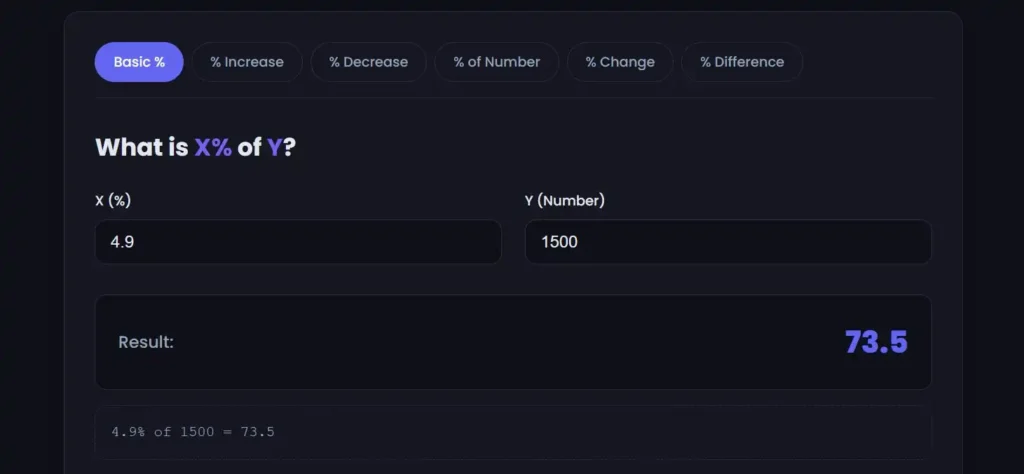
The MiniToolsPro Percentage Calculator includes percentage error functionality among its percentage tools. It's useful for students checking lab results, engineers validating measurements, or analysts reviewing forecast accuracy.
Real-World Applications of Percentage Error
Science and Laboratory Work
Students and researchers regularly compare experimental results to accepted values. Whether measuring gravity, chemical concentrations, or the speed of sound, percentage error provides a standardized way to report how close the experiment came to reality.
Manufacturing and Quality Control
Production lines often specify tolerance levels as percentages. A component designed to be 50 mm with a tolerance of ±2% must fall between 49 mm and 51 mm. Percentage error calculations verify whether parts meet specifications.
Financial Forecasting
Analysts track forecast error to improve future projections. If quarterly revenue forecasts consistently show 15% error, the forecasting model or assumptions need adjustment. Percentage error makes those trends visible across different revenue scales.
Sports and Fitness
Fitness trackers estimate calorie burn, distance, and heart rate. Comparing those estimates to more accurate reference measurements lets you quantify how reliable a device is. A 5% error on a 400-calorie estimate means the true value could be off by roughly 20 calories — meaningful if you're tracking intake closely.
How to Reduce Percentage Error
If your percentage error is higher than you'd like, consider these factors:
- Instrument precision: More precise measurement tools typically reduce error.
- Measurement technique: Consistent, careful technique matters more than people expect.
- Sample size: In experiments and surveys, larger samples usually reduce random error.
- Calibration: Instruments that aren't properly calibrated introduce systematic error.
- Environmental conditions: Temperature, humidity, and other factors can affect measurements.
Percentage error doesn't tell you the cause of the error — only its size. But tracking it over time can help you identify when something in your process has changed.
Frequently Asked Questions
What is the formula for percentage error?
Percentage Error = |(Measured Value − Actual Value) ÷ Actual Value| × 100. The absolute value ensures the result is always positive.
Can percentage error be negative?
No. The absolute value in the formula means percentage error is always reported as a positive number. The direction of the error is captured separately by the raw error value.
What's the difference between percentage error and percent difference?
Percentage error compares a measured value to a known true value. Percent difference compares two values when neither is a trusted reference. Percentage error uses the actual value as the denominator, while percent difference uses the average of the two values.
What is a good percentage error?
It depends on the field. In many educational labs, under 5% is acceptable and under 2% is good. In precision engineering, errors under 1% are often required. In financial forecasting, 10% or more may still be considered useful.
Can I use a percentage error calculator for any type of measurement?
Yes, as long as you have a measured value and an actual or reference value. The calculation is unit-agnostic — it works for lengths, weights, temperatures, financial figures, time estimates, and any other measurable quantity.
What if my actual value is zero?
Percentage error is undefined when the actual value is zero because division by zero isn't possible. If the true value is zero, you'll need to use raw error or another relative measure appropriate for your context.
Making Accuracy Part of Your Workflow
Percentage error is a small calculation with outsized importance. It converts raw mistakes into meaningful comparisons and lets you assess accuracy across completely different contexts. Whether you're checking a lab result, validating a forecast, or just curious how far off your estimate was, the formula gives you a clear answer.
When you need the number quickly or want to check several values without manual arithmetic, the MiniToolsPro Percentage Calculator handles percentage error alongside other percentage calculations. You'll get a consistent result and can move on to the more important work of interpreting what that result means.
Share this article 👇

0 Comments