
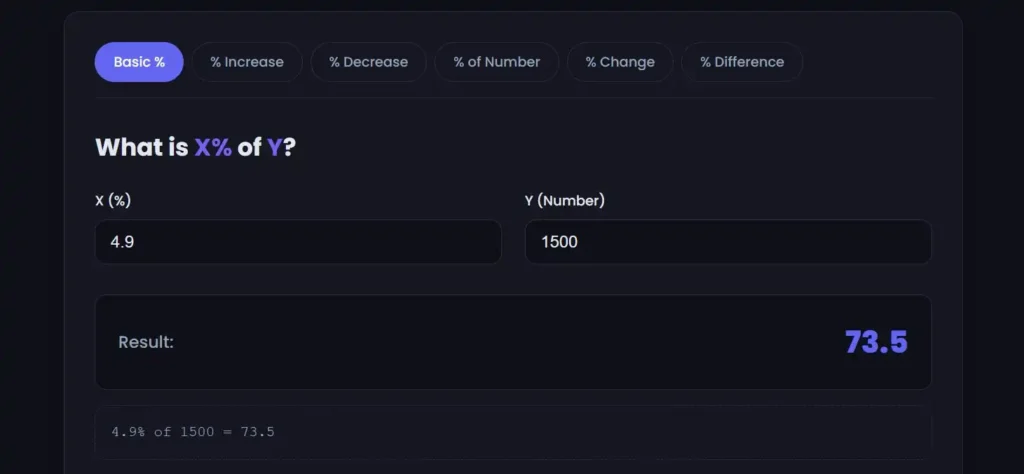
To calculate a percentage, divide the part by the whole, then multiply by 100. The formula is (Part ÷ Whole) × 100. That's the whole skill. Once you understand this single relationship, every percentage problem becomes the same problem with different numbers.
You can also skip the manual work and use a percentage calculator when you need an answer right now. But if you want actually to know what's happening — and be able to do this in your head at a restaurant or a store — keep reading.
Table of Contents
The Core Formula: Part Divided by Whole
Every percentage calculation starts with the same question: "What portion of this total am I looking at?"
The formula never changes:
Percentage = (Part ÷ Whole) × 100
Let's say you answered 42 questions correctly out of 50 on a test.
42 ÷ 50 = 0.84
0.84 × 100 = 84%
That's your score. 84%. No complicated steps, no special calculator needed.
Here's another one with money. You spent $27 on groceries, which was $30 over your $60 weekly budget.
27 ÷ 60 = 0.45
0.45 × 100 = 45%
You've used 45% of your grocery budget. You still have 55% left for the rest of the week.
How to Calculate a Percentage of a Number
This is the reverse direction. Instead of asking "what percent is A of B?" you're asking "what is X percent of Y?"
The formula flips slightly:
Result = (Percentage ÷ 100) × Number
Or in simpler terms: convert the percentage to a decimal, then multiply.
Example: What is 30% of 240?
30 ÷ 100 = 0.30
0.30 × 240 = 72
So 30% of 240 is 72.
Here's where people mess up. They see "30%" and try to do some division in their head, or they forget to move the decimal point. Just remember: percentage to decimal means moving the decimal two places to the left. 30% becomes 0.30. 7% becomes 0.07. 150% becomes 1.50. That's the whole trick.
How to Calculate Percentage Increase or Decrease
Percentage change answers a different question: "How much did this number move compared to where it started?"
The formula:
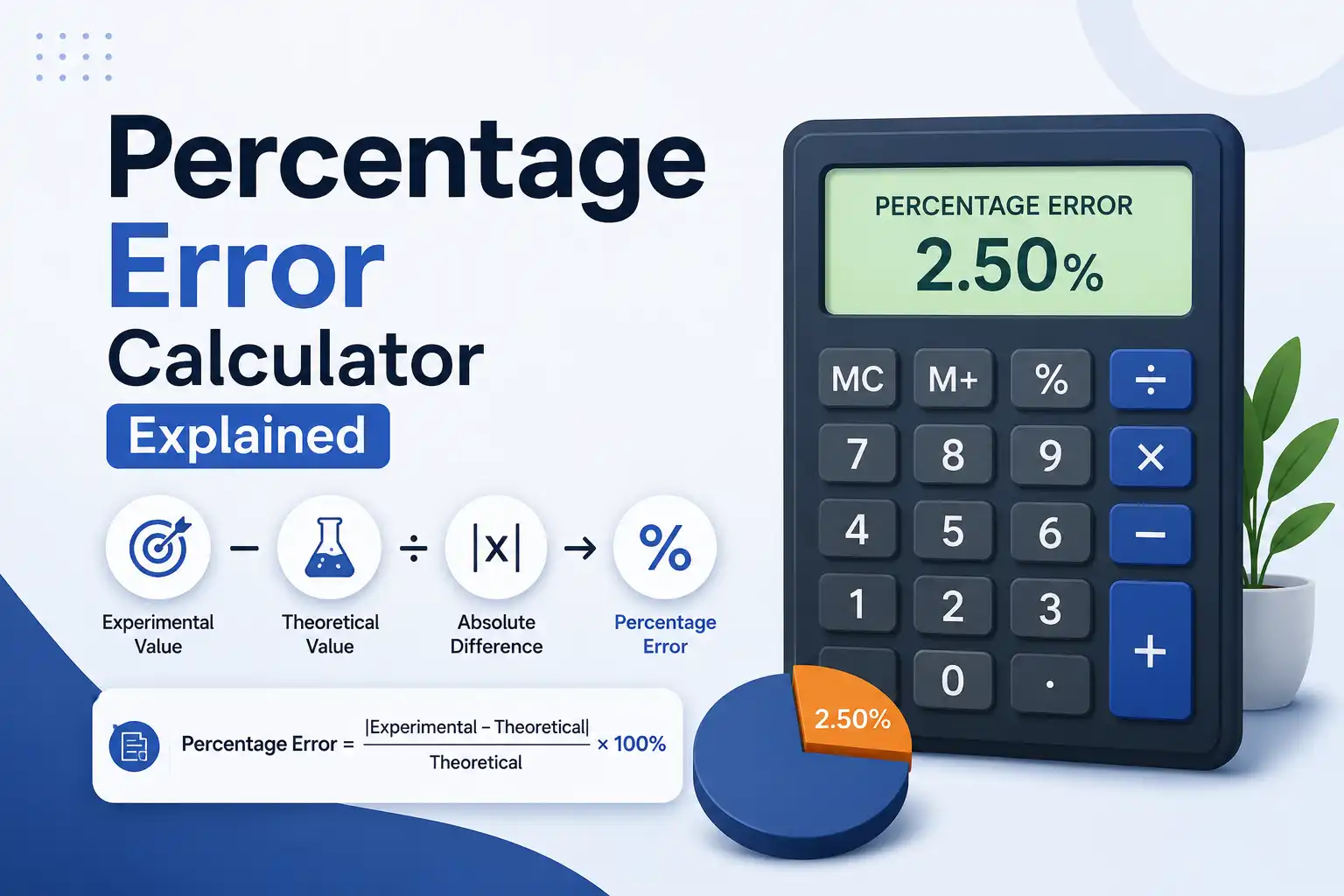
Percentage Change = ((New Number − Old Number) ÷ Old Number) × 100
Always divide by the original number. Never the new one. That's the most common mistake people make.
Example of increase: Your electric bill went from $95 to $118 last month.
118 − 95 = 23
23 ÷ 95 = 0.2421
0.2421 × 100 = 24.2%
Your bill increased 24.2%. That's a significant jump — worth checking if you left a space heater running.
Example of decrease: A jacket originally priced at $85 is now selling for $51.
51 − 85 = −34
−34 ÷ 85 = −0.40
−0.40 × 100 = −40%
That's a 40% discount. Not bad.
If you want to go deeper on this specific calculation, check out our guide on how to calculate percentage change. It walks through several real scenarios step by step.
The Fast Mental Math Tricks
You don't always need a formula. For common percentages, you can do the math in your head faster than you can pull out your phone.
10% of any number: Move the decimal one place left. 10% of $47 is $4.70.
5% of any number: Take 10%, then divide by 2. 5% of $47 is $2.35.
20% of any number: Take 10%, then double it. 20% of $47 is $9.40.
15% tip: Take 10%, add half of that. On a $62 meal: 10% is $6.20. Half is $3.10. Add them — $9.30 tip.
These tricks work because percentages are just fractions. 10% is 1/10. 25% is 1/4. 50% is 1/2. 75% is 3/4. If you know the fractions, you know the percentages.
For example, 25% off a $48 item? 25% is one quarter. $48 ÷ 4 = $12. You save $12. Final price: $36.
Common Percentage Calculations in Real Life
Calculating a Tip
The standard tip in the US is 15% to 20% of the pre-tax bill. For a $54 meal:
20% tip = $54 × 0.20 = $10.80
Total with tip = $64.80
If service was average, 15% works out to $8.10. Many people just round to the nearest dollar — so $11 on a $54 bill is roughly a 20% tip.
Always tip on the pre-tax amount, not the after-tax total. Sales tax can be 8-10% in some states. Tipping on the taxed total means you're tipping on the tax itself. Servers won't complain, but it's not standard practice.
Calculating a Discount
A store says "35% off" on a $120 item.
$120 × 0.35 = $42 (that's your discount)
$120 − $42 = $78 (that's what you pay)
Or skip the two-step: multiply by 0.65 directly. $120 × 0.65 = $78. Same answer, fewer steps.
Calculating a Grade
You have an 82% going into the final. The final is worth 25% of your grade. What do you need to get an A (90%)?
Current: 82 × 0.75 = 61.5
Needed from final: 90 − 61.5 = 28.5
Final exam score needed: 28.5 ÷ 0.25 = 114%
You need a 114% on the final. That's impossible. So you can't get an A. But you could still get a B if you score at least a 74% on the final. This kind of math helps you set realistic expectations.
If you're working with multiple grades and weights, an average calculator can help you see the full picture without doing five separate calculations.
How to Calculate Percentage on a Calculator
If you have a basic calculator, here's the fastest method:
To find 25% of 80:
80 × 25 % = 20
Most calculators have a % button. Just type the number, hit multiply, type the percentage, then hit %. The calculator does the conversion for you.
If your calculator doesn't have a % button, do this:
80 × 0.25 = 20
Same answer. The % button is just a shortcut for dividing by 100.
For percentage change on a calculator:
New number − old number = difference
Difference ÷ old number = decimal
Decimal × 100 = percentage
Or use an online percentage calculator and skip all of that.
Frequently Asked Questions
How do you calculate percentage manually?
Divide the part by the whole, then multiply by 100. For example, if you got 18 out of 24 questions right: 18 ÷ 24 = 0.75, then 0.75 × 100 = 75%.
What is the easiest way to calculate a percentage?
Convert the percentage to a decimal by dividing by 100, then multiply. For 20% of 50: 20 ÷ 100 = 0.20, then 0.20 × 50 = 10. This works for any percentage and any number.
How do I calculate percentage on a calculator?
Multiply the number by the percentage, then press the % button. For example, type 60 × 15 %, and the calculator shows 9. If there's no % button, multiply by the decimal form: 60 × 0.15 = 9.
What is 20% of 150?
20% of 150 is 30. Calculation: 20 ÷ 100 = 0.20, then 0.20 × 150 = 30.
How do you calculate percentage increase or decrease?
Subtract the old number from the new number, divide by the old number, then multiply by 100. A positive result means increase. A negative result means decrease.
You don't need to memorize twenty different formulas. Just remember one: (Part ÷ Whole) × 100. Everything else — discounts, tips, percentage change, grades — is just a variation of that core idea. And when you're juggling multiple numbers or need a quick double-check, the percentage calculator handles it in about two seconds.
Learning the basic percentage formula makes it easier to solve many everyday problems, but different situations may require different approaches. For a complete overview of percentage calculations, visit our Percentage Calculator: How to Calculate Percentages Easily. It covers the main percentage formulas and explains how to apply them to common calculation scenarios.
Share this article 👇
0 Comments