
Table of Contents
To calculate a percentage of a number, convert the percentage to a decimal and multiply it by the number. The formula is: Result = (Percentage ÷ 100) × Number. For example, 25% of 80 is (25 ÷ 100) × 80 = 0.25 × 80 = 20. That's the core method, and once you understand it, you can apply it to discounts, taxes, tips, test scores, and dozens of other everyday situations.
This guide breaks down the calculation step by step, shows you several ways to solve percentage problems, and explains common mistakes that trip people up. You'll also find practical examples and a faster way to get answers when you don't want to do the math manually.
What Does "Percentage of a Number" Actually Mean?
A percentage is simply a fraction out of 100. The word itself comes from "per cent," which means "per hundred." When you calculate a percentage of a number, you're really answering the question: If I split this number into 100 equal parts, how many of those parts am I taking?
So when someone says "15% of 200," they're asking for 15 out of every 100 parts of 200. Since 200 is two groups of 100, 15% of 200 is 30. That's why the decimal method works: 15% becomes 0.15, and 0.15 × 200 = 30.
Understanding this underlying concept matters because it means you can reason about percentages even when you don't have a calculator handy. You can estimate, break numbers apart, and check whether an answer makes sense.
The Basic Formula for Finding a Percentage of a Number
The standard formula is:
Result = (Percentage ÷ 100) × Number
Here's what each part means:
- Percentage — the percentage you want to find, such as 20, 35, or 7.5
- Number — the base value you're taking the percentage of
- Result — the portion of the number that corresponds to the percentage
The division by 100 converts the percentage into its decimal equivalent. Then the multiplication applies that decimal to the base number. The order doesn't matter mathematically: you can divide first and then multiply, or multiply first and then divide by 100. Both approaches give the same result.
Step-by-Step Example: Finding 18% of 450
Let's work through a complete example to see the method in practice.
Step 1: Write down the percentage you need to find. In this case, it's 18.
Step 2: Convert 18% to a decimal by dividing by 100. That gives you 0.18.
Step 3: Multiply the decimal by the base number: 0.18 × 450 = 81.
Answer: 18% of 450 is 81.
You can verify this makes sense. Ten percent of 450 is 45, and 20% would be 90. Since 18% is just below 20%, the answer should be just below 90. And 81 fits that expectation.
Different Ways to Solve Percentage Problems
The decimal method is the most direct, but it isn't the only approach. Depending on the numbers involved, another method might be faster or easier to do in your head.
Method 1: Decimal Multiplication
Convert the percentage to a decimal and multiply. This is the most reliable method for any numbers.
Example: 12% of 340 = 0.12 × 340 = 40.8
Method 2: Fraction Method
Convert the percentage to a fraction and multiply. Common percentages map to simple fractions: 50% is ½, 25% is ¼, 10% is 1/10, 20% is 1/5, and so on.
Example: 25% of 88 = ¼ × 88 = 22
This method shines when the percentage matches a familiar fraction. For less common percentages like 37%, the decimal method is usually simpler.
Method 3: The 10% Shortcut
Find 10% of the number by moving the decimal point one place to the left, then scale from there. This works well for mental math.
Example: Find 30% of 150. First, 10% of 150 is 15. Then multiply by 3: 15 × 3 = 45. So 30% of 150 is 45.
Example with a non-round percentage: Find 15% of 80. Ten percent of 80 is 8. Five percent is half of that, so 4. Add them together: 8 + 4 = 12. So 15% of 80 is 12.
Method 4: Direct Proportion
Set up a proportion and solve for the unknown. This method can feel more intuitive if you think visually about ratios.
Example: What is 20% of 250?
20 / 100 = x / 250
Cross-multiply: 100x = 20 × 250 = 5,000
Divide: x = 50
This approach takes more steps, but it reinforces what a percentage actually represents.
Common Real-World Applications
Calculating a percentage of a number comes up constantly in daily life. Here are the situations where you'll most often use it.
Discounts and Sale Prices
When a store advertises "30% off," you need to find 30% of the original price to know how much you're saving. Subtract that amount from the original price to get the sale price.
Example: A jacket costs $140 and is 25% off. Savings: 0.25 × 140 = $35. Sale price: 140 − 35 = $105.
Sales Tax
Sales tax is typically expressed as a percentage of the purchase price. If tax is 8%, you calculate 8% of the subtotal and add it to the total.
Example: A meal costs $60 before tax, and the tax rate is 8%. Tax: 0.08 × 60 = $4.80. Total: $64.80.
Tips at Restaurants
Tipping usually involves finding 15%, 18%, or 20% of the bill. The 10% shortcut works well here.
Example: A bill is $52. Find a 20% tip. Ten percent is $5.20. Double it: $10.40. That's the tip.
Test Scores and Grades
If a test has 80 questions and a student answers 68 correctly, you calculate the percentage score: (68 ÷ 80) × 100 = 85%. The reverse also applies: to find how many questions equal 85% of 80, calculate 0.85 × 80 = 68.
Financial Calculations
Interest rates, investment returns, loan payments, and budget allocations all involve percentages. If you earn 4% interest on a $5,000 savings balance, that's 0.04 × 5,000 = $200 per year.
Common Mistakes When Calculating Percentages
Even simple percentage calculations can go wrong. Here are the most frequent errors and how to avoid them.
Forgetting to Divide by 100
The most common mistake is multiplying by the percentage directly without converting it first. If you multiply 25 × 80 to find 25% of 80, you'll get 2,000 instead of 20. The result is 100 times too large. Always divide the percentage by 100 first.
Mixing Up the Base Number
People often apply a percentage to the wrong number. For example, if a price increases from $100 to $120 and then decreases by 20%, the decrease is 20% of $120, not 20% of $100. That's a reduction of $24, not $20. The result is $96, not $100. The base number matters.
Confusing Percentage Points with Percentages
If an interest rate rises from 4% to 5%, that's an increase of one percentage point. But it's also a 25% relative increase, because 1 is 25% of 4. The two concepts are different and often misunderstood.
Rounding Too Early
When you're calculating percentages with decimals, rounding the intermediate values can introduce errors. For example, if you're working with 33% of 700 and you round 33% to 30% before calculating, you'll get 210 instead of 231. Round only the final answer, not the intermediate steps.
Misplacing the Decimal Point
With percentages that have decimals, like 7.5% or 0.5%, it's easy to make a conversion error. Seven-and-a-half percent is 0.075, not 0.75. Half a percent is 0.005, not 0.5. Double-check your decimal placement when the percentage is less than 1% or includes a fractional component.
How to Check Your Answer
You don't need to take a percentage calculation on faith. A few quick checks can help you catch errors.
Use benchmark percentages. Ten percent of any number is that number divided by 10. One percent is the number divided by 100. If 10% of 240 is 24, then 20% should be around 48, and 30% should be around 72. If your answer for 25% of 240 comes out to 120, something is wrong.
Check that the result is smaller than the base. For any percentage below 100%, the result must be smaller than the original number. If you get a result larger than the base, you've likely skipped the division step.
Reverse the calculation. If you calculate that 15% of 240 is 36, you can check by dividing 36 by 240. The result should be 0.15, or 15%. If it doesn't match, an error occurred somewhere.
When the Percentage Includes Decimals or Fractions
Percentages don't have to be whole numbers. You might need to find 12.5% of a value, or 0.75% of a quantity. The same method applies, but the conversion requires more care.
Example: Find 12.5% of 320.
Convert to decimal: 12.5 ÷ 100 = 0.125
Multiply: 0.125 × 320 = 40
Example: Find 0.75% of 600.
Convert to decimal: 0.75 ÷ 100 = 0.0075
Multiply: 0.0075 × 600 = 4.5
These calculations are more error-prone by hand, which is exactly when an online calculator becomes genuinely useful.
When You Might Want a Calculator Instead
The manual method is worth knowing because it helps you estimate and verify results. But there are times when reaching for a calculator makes more sense than doing the arithmetic yourself.
- When the percentage involves multiple decimal places
- When the base number is large or awkward
- When you need a precise result quickly
- When you're doing several percentage calculations in a row
- When you're on a mobile device and want a fast answer
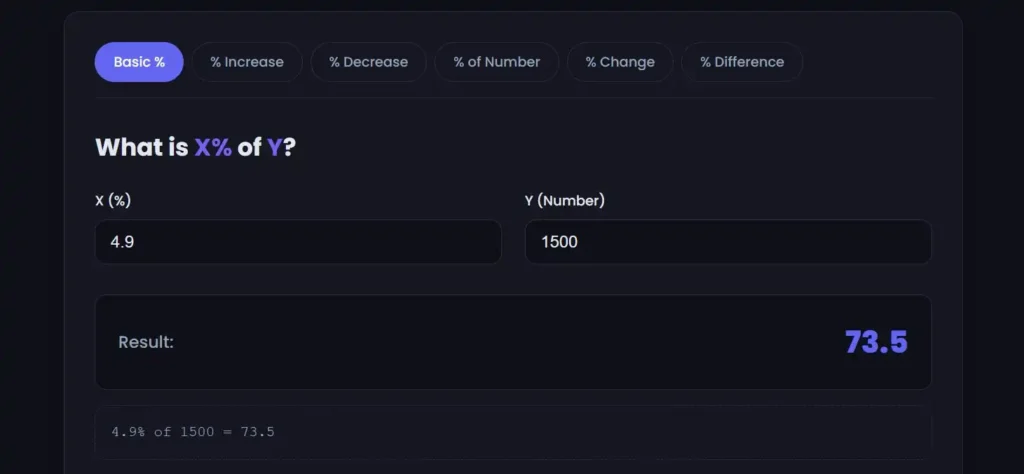
In those cases, you can use the MiniToolsPro percentage calculator to find the percentage of a number instantly. You enter the percentage and the base value, and the tool applies the formula correctly every time — no decimal conversion needed on your part.
Frequently Asked Questions
What is the easiest way to calculate a percentage of a number?
Convert the percentage to a decimal by dividing by 100, then multiply by the number. For quick mental math, find 10% of the number by moving the decimal point one place left, then multiply or divide that amount as needed.
How do I find a percentage without a calculator?
Use benchmark values. Find 10% by dividing by 10, find 1% by dividing by 100, then combine those amounts. For example, to find 16% of 50, calculate 10% (5) plus 6% (three times 1%, or 1.5 × 3 = 4.5), giving 9.5. Adjust based on the specific percentage.
What is the difference between finding a percentage of a number and finding what percent one number is of another?
Finding a percentage of a number means calculating a portion of a known base value, like finding 20% of 150. Finding what percent one number is of another means determining the relative size, like asking what percent 30 is of 150. The first multiplies; the second divides.
Why does my percentage calculation give a result larger than the original number?
You likely forgot to divide the percentage by 100 before multiplying. For example, multiplying 50 × 40 directly gives 2,000, but 50% of 40 should be 20. Divide the percentage by 100 first, and the result will be correct.
Can a percentage of a number be greater than the number itself?
Only if the percentage is greater than 100%. For example, 150% of 80 is 120, which is larger than 80. For any percentage below 100%, the result will always be smaller than the base number.
Putting It to Work
Next time you need to calculate a discount, figure out a tip, determine tax, or solve any other percentage problem, start with the formula: divide the percentage by 100, then multiply by the base number. Use the mental math shortcuts when the numbers are friendly, and check your work against benchmark values like 10% and 1%.
If you'd rather not do the arithmetic at all, the MiniToolsPro percentage calculator handles the calculation for you in seconds. But even with the tool, knowing the underlying method helps you verify that the answer you get makes sense.
Calculating a percentage of a number is one of the most common percentage problems, whether you are working with prices, grades, statistics, or everyday calculations. For a wider look at percentage calculations and the formulas behind them, visit our Percentage Calculator: How to Calculate Percentages Easily. It explains the core concepts and shows how different types of percentage problems can be solved.
Share this article 👇
0 Comments