
Table of Contents
You're baking a cake and the recipe calls for 180°C, but your oven is in Fahrenheit. Or you're traveling to Europe and the weather app says it's 30°C, but you don't know if that's hot or cold. Sound familiar? These little moments of confusion happen to everyone. Temperature is a universal measure, but how we express it differs around the world.
Whether you're cooking, planning a trip, studying science, or just curious, you've likely needed a temperature converter at some point. The good news is you don't need a degree in thermodynamics to figure it out. With the right tools and a bit of understanding, you can convert any temperature quickly and accurately.
This article covers everything from basic Fahrenheit to Celsius conversion methods to practical tips and best practices. You'll learn how to convert temperatures manually, understand when to use each scale, and discover a free tool that makes the entire process instant.
For most people, temperature conversion is a frequent need. It pops up in everyday life, from adjusting oven dials to interpreting weather forecasts. But it's also essential in many fields like science, medicine, and engineering. Making a mistake isn't just inconvenient—in some cases, it can be dangerous. That's why having a reliable method to convert temperatures, whether a formula or a digital tool, is crucial. This guide will walk you through everything you need to know, so you never have to guess again.
Quick Answer: What is a Temperature Converter?
A temperature converter is a tool or formula used to change a temperature reading from one unit (like Celsius) to another (like Fahrenheit). It uses specific conversion formulas to ensure accuracy, making it easy to understand and compare temperatures across different measurement systems.
What is a Temperature Converter?
A temperature converter is simply a method—mathematical or digital—that transforms a value from one temperature scale to another. The three most common scales you'll encounter are Celsius (°C), Fahrenheit (°F), and Kelvin (K). While Kelvin is primarily used in scientific contexts, Celsius and Fahrenheit are what most of us use daily. A converter handles these specific conversions: celsius to fahrenheit and fahrenheit to celsius. You might also hear people use terms like centigrade to fahrenheit, especially in older texts or specific countries, but it's the same as Celsius.
In its simplest form, a temperature converter does the math for you. You give it a number, tell it what scale you're starting from, and what scale you want to end with, and it gives you the equivalent. It saves you from having to memorize or manually calculate formulas, which reduces the chance of error. Whether you're looking to convert fahrenheit to celsius for a science project or celsius to f for a personal reason, a converter makes the task seamless.
Why Accurate Temperature Conversion Matters
Getting your temperature conversions right is more important than you might think. A small error in a recipe can ruin a meal. A miscalculation in a scientific experiment can skew results. In medical settings, an incorrect temperature reading can impact a diagnosis.
Here are a few key reasons why accurate temperature conversion matters:
- Precision in Cooking and Baking: Ovens and recipes often use different scales. Using the wrong one can lead to undercooked or burned food.
- Interpretation of Medical Info: Body temperature is a vital sign. If you're looking at a chart in Celsius but your thermometer reads in Fahrenheit, you need to convert accurately.
- Scientific Accuracy: In labs, precise measurements are critical. Inaccurate conversions can compromise an entire experiment.
- Travel and Weather: You need to know how to pack. Converting a weather forecast from Celsius to Fahrenheit helps you understand what to expect.
- Industrial and Manufacturing Processes: Many industrial processes rely on strict temperature controls. A conversion error can cause product defects or even safety hazards.
How Temperature Converter Works
Temperature scales measure how hot or cold something is, but they use different reference points. The Celsius scale sets the freezing point of water at 0°C and the boiling point at 100°C. The Fahrenheit scale sets these points at 32°F and 212°F respectively. Kelvin is an absolute scale, starting at absolute zero, which is -273.15°C.
Because these points are different, the relationships between the scales are not a simple 1-to-1 ratio. To convert fahrenheit to celsius or vice versa, you need a specific formula that accounts for these different starting points and increments.
Here are the core formulas:
- To convert Celsius to Fahrenheit: (°C × 9/5) + 32 = °F
- To convert Fahrenheit to Celsius: (°F − 32) × 5/9 = °C
Let's break down the steps to convert fahrenheit to celsius using the formula. First, you subtract 32 from the Fahrenheit temperature. This adjusts for the 32-degree offset at the freezing point of water. Then, you multiply by 5 and divide by 9 to account for the different scale sizes (since a degree Fahrenheit is smaller than a degree Celsius).
Technical Explanation (For the Curious Mind)
Understanding the math behind temperature conversion can be helpful if you like to know how things work.
The formula for converting from Celsius to Fahrenheit (°F = °C × 9/5 + 32) stems from the relationship between the two scales. The ratio 9/5 (or 1.8) comes from the fact that there are 180 degrees between the freezing and boiling points of water in Fahrenheit and 100 in Celsius. The +32 is the offset between the freezing point of water in the two systems.
Similarly, for Fahrenheit to Celsius (°C = (°F − 32) × 5/9), you're reversing the process. You first subtract the offset (32) and then apply the inverse ratio (5/9 or 0.5556) to normalize the value back to the Celsius scale.
Quick Reference Temperature Conversion Table
For fast lookups, here's a handy table of common temperature conversion values. This is perfect for quick reference, whether you're cooking, checking the weather, or doing homework.
| Celsius (°C) | Fahrenheit (°F) | Kelvin (K) |
|---|---|---|
| -40°C | -40°F | 233.15 K |
| -30°C | -22°F | 243.15 K |
| -20°C | -4°F | 253.15 K |
| -10°C | 14°F | 263.15 K |
| 0°C (Freezing Point of Water) | 32°F | 273.15 K |
| 10°C | 50°F | 283.15 K |
| 20°C (Room Temperature) | 68°F | 293.15 K |
| 30°C (Warm Day) | 86°F | 303.15 K |
| 40°C (Hot Day) | 104°F | 313.15 K |
| 50°C | 122°F | 323.15 K |
| 70°F (Comfortable) | ~21°C | 294.26 K |
| 72°F (Ideal Room Temp) | ~22.2°C | 295.37 K |
| 75°F (Warm Room) | ~23.9°C | 297.04 K |
| 80°F (Hot Day) | ~26.7°C | 299.82 K |
| 100°F (Very Hot Day) | ~37.8°C | 310.93 K |
| 100°C (Boiling Point of Water) | 212°F | 373.15 K |
| 200°C | 392°F | 473.15 K |
| 1000°C | 1832°F | 1273.15 K |
How to Convert Temperatures: A Step-by-Step Guide
Manual Method: Using the Formula
While using a temperature converter tool is the easiest method, knowing how to do it manually is a valuable skill.
- Identify the scale you have: Determine if your starting temperature is in Celsius or Fahrenheit.
- Choose the correct formula:
- If converting celsius to fahrenheit: Use (°C × 9/5) + 32.
- If converting fahrenheit to celsius: Use (°F − 32) × 5/9.
- Plug in your number: Replace the variable in the formula with your temperature value.
- Perform the calculation: Solve the equation following the order of operations (PEMDAS/BODMAS).
- Write down your result: Don't forget to include the correct unit (°C or °F).
Example: Let's convert fahrenheit to celsius for a recipe that calls for 350°F. To convert to Celsius: (350°F − 32) × 5/9 = 318 × 5/9 = 176.6°C. The oven temperature should be set to roughly 177°C.
Modern Method: Using a Digital Temperature Converter Tool
For speed, accuracy, and convenience, a digital tool is the clear winner. You don't have to worry about making a math mistake, and it works for any number, even decimals. This is where a temperature converter like the one on MiniToolsPro shines. You can perform a fahrenheit to celsius conversion or celsius to fahrenheit in a split second.
Best Practices for Manual & Digital Conversion
- Double-check your work: If using the manual method, it's easy to make a simple arithmetic error.
- Use a reliable online tool: For critical tasks, a digital tool ensures 100% accuracy.
- Understand the context: Make sure you're using the right scale for your purpose (e.g., water freezes at 0°C but 32°F).
Common Temperature Conversion Mistakes to Avoid
- Using the wrong formula: This is the most common mistake. Mixing up the formulas for celsius to fahrenheit and fahrenheit to celsius will give you an entirely incorrect result. To convert correctly, always remember that Celsius to Fahrenheit requires multiplication first, while Fahrenheit to Celsius starts with subtraction.
- Forgetting the order of operations: In the fahrenheit to celsius formula, you must subtract 32 before multiplying by 5/9. Similarly, for celsius to f, you multiply by 9/5 before adding 32. Reversing these steps will lead to error.
- Not accounting for negative numbers: Temperatures can be negative, especially in winter. When using the formulas, be careful with negative signs. For example, to convert -10°C to Fahrenheit: (-10 × 9/5) + 32 = -18 + 32 = 14°F. The math works, but you must be mindful of the signs.
- Misunderstanding the scales: A common misconception is that 1 degree Celsius equals 1 degree Fahrenheit. It doesn't; their increments are different. This is why you can't just add or subtract a fixed number to convert between them.
Real-World Use Cases for a Temperature Converter
A temperature converter is a versatile tool that you can use in many scenarios.
1. The Home Chef
You find a fantastic recipe online, but it calls for 200°C. Your oven only shows Fahrenheit. A quick celsius to fahrenheit conversion will tell you to set it to 392°F.
2. The International Traveler
You're checking the weather for your trip to Paris, and it says it will be 30°C. You want to know if you need a jacket. A quick celsius to f conversion shows it's 86°F, so you pack light.
3. The Science Student
Your lab manual asks you to heat a solution to 75°F. Your thermometer uses Celsius. You need to convert it: (75 − 32) × 5/9 = 23.9°C. So you set your heater to 24°C.
4. The Healthcare Professional
You're looking at a patient's chart, which lists a fever as 38.5°C. To explain it to a patient more familiar with Fahrenheit, you convert Fahrenheit to Celsius. No, you convert the Celsius to Fahrenheit: (38.5 × 9/5) + 32 = 101.3°F.
5. The Hobbyist Gardener
You're using a soil thermometer for your greenhouse. The recommendation for a certain seed is 70°F. Your thermometer is in Celsius. You convert to 21°C.
Use Our Free Temperature Converter Tool
Now that you understand the concepts and formulas, you might be thinking, "This is all great, but I just need a quick answer." And you're right. Instead of doing the math manually every time, use our free and accurate temperature converter tool. It's designed to handle both the Celsius to Fahrenheit and Fahrenheit to Celsius conversions, as well as converting to and from Kelvin, making it a complete solution for all your needs.
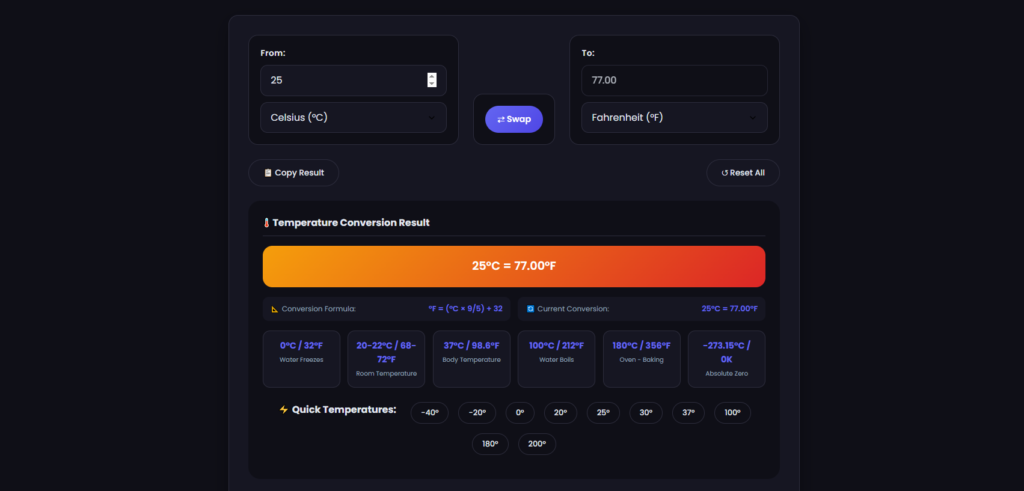
By using the MiniToolsPro temperature converter, you can save time, avoid calculation errors, and get the correct temperature instantly. It's perfect for professionals and hobbyists alike, and it's completely free.
Advanced Tips & Best Practices for Temperature Conversion
- Understand the concept of absolute zero: At absolute zero (0 Kelvin or -273.15°C), all molecular motion stops. This is the lowest possible temperature and is a good reference point to understand.
- Use conversion tools for batch conversions: If you have many temperatures to convert, a manual method is inefficient. Use a tool that can process conversions quickly.
- Round appropriately: While the formulas give exact numbers, in many contexts (like cooking), you don't need decimal precision. Rounding to the nearest whole number is usually perfectly fine.
Frequently Asked Questions (FAQ)
What is the formula for converting Celsius to Fahrenheit?
The formula to convert Celsius to Fahrenheit is (°C × 9/5) + 32 = °F. You multiply the Celsius temperature by 9/5 (or 1.8) and then add 32 to get the Fahrenheit equivalent.
What is the formula for converting Fahrenheit to Celsius?
The formula to convert Fahrenheit to Celsius is (°F − 32) × 5/9 = °C. You subtract 32 from the Fahrenheit temperature, then multiply by 5/9 (or 0.5556) to get the Celsius value.
Is 30°C hot or cold?
30°C is generally considered a warm to hot day. In Fahrenheit, it's 86°F. This is typical summer weather in many parts of the world, perfect for shorts and a t-shirt.
Is 70°F hot or cold?
70°F is generally considered comfortable room temperature. In Celsius, this is approximately 21°C. It's a pleasant temperature for indoor living.
How do I convert 100°F to Celsius?
To convert 100°F to Celsius, use the formula (100°F - 32) × 5/9 = 37.8°C. So, 100°F is equivalent to approximately 37.8°C, which is a normal human body temperature.
How do I convert 200°C to Fahrenheit?
To convert 200°C to Fahrenheit, use the formula (200°C × 9/5) + 32 = 392°F. This is a common baking temperature.
Why does the US still use Fahrenheit?
The US uses Fahrenheit due to historical and cultural reasons. It was adopted early on and became standardized. While most of the world uses Celsius, the US remains one of the few countries to use Fahrenheit for everyday life, though scientific communities use both.
What is the difference between Celsius and Centigrade?
Celsius and Centigrade are essentially the same scale. The term 'centigrade' is older and means '100 degrees'. The scale was renamed to Celsius in 1948 by the International Conference on Weights and Measures in honor of Anders Celsius, who first proposed it.
Is Kelvin used for everyday temperature?
No, Kelvin is primarily used in scientific and engineering contexts, especially in fields like physics and chemistry where absolute temperatures are needed. It is not used for weather forecasts or cooking.
At what temperature is Celsius equal to Fahrenheit?
The temperature at which Celsius and Fahrenheit are equal is -40°. At -40°C and -40°F, both scales show the same numerical value.
What is a good temperature for baking a cake in Celsius?
A common baking temperature for a cake is 180°C. This is equivalent to 350°F. However, always refer to your specific recipe for the correct temperature.
Final Thoughts
Understanding how to convert temperatures is a practical skill that simplifies many aspects of daily life, from cooking to traveling. Whether you use the manual formulas for a deeper understanding or a digital temperature converter for speed and precision, having this ability at your fingertips is invaluable. The formulas are straightforward, but they do require careful calculation. That's why having a reliable online tool, like the free one from MiniToolsPro, is so convenient. It eliminates the risk of human error and gives you instant results, whether you need to convert fahrenheit to celsius or celsius to fahrenheit.
So, the next time you're faced with a temperature in a scale you're not familiar with, you'll know exactly what to do. You can either do the math yourself or, for the quickest and easiest solution, use the MiniToolsPro Temperature Converter.
Related Tools You May Find Useful
- Weight Converter – Convert between kilograms, pounds, and ounces.
- Length Converter – Convert between meters, feet, inches, and more.
- Volume Converter – Convert between liters, gallons, and cubic meters.
- Area Converter – Convert between square meters, square feet, and acres.
- Discount Calculator – Calculate discounts and savings instantly.
- Date-to-Date Calculation Guide – Learn how to calculate the difference between dates accurately.
Share this article 👇



0 Comments