
Table of Contents
Ever tried to figure out someone's exact age and felt stuck halfway through?
You know their birthdate. You know today's date. But doing the math in your head? That's where it gets messy.
Maybe you don't have your phone nearby. Or you're helping a child with homework. Or you just want to understand how to calculate chronological age the old-fashioned way — no apps, no websites, just pen and paper.
Good news. It's not complicated. You just need a simple formula and a little patience.
Let me show you exactly how.
What Does "Chronological Age" Actually Mean?
Chronological age sounds fancy. It's not.
It simply means the amount of time someone has been alive — measured in years, months, and days.
Think of it like this: from the moment you were born, a clock started ticking. Your chronological age is how much time has passed on that clock up to today.
It's different from:
- Biological age (how old your body seems health-wise)
- Mental age (cognitive development)
- Developmental age (milestones reached)
We're only talking about calendar time. Nothing more.
So when someone asks, "How old are you?" — they want your biological age. And now you'll know how to calculate it manually.
The Step-by-Step Formula to Calculate chronological Age Manually
Here's the core method. It's basically subtraction — but with a twist.
You subtract the birthdate from the current date in three parts: days, then months, then years.
Let me break it down.
How to Calculate Days
This is where most people get stuck.
You take the current day minus the birth day.
If the current day is larger than the birth day, great. Simple subtraction.
If not? You need to "borrow" days from the current month.
Example: Birth day = 25th. Current day = 14th.
You can't do 14 − 25. So you borrow days from the previous month. Add the number of days in that previous month to the current day, then subtract.
Yes, that means you need to know how many days are in each month. (More on that in a minute.)
How to Calculate Months
Once days are done, move to months.
Take the current month minus the birth month.
If the current month is larger than the birth month, subtract normally.
If not? Borrow 12 months from the current year. Add 12 to the current month, then subtract the birth month. And you reduce the year difference by 1.
How to Calculate Years
Finally, years.
Take the current year minus the birth year.
But here's the catch: if you borrowed months in the previous step, subtract 1 from your year result first.
That's it. That's the whole formula for age calculation formula.
Let me walk you through a real example so it clicks.
A Real Example (Walk Through Slowly)
Imagine someone was born on March 25, 1995.
Today's date is May 14, 2026.
Let's calculate their biological age.
Step 1 — Days:
Current day = 14. Birthday = 25.
14 − 25 = can't do it.
So borrow days from April (previous month). April has 30 days.
14 + 30 = 44. Then 44 − 25 = 19 days.
Because we borrowed from April, we reduce the current month by 1. May becomes April for the month calculation.
Step 2 — Months:
Adjusted current month = April (4). Birth month = March (3).
4 − 3 = 1 month.
No borrowing needed here.
Step 3 — Years:
Current year = 2026. Birth year = 1995.
2026 − 1995 = 31 years.
No year adjustment because we didn't borrow months.
Final answer: 31 years, 1 month, and 19 days.
See? Not magic. Just step-by-step subtraction for manual age computation.
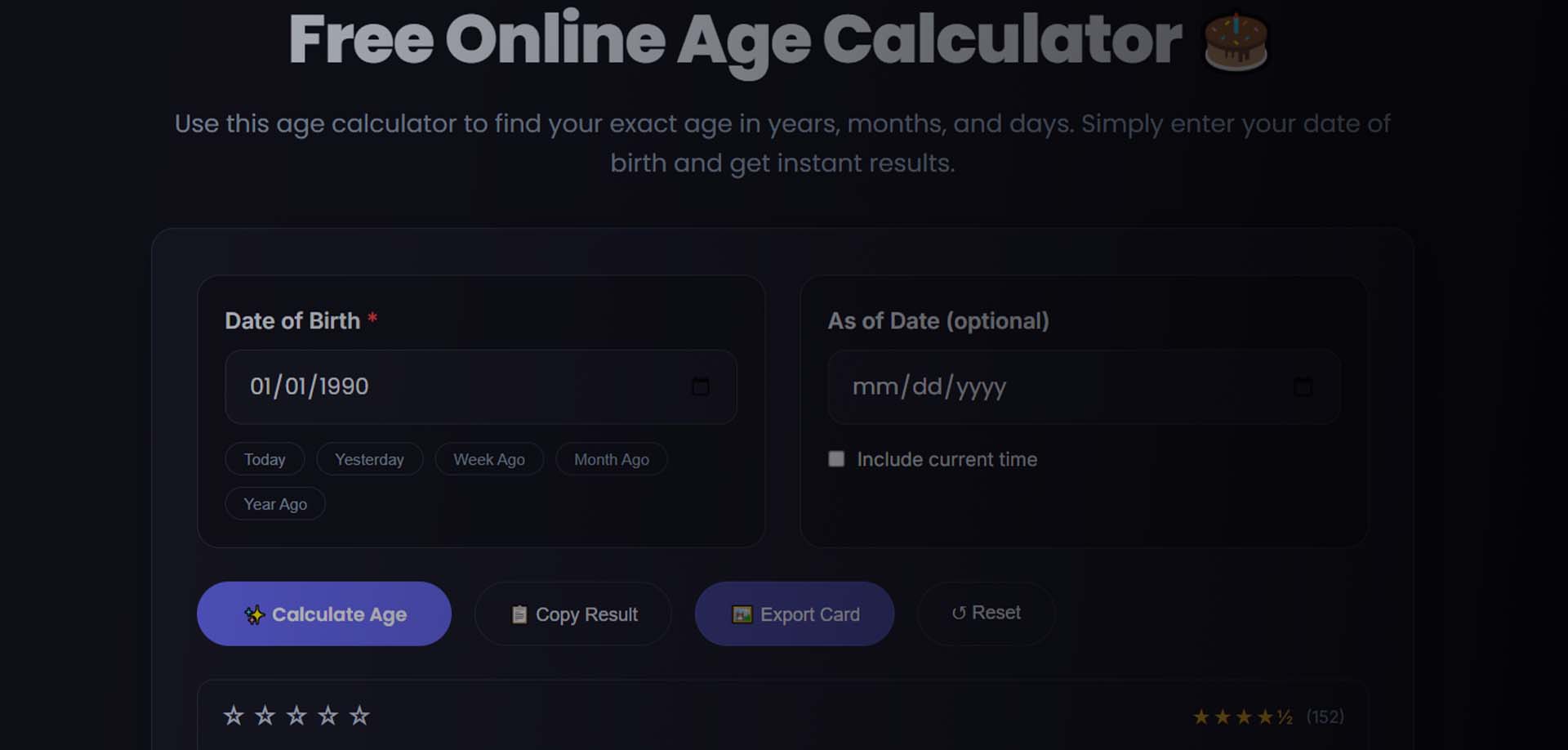
👉 Want to skip the math next time? Use the free online calculator chronological age — enter any birthdate and get instant results in years, months, days, hours, and even seconds.


Common Mistakes People Make (and How to Avoid Them)
Even smart people mess this up. Here's what to watch for.
Mistake #1: Forgetting month lengths
How many days in January? March? August?
If you borrow days, you must know the previous month's day count.
Fix: Keep a mental list. 30 days have April, June, September, and November. The rest have 31. February has 28 or 29.
Mistake #2: Ignoring leap years
When calculating days between two dates across multiple years, leap year adjustment is crucial. Leap years add one day in February.
Fix: If your calculation crosses a February 29 in a leap year, adjust accordingly. For simple age calculation, leap years usually don't affect the final age unless the birthdate is February 29 itself.
Mistake #3: Borrowing incorrectly
People borrow months but forget to adjust the year. Or borrow days but use the wrong month length.
Fix: Write down each step. Days → months → years. Borrow one unit at a time.
Mistake #4: Rushing the order
Always do days first, then months, then years. Reverse order breaks everything.
📱 Prefer accuracy over shortcuts? The age calculator tool handles leap years, month lengths, and even gives you total days, weeks, hours, and minutes. Free and instant.
Quick Mental Shortcuts for Approximate Age
Sometimes you don't need exact days. You just need "close enough."
Here are fast tricks.
Shortcut #1: Subtract birth year from current year
If today's month/day is after their birth month/day, that's their age.
If today's month/day is before their birth month/day, subtract one year.
Example: Born March 1995. Today is May 2026 → already past March → age 31.
Born July 1995. Today is May 2026 → not yet July → age 30.
Shortcut #2: Round to the nearest half-year
If they're within 3 months of their next birthday, say "about X and a half."
Shortcut #3: Use landmark dates
"Born in 1995? That's about 31 years ago from 2026." Close enough for conversation.
These shortcuts won't win a legal document. But for casual use? They work fine.
For more on date math, check out this external guide on calendar calculations.
Why Bother Learning the Manual Formula?
Good question.
Digital calculators are everywhere. So why learn this?
Imagine you're at a family gathering. Your phone is in another room. Your niece asks, "How old is Grandpa?" You want to impress her by figuring it out on the spot — no device needed.
Or you're a teacher. Your students are learning math. You want to show them that dates are just numbers you can subtract.
Or you're filling out a paper form. No internet. Just you and a pen.
Knowing how to calculate biological age manually means you're never stuck. It's a life skill. A small superpower.
Plus, it sharpens your mental math. And that never hurts.
Try It Yourself — Or Let the Tool Do It
Grab your own birthdate and today's date.
Write them down.
Current date: _ / / Birth date: / / _
Now run through the three steps:
- Days (borrow if needed)
- Months (borrow if needed)
- Years (adjust if you borrowed months)
What did you get?
If you're off by a day or two, don't worry. Practice once more with a different date. It'll click.
🎂 Need a quick answer without the math? Head over to MiniToolsPro Age Calculator. Enter your birthdate and see your exact age in years, months, days, total hours, minutes, seconds — plus your zodiac sign, birthstone, and even how many times you've blinked.
Frequently Asked Questions
Q: What is chronological age?
A: It's the exact amount of time someone has been alive, measured in years, months, and days.
Q: Why calculate age manually instead of using a tool?
A: Manual calculation helps you understand the math behind dates. It's also useful when you don't have internet access or a device nearby.
Q: How do leap years affect age calculation?
A: If someone is born on February 29, their birthday is typically celebrated on February 28 or March 1 in non-leap years. For most people, leap years don't change the final age.
Q: What's the fastest way to get an exact age?
A: Use an online tool like MiniToolsPro Age Calculator — it's instant and accounts for everything automatically.
Q: Why use our age calculator tool instead of doing it manually?
A: Because you get a beautifully designed PNG card with your exact age, zodiac sign, birthstone, and fun facts — ready to export and share.
Related Age Calculation Guides
Chronological age is one part of understanding your age from a birth date. For a deeper explanation of the difference between chronological and biological age, read our Chronological Age and Biological Age guide. You can also explore our Age Calculator Explained guide to learn how online age calculations work, or return to the main Age Calculator Guide.
Final Summary
You now know how to calculate chronological age manually in three simple steps:
- Subtract days (borrow from months if needed)
- Subtract months (borrow from years if needed)
- Subtract years
Practice with your own birthdate. Then try it on a friend's.
And whenever you want to skip the math, the free age calculator tool is always there for you — fast, accurate, and free.
People are also using these important tools
Other Tools
Share this article 👇
0 Comments